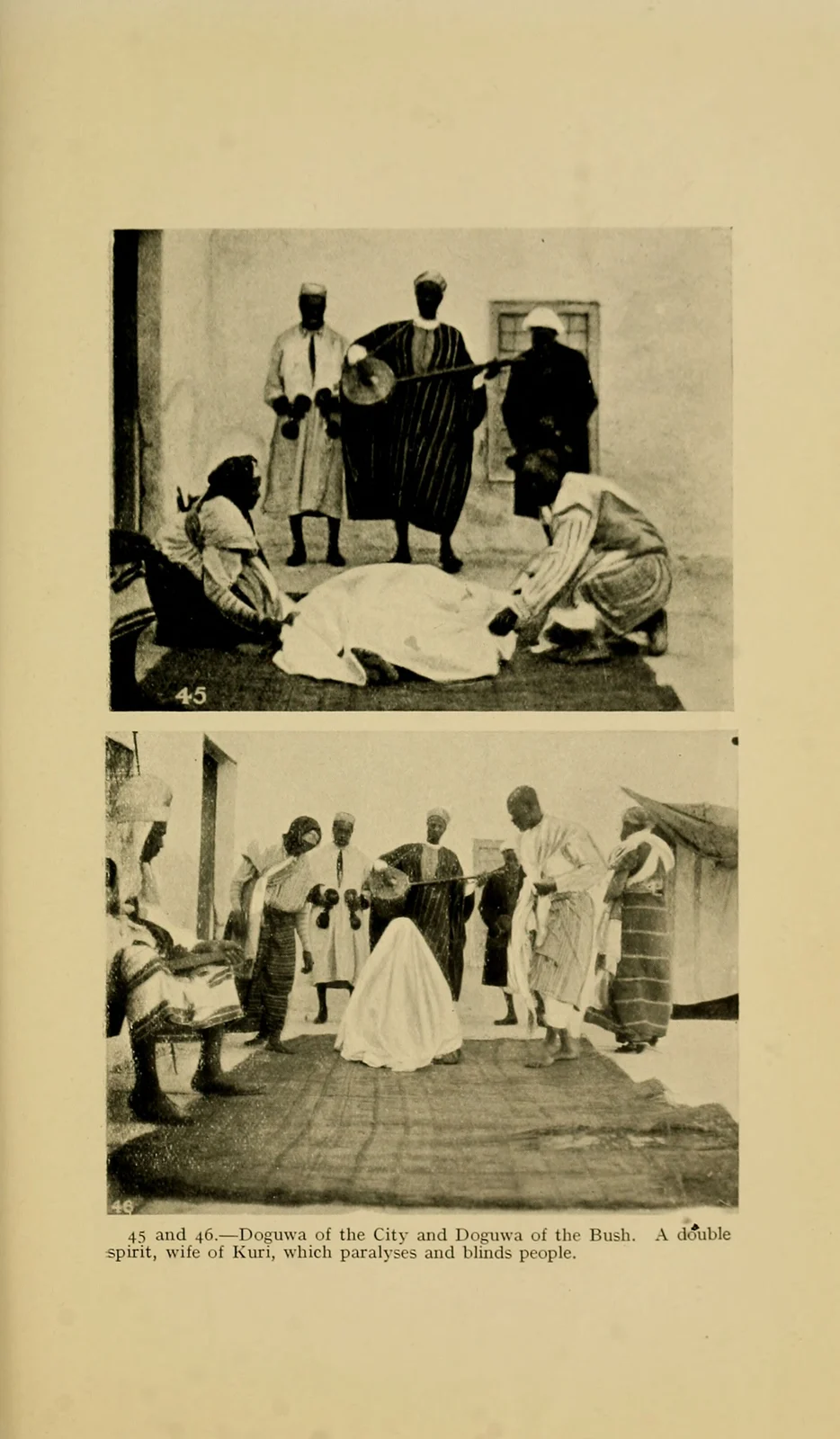
Doguwa’s two human ritual representations in photographs45 and46, 1914
Photographs45 and46 illustrate the city and bush representations of Doguwa. A human participant lies beneath a sheet in the upper scene and sits fully covered below. The change belongs to a recorded performance, not a photograph of a literal half-bodied spirit.
Overview
Doguwa is a double Bori spirit in Tremearne’s selected account. The house or town aspect, Doguwa Na Gida, is also called Mai-Inna; the bush aspect, Doguwa Na Daji, has the names Uwar-Dowa and Mai-Gida Biyu. The house figure enjoys combing her hair and looks after boxers, wrestlers and those fighting with the koraiya. The bush figure is described as a very tall half-woman capable of making enemies resemble her. Some informants describe white clothes, while another gives her hair long enough to hide an unclothed body. These alternatives support a varied represented appearance rather than a single rigid costume.
The house dance begins with the human mount lying on her side and rocking while attendants in front and behind flap a cloth over her. Consultation can occur beneath the cloth. An attendant then places a hand at the navel and another beneath the head and raises the mount into a seated posture, effecting the transition to the bush representation. That aspect sits covered and goes through milking motions. The collector records disagreement over whether black or white sheets belong to either form and concludes that their colors are not consistently significant. Both faces must remain hidden because exposure is considered dangerous. The movement sequence describes performers representing the spirit, not observation of an independent half-bodied creature changing anatomy.
The songs call her a mother and wife, threaten loss of hands and feet, and associate the bush form with cattle and sour milk. The prose attributes paralysis, blindness and painful eyes to her displeasure; those are historical religious explanations, not verified causes. Genealogy varies too: both aspects are described as Kuri’s wives, but one account associates Mai-Inna with Gajere Mai-Dowa and another the bush half with Sambo. Uwar-Gwona is also confused with her, although linked with Magiro elsewhere. Tremearne admits uncertainty over some Kanuri words in the translated song. This profile therefore keeps the double representation together while preserving contested names, relationships and translation limits instead of multiplying aliases into separate beings or fabricating a harmonized pantheon.
Origins & earliest records
Tremearne’s historical collection combines accounts and ritual observations in Hausa-associated North African communities and northern Nigeria. Its evolutionary and comparative origin theories are not adopted.
Records & interpretation
The Ban of the Bori, pp 332–335. Named representations, translated songs and competing informant explanations retained as historical evidence; collector’s speculative cross-cultural equivalences are not asserted.
Additional images
 View larger
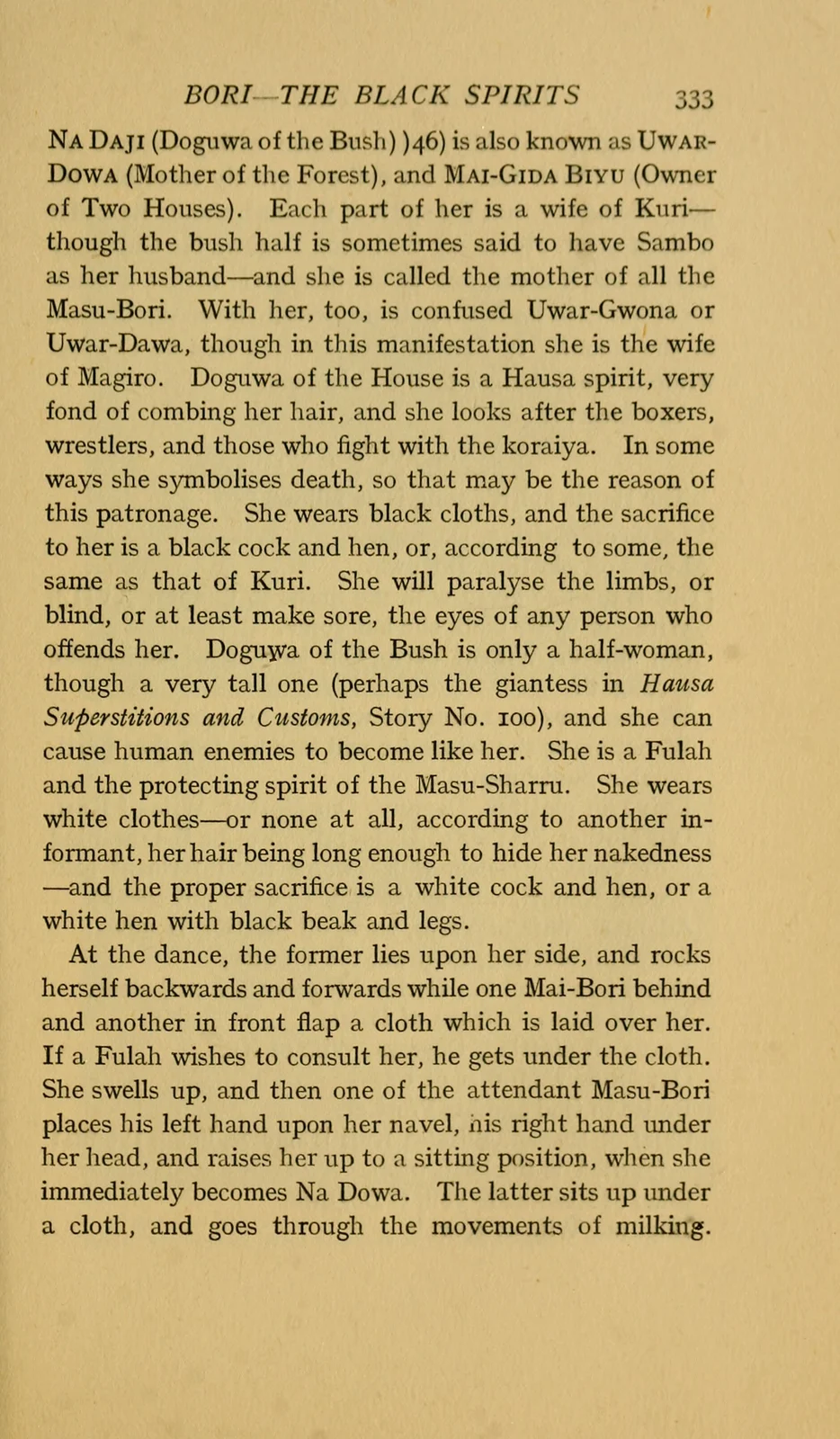
 Doguwa,1914 historical printed text witness, page333; documentary source-page facsimile
Documentary text facsimile naming Doguwa and describing ritual/narrative attributes; not a photograph of a spirit or creature artwork. Colonial observer terminology and interpretations belong to the original1914 text.
Selected bibliography
Documented works and useful reading. This is not a list of every appearance.
- 01
The Ban of the Bori
Selected witness pp 332–335; colonial collection with uneven narrator attribution.
Family, evolution & connections
Ba-Toye’s named parents in one qualified witness
Tremearne’s selected 1914 historical Bori notices, pp. 350–351.
Scroll sideways to see all branches. With a keyboard, focus the tree and use the arrow keys.
- Gajere + Uwar-Dowa (two stated parents; identification qualified)
Prose explicitly names Gajere and Uwar-Dowa as parents; the song separately names the mother. Joint-parent root groups two individuals. The collector admits confusion over Gajere / Kuri identity; this tree retains Gajere rather than merging alternate names. Uwar-Dowa refers to the forest-aspect naming scope, not every Doguwa manifestation. These are attributed historical religious relationships, not biological phylogeny or a universal contemporary doctrine.
Attributed sons of Kuri and the forest Doguwa aspect
Tremearne’s distinct informant qualifications in the 1914 notices, pp. 316–318.
Scroll sideways to see all branches. With a keyboard, focus the tree and use the arrow keys.
- Kuri + Uwar-Dowa / Doguwa Na Daji (reported parents; version qualified)
Mai-Aska is a son of Kuri/Uwar-Dowa according to some; Sambo is a younger son of Kuri/Doguwa Na Daji according to most. Joint root groups two named parents. The labels preserve different attribution strengths. Some instead call Sambo the forest aspect’s husband; this contradictory marital version is recorded separately in prose, not drawn simultaneously as descent. The two son reports do not independently state full brotherhood or a shared universal pantheon. House and forest aspects are not silently interchangeable. This is textual religious genealogy, not biological evolution.
References
Sources supporting this profile. Linked pages have their own scope and editorial standards.
- Historical ritual observation and translated songsThe Ban of the Bori — DoguwaResearch access: 2026-10-05
Image credits
Historical ritual performance photographDoguwa’s two human ritual representations in photographs45 and46, 1914
Photographs45 and46 illustrate the city and bush representations of Doguwa. A human participant lies beneath a sheet in the upper scene and sits fully covered below. The change belongs to a recorded performance, not a photograph of a literal half-bodied spirit.
Further credits appear with each additional image.