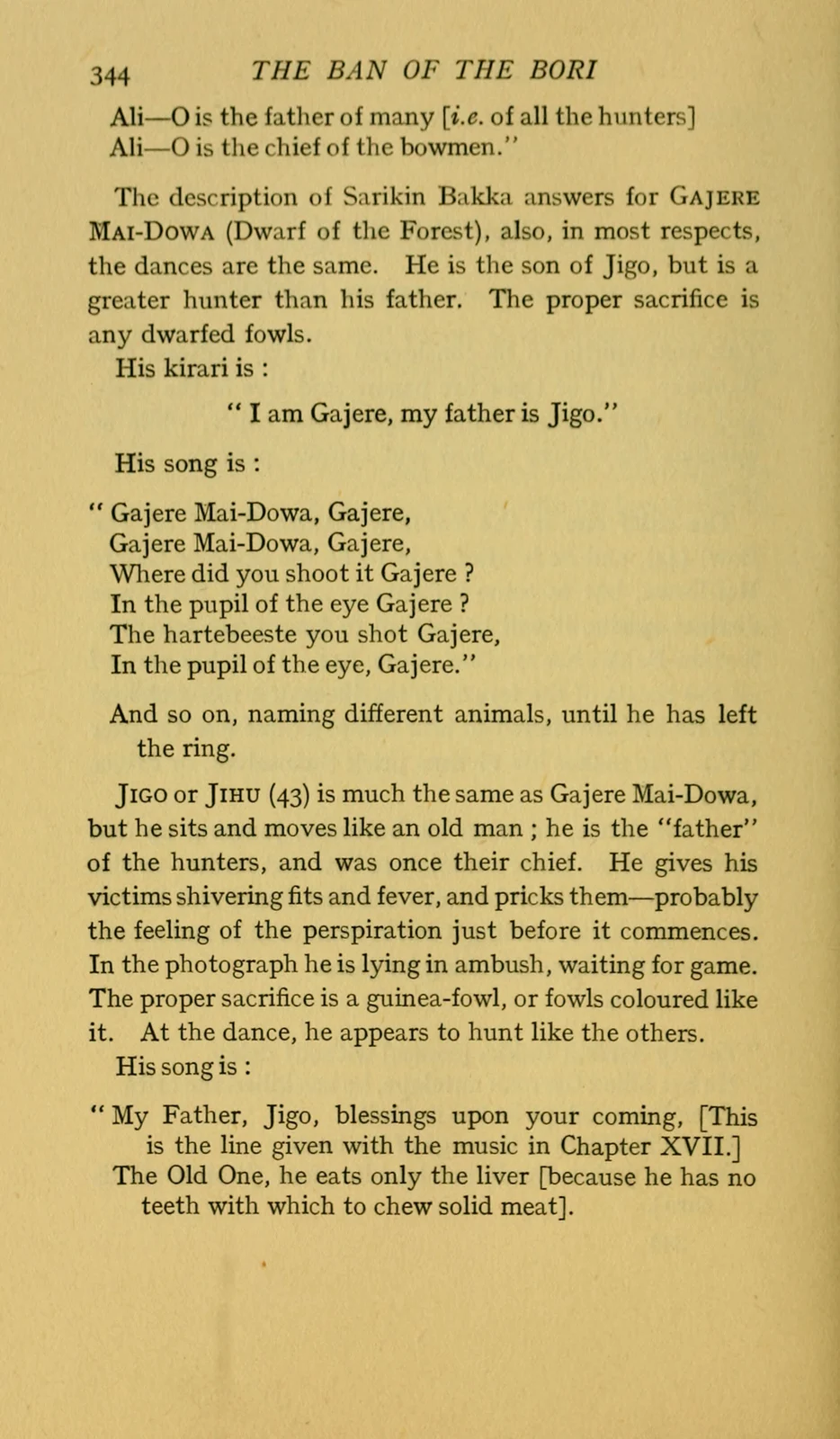
Jigo,1914 historical printed text witness, page344; documentary source-page facsimile
Documentary text facsimile naming Jigo and describing ritual/narrative attributes; not a photograph of a spirit or creature artwork. Colonial observer terminology and interpretations belong to the original1914 text.
Overview
Jigo, also called Jihu, is the older father of the hunters in Tremearne’s account. He was formerly their chief and is presented as less vigorous than Gajere Mai-Dowa, his son, who is described as the greater hunter. Jigo sits and moves like an old man, though his performance still follows the hunting actions of the surrounding bow-bearing spirits. Tremearne describes the pictured mount as lying in ambush, waiting for game.
The song greets him as father and old one, blesses his coming and sleep, and says that he eats only liver because he lacks teeth for solid meat. It then imagines an elephant and a buffalo encountering him in the forest and recognizing the danger. Calling him a stranger and an angel of the forest, the musicians propose returning to the bush to set an ambush. These concrete descriptions join age and skill rather than treating old movement as an absence of power.
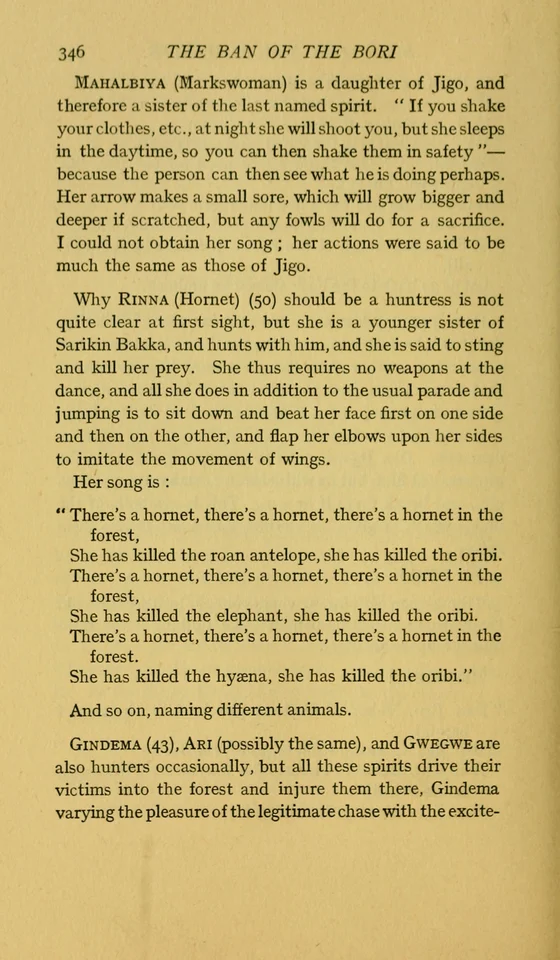
The chapter associates shivering fits, fever and pricking sensations with Jigo’s influence; Tremearne’s attempt to connect the last sensation to perspiration is his explanation. It also distinguishes two children: Dan Jigo breaks vessels in his representation, while the daughter Mahalbiya is said to shoot people who shake clothing at night and to sleep during the day. Their particular actions are not copied into the father’s account. Jigo remains a separately named senior hunter with his own praise and ambush role.
Origins & earliest records
Tremearne’s historical collection combines accounts and ritual observations in Hausa-associated North African communities and northern Nigeria. Its evolutionary and comparative origin theories are not adopted.
Records & interpretation
The Ban of the Bori, pp 344–345. Ritual movements describe human mounts representing spirits; translated songs and attributed powers are evidence of this recorded representation, not proof of medical causation or uniform contemporary community practice.
Selected bibliography
Documented works and useful reading. This is not a list of every appearance.
- 01
The Ban of the Bori
Selected witness pp 344–345; colonial collection with uneven narrator attribution.
Family, evolution & connections
Jigo’s three expressly named children
Tremearne’s selected 1914 historical Bori notices, pp. 343–346.
Scroll sideways to see all branches. With a keyboard, focus the tree and use the arrow keys.
Individual notices explicitly name Jigo as father of Gajere, Dan Jigo and Mahalbiya. No mother is named. The generic praise Father of the Hunters does not add all hunters as offspring. Disputed Gajere / Sarikin Bakka identity is not harmonized. These are attributed historical religious relationships, not biological phylogeny or a universal contemporary doctrine.
Gajere Mai-Dowa
Tremearne explicitly calls Gajere Jigo’s son, and Gajere’s translated announcement names his father. The disputed identification of Gajere with Sarikin Bakka is retained; it does not silently transfer this parentage to every Bakka account.
Dan Jigo
The Dan Jigo notice identifies him as son of the immediately preceding Jigo. His vessel-breaking representation remains distinct from his father’s ambush performance.
Mahalbiya
Mahalbiya is expressly called Jigo’s daughter. The source does not name her mother; her own arrow attack and nighttime warning are not inherited facts about every hunter spirit.
References
Sources supporting this profile. Linked pages have their own scope and editorial standards.
- Historical ritual observation and translated songsThe Ban of the Bori — JigoResearch access: 2026-10-05
Image credits
Historical text facsimileJigo,1914 historical printed text witness, page344; documentary source-page facsimile
Documentary text facsimile naming Jigo and describing ritual/narrative attributes; not a photograph of a spirit or creature artwork. Colonial observer terminology and interpretations belong to the original1914 text.