
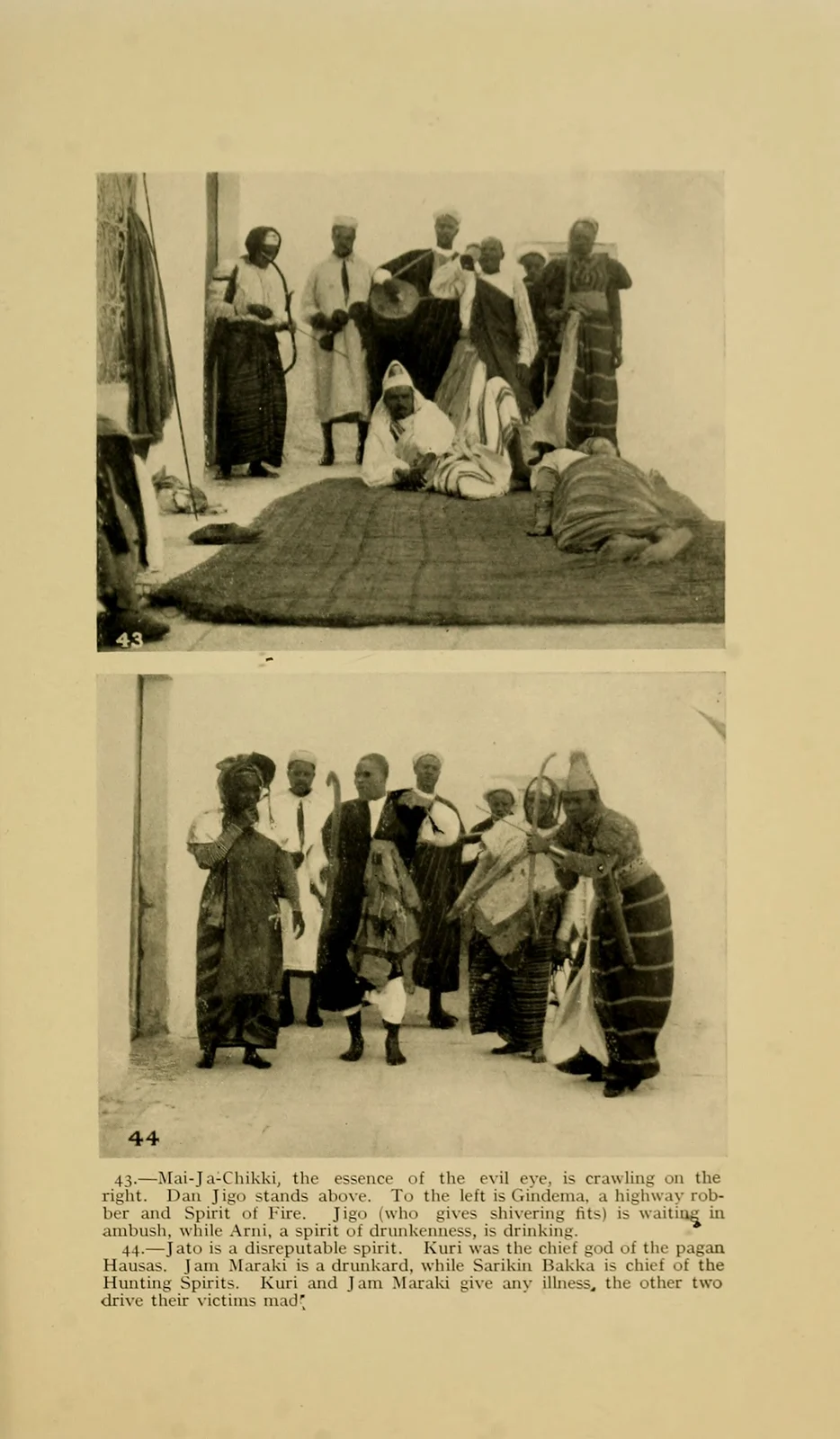
Dan Jigo represented standing above the crawling participant in photograph43, 1914
In the upper photograph43, the printed caption identifies Dan Jigo standing above Mai-Ja-Chikki, who crawls at the right. These are human representations of named bori, rather than photographed supernatural bodies.
Overview
Dan Jigo is a son of the older hunter Jigo. He begins the performance with similar hunting movements but then tries to seize and break calabashes or pottery. Tremearne relates that smashing to the shivering attributed to the spirit. His spoken praise insists that nothing is too valuable to destroy, explaining the aggressive action toward objects in the ring rather than requiring a separate origin story for each broken vessel.
The song calls him a maker of orphans because he kills parent animals, and a maker of poverty because he shoots cattle belonging to Fulani herders. Both lines are interpreted in the source as consequences of his hunting. His sister Mahalbiya receives a separate notice with a nighttime arrow attack; that power is not assigned to Dan Jigo simply because they are siblings. He remains the specifically destructive son with the vessel-breaking representation.
Origins & earliest records
A. J. N. Tremearne combines interviews and descriptions of bori performances with comparative interpretation. These selected notices do not consistently name individual speakers; printed attributes are distinguished from his conjectures.
Records & interpretation
Complete selected notice in chapter XXIV, printed pp. 345; chapter read through its ending.
Selected bibliography
Documented works and useful reading. This is not a list of every appearance.
- 01
The Ban of the Bori: Demons and Demon-Dancing in West and North Africa
Chapter XXIV, printed pp. 345; complete attributed spirit notice and representation.
Family, evolution & connections
Jigo’s three expressly named children
Tremearne’s selected 1914 historical Bori notices, pp. 343–346.
Scroll sideways to see all branches. With a keyboard, focus the tree and use the arrow keys.
Individual notices explicitly name Jigo as father of Gajere, Dan Jigo and Mahalbiya. No mother is named. The generic praise Father of the Hunters does not add all hunters as offspring. Disputed Gajere / Sarikin Bakka identity is not harmonized. These are attributed historical religious relationships, not biological phylogeny or a universal contemporary doctrine.
References
Sources supporting this profile. Linked pages have their own scope and editorial standards.
- Digitized historical ethnographic accountTremearne — Dan JigoResearch access: 2026-10-05
Image credits
Historical ritual performance photographDan Jigo represented standing above the crawling participant in photograph43, 1914
In the upper photograph43, the printed caption identifies Dan Jigo standing above Mai-Ja-Chikki, who crawls at the right. These are human representations of named bori, rather than photographed supernatural bodies.