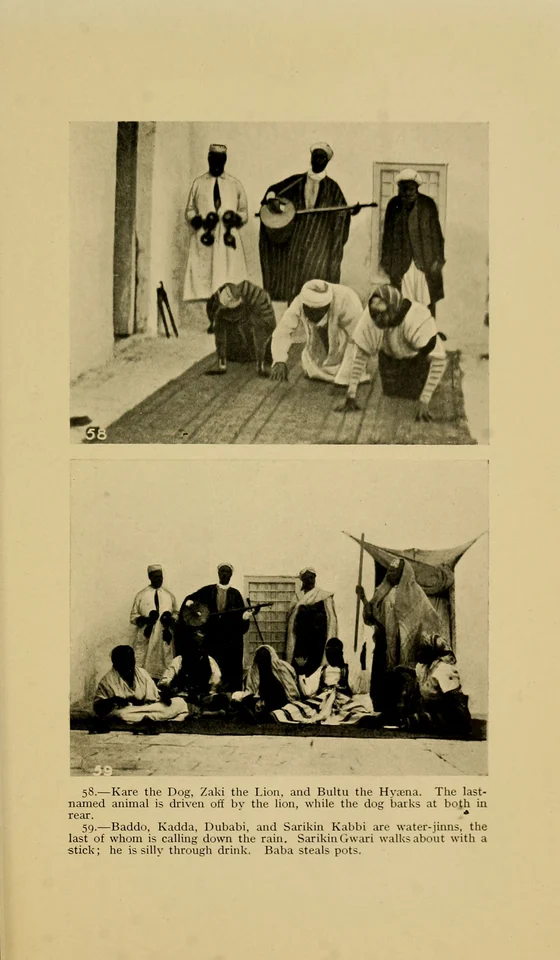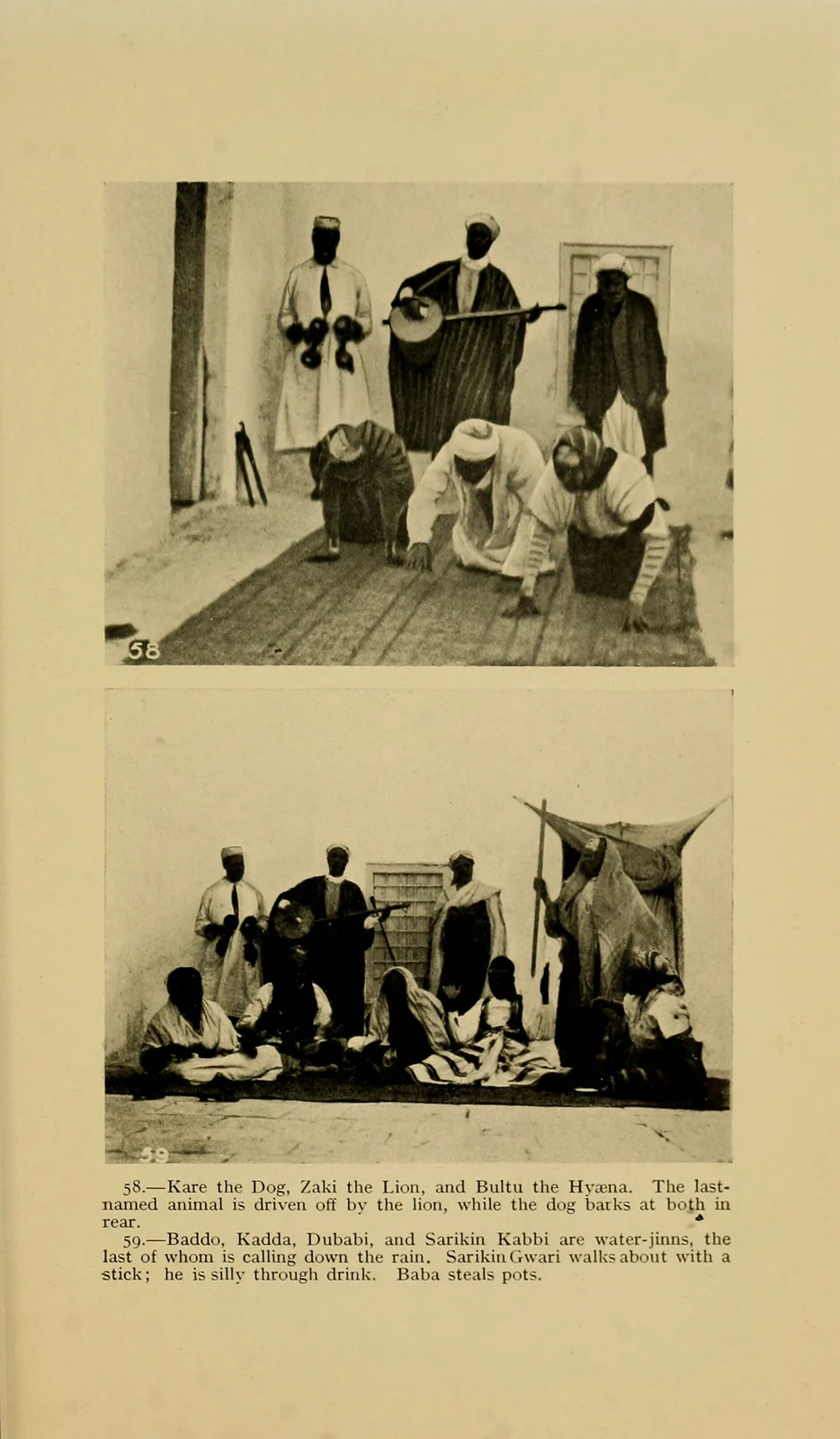
A human participant enacts Zaki beside Kare and Bultu in photograph58, 1914
The upper photograph58 records human participants representing the dog, lion and hyena spirits. The caption says Zaki drives Bultu away while Kare barks behind them. Crawling and confrontation are performed roles, not lion anatomy visible in a zoological image.
Overview
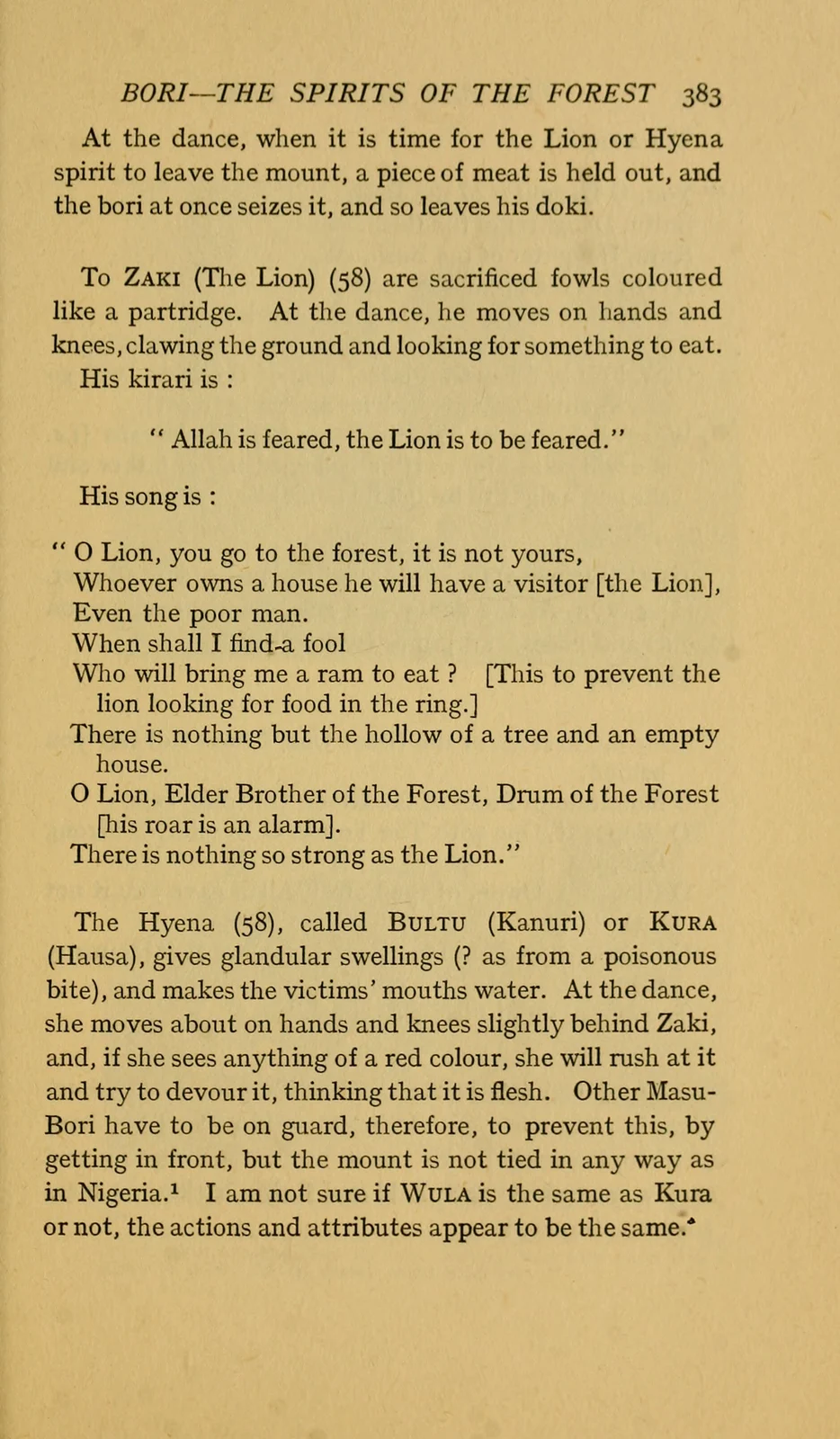
Zaki, also written Zaiki, is the lion among the forest spirits represented in Tunis in Tremearne’s account. The human mount moves on hands and knees, claws the ground and searches for food. His praise sets fear of the lion beside fear of Allah, while partridge-coloured fowls are specified as an offering. The song calls him elder brother and drum of the forest, the latter explained through his roar as an alarm.
The same song places the lion at a tree hollow and an empty house, then warns that a visitor can reach anyone who owns a house, including a poor person. It asks for someone to bring a ram; Tremearne explains that feeding him prevents a search for food among people in the ring. The song’s house visitation and the performer’s searching therefore give the threat a particular setting rather than an unspecified catalogue of powers.
Zaki appears with Bultu the hyena and Kare the dog. The printed picture caption describes the lion driving the hyena away while the dog barks from behind, and the general notice says animal spirits bite or claw their victims even when no mark is visible. At departure, a piece of meat is held out: the spirit seizes it and leaves the human mount. That dismissal sequence is shared with the hyena, although their individual behavior in the ring differs.
Origins & earliest records
Tremearne’s historical collection combines accounts and ritual observations in Hausa-associated North African communities and northern Nigeria. Its evolutionary and comparative origin theories are not adopted.
Records & interpretation
The Ban of the Bori, pp 382–383. Ritual movements describe human mounts representing spirits; translated songs and attributed powers are evidence of the recorded representation, not proof of medical causation or uniform contemporary community practice.
Additional images
 View larger
 Zaki,1914 historical printed text witness, page383; documentary source-page facsimile
Documentary text facsimile naming Zaki and describing ritual/narrative attributes; not a photograph of a spirit or creature artwork. Colonial observer terminology and interpretations belong to the original1914 text.
Selected bibliography
Documented works and useful reading. This is not a list of every appearance.
- 01
The Ban of the Bori
Selected witness pp 382–383; colonial collection with uneven narrator attribution.
Family & connections
A source-supported family tree or inspiration record has not yet been compiled for this profile. Related reading below indicates a connection in subject matter, not a proven lineage or creative influence.
References
Sources supporting this profile. Linked pages have their own scope and editorial standards.
- Historical ritual observation and translated songsThe Ban of the Bori — ZakiResearch access: 2026-10-05
Image credits
Historical ritual performance photographA human participant enacts Zaki beside Kare and Bultu in photograph58, 1914
The upper photograph58 records human participants representing the dog, lion and hyena spirits. The caption says Zaki drives Bultu away while Kare barks behind them. Crawling and confrontation are performed roles, not lion anatomy visible in a zoological image.
Further credits appear with each additional image.