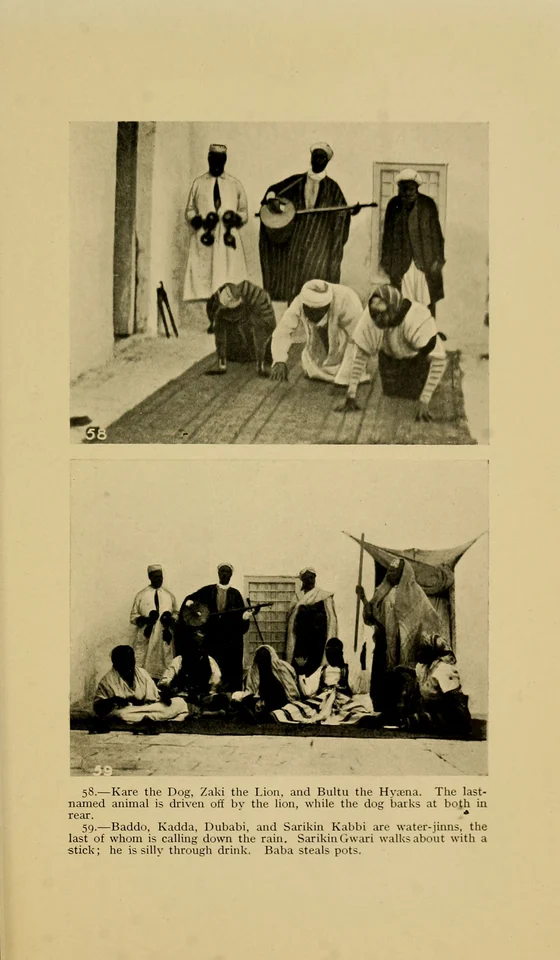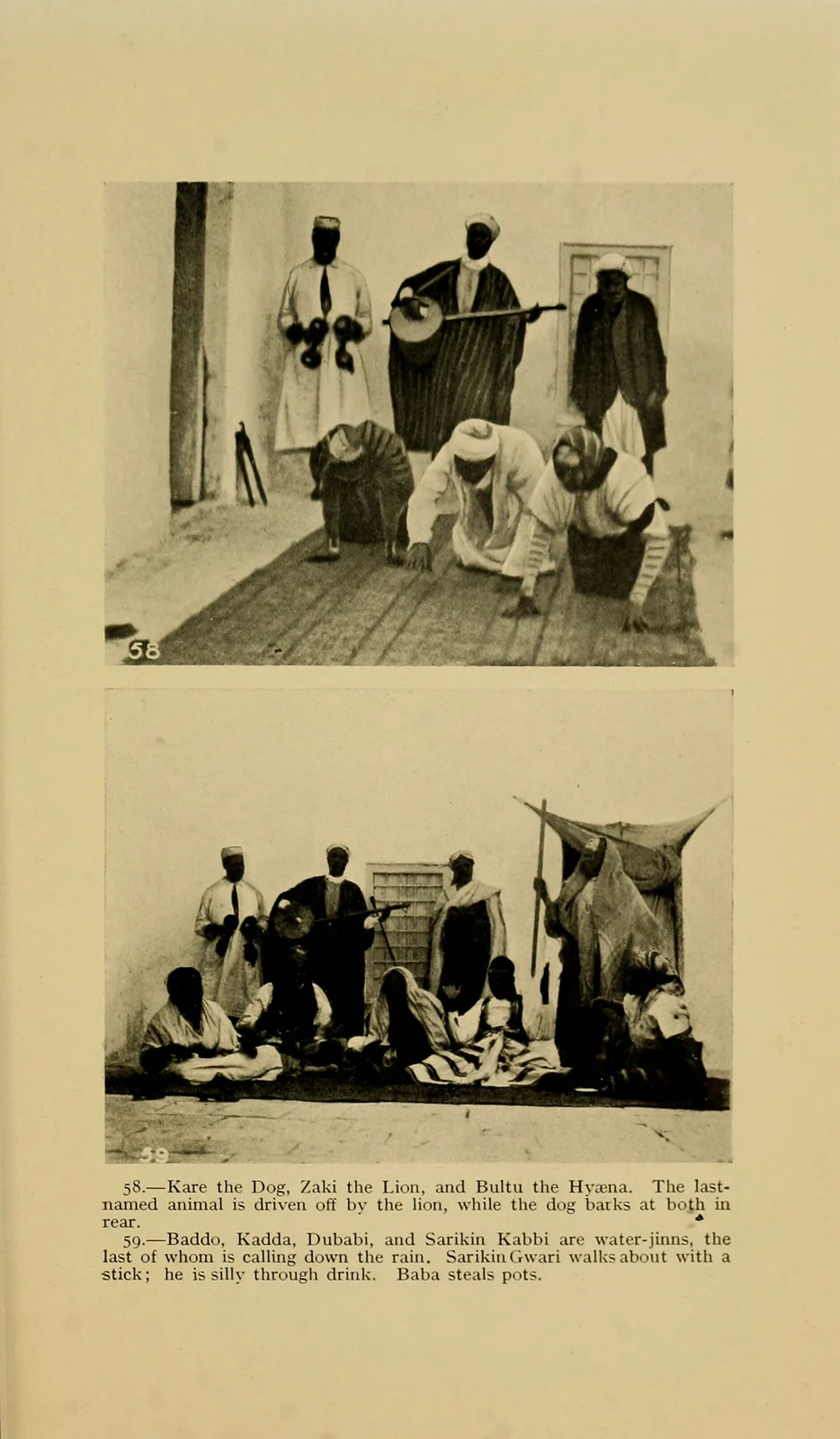
A human participant enacts Bultu beside Kare and Zaki in photograph58, 1914
The upper photograph58 illustrates human enactments of Bultu the hyena, Zaki the lion and Kare the dog. Its caption places Bultu in the confrontation with the lion. The participants’ bodies are not presented as the physical bodies of spirits.
Overview
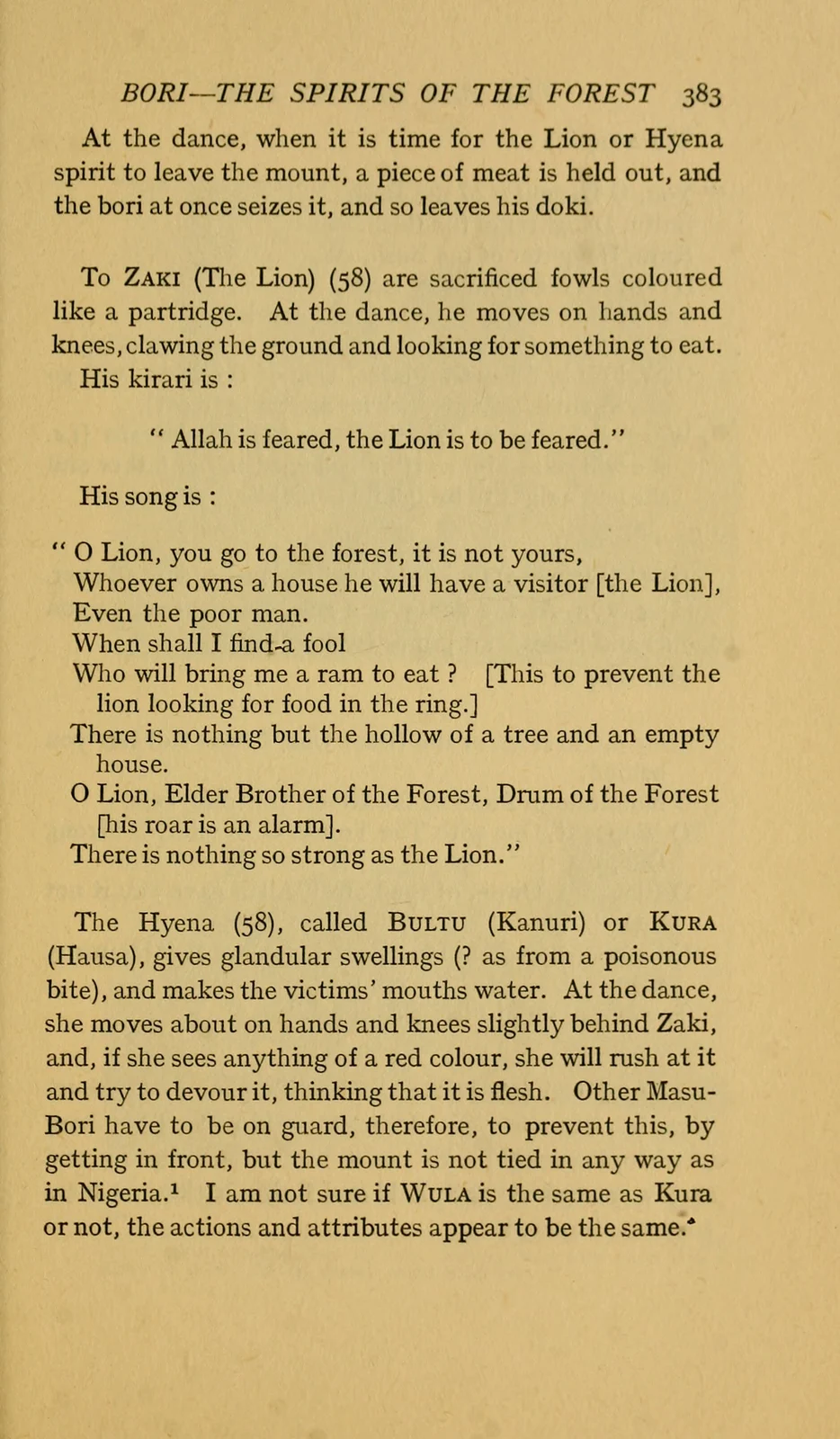
Bultu is the Kanuri name and Kura the Hausa name printed for the hyena spirit. She moves on hands and knees slightly behind Zaki the lion. A red object can provoke her to rush at it and try to eat it as flesh, requiring other participants to stand in her way. Tremearne expressly says that the mount is not tied in this performance as in Nigeria. He remains unsure whether Wula is the same figure, so Wula is an unresolved comparison rather than another independent profile.
The song names her daughter of the bush and warns her not to eat the drummers’ ram while complaining that she has been given nothing. Calling her a scrambler and a dog of the rain, it explains an appetite that carries her anywhere in any weather. Another line imagines a person abroad at night as her father’s servant, someone she consequently feels entitled to seize and bring home. That claim belongs to the song’s predatory characterization.
The source also attributes glandular swellings and watering mouths to her; its proposed connection with a poisonous bite is the collector’s question. The printed group caption describes the lion driving her off and Kare barking at both. At the end of the performance, attendants hold out meat so that she seizes it and leaves the mount. Her appetite thus shapes both the guarded arrival and the specific means of dismissal.
Origins & earliest records
Tremearne’s historical collection combines accounts and ritual observations in Hausa-associated North African communities and northern Nigeria. Its evolutionary and comparative origin theories are not adopted.
Records & interpretation
The Ban of the Bori, pp 383–384. Ritual movements describe human mounts representing spirits; translated songs and attributed powers are evidence of the recorded representation, not proof of medical causation or uniform contemporary community practice.
Additional images
 View larger
 Bultu,1914 historical printed text witness, page383; documentary source-page facsimile
Documentary text facsimile naming Bultu and describing ritual/narrative attributes; not a photograph of a spirit or creature artwork. Colonial observer terminology and interpretations belong to the original1914 text.
Selected bibliography
Documented works and useful reading. This is not a list of every appearance.
- 01
The Ban of the Bori
Selected witness pp 383–384; colonial collection with uneven narrator attribution.
Family & connections
A source-supported family tree or inspiration record has not yet been compiled for this profile. Related reading below indicates a connection in subject matter, not a proven lineage or creative influence.
References
Sources supporting this profile. Linked pages have their own scope and editorial standards.
- Historical ritual observation and translated songsThe Ban of the Bori — BultuResearch access: 2026-10-05
Image credits
Historical ritual performance photographA human participant enacts Bultu beside Kare and Zaki in photograph58, 1914
The upper photograph58 illustrates human enactments of Bultu the hyena, Zaki the lion and Kare the dog. Its caption places Bultu in the confrontation with the lion. The participants’ bodies are not presented as the physical bodies of spirits.
Further credits appear with each additional image.