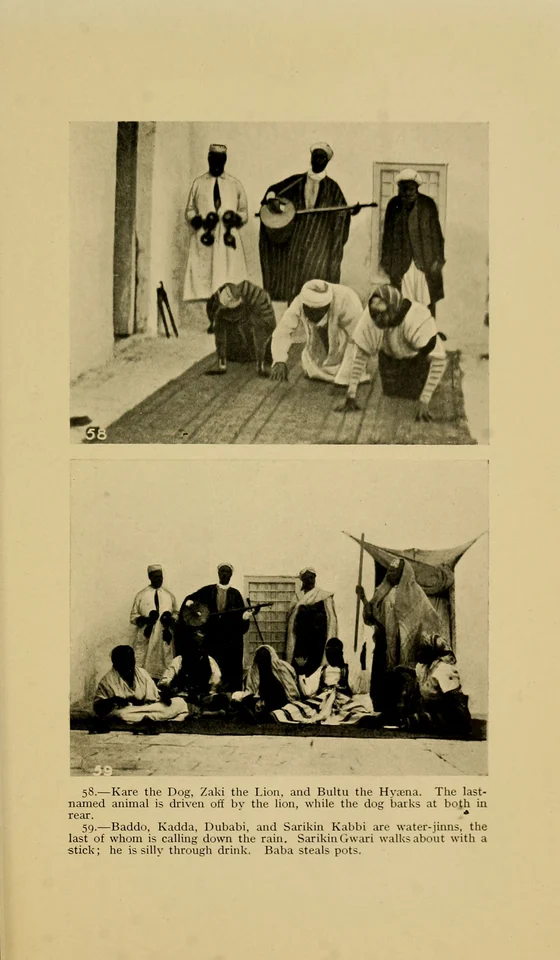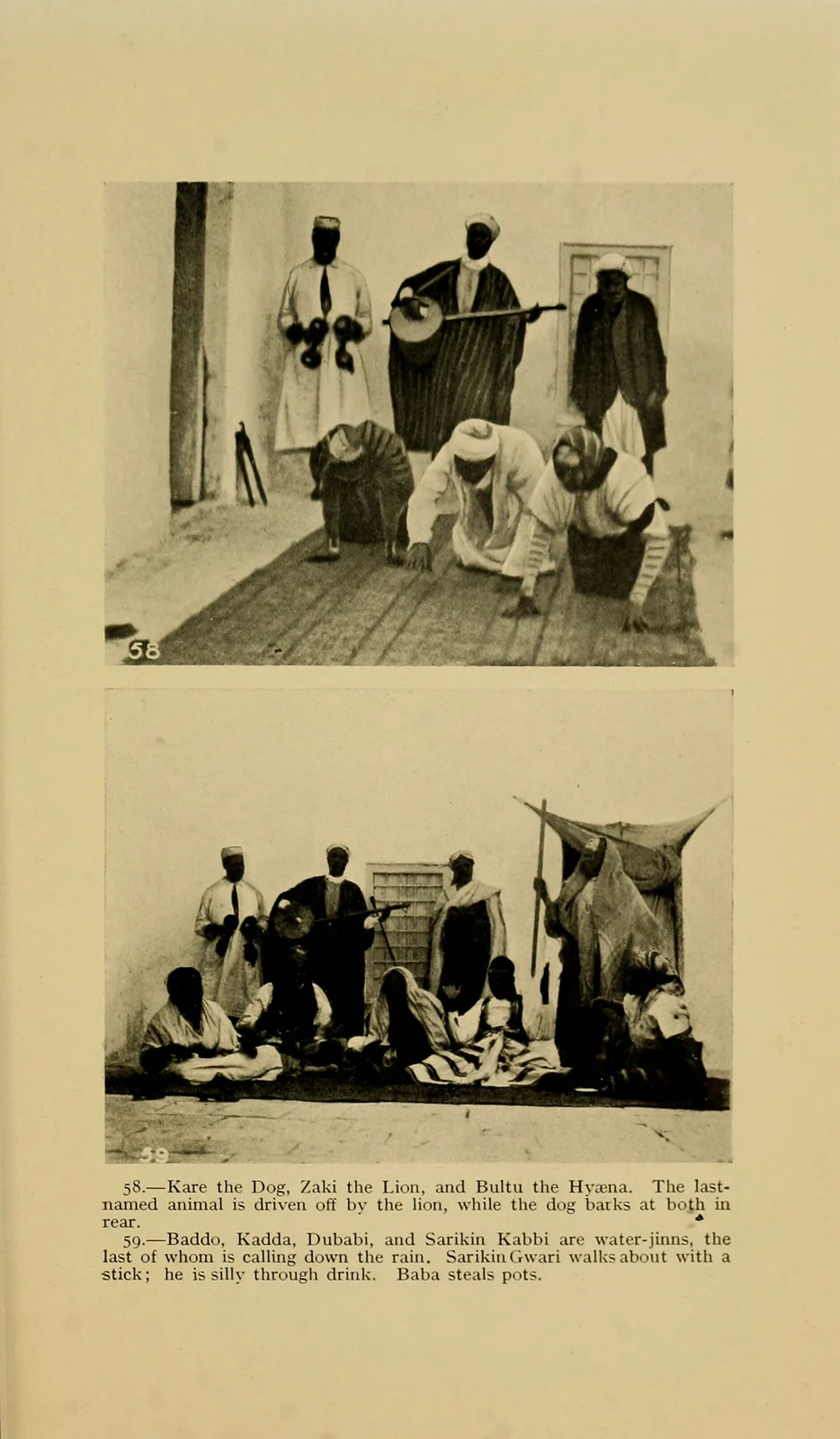
A human participant enacts Kare beside Zaki and Bultu in photograph58, 1914
The upper photograph58 records participants representing Kare the dog, Zaki the lion and Bultu the hyena on hands and knees. Its caption describes Kare barking behind the two predators. It is a performed animal-spirit relationship, not a photograph of supernatural animals.
Overview
Kare, also written Karre, is grouped with forest spirits because the dog chases threatening animals when they approach a house. In Tremearne’s photographed and described group he stays behind Zaki the lion and Bultu the hyena, watching and barking at both to alarm people. The account identifies him with Tsuguna in northern Nigeria; those labels are retained together here rather than multiplied into two beings. His small translated song repeats barking sounds and presents him as the chief’s dog.
The performance therefore gives the dog a relational role: he is a lookout and warning voice beside the predators, rather than their silent companion. Tremearne also records the belief that the spirit makes victims produce bark-like noises, adding a tentative comparison with whooping cough. That diagnostic suggestion is the collector’s interpretation and is not adopted as identification or medical fact. The account’s animal-spirit framework permits attacks without visible marks, but provides no independent observation of a supernatural canine. The selected evidence supports this ritual dog representation and its named regional comparison; it cannot identify a domestic breed or settle every present-day community usage.
Origins & earliest records
Tremearne’s historical collection combines accounts and ritual observations in Hausa-associated North African communities and northern Nigeria. Its evolutionary and comparative origin theories are not adopted.
Records & interpretation
The Ban of the Bori, pp 382–385. Ritual movements describe human mounts representing spirits; translated songs and attributed powers are evidence of the recorded representation, not proof of medical causation or uniform contemporary community practice.
Additional images
 View larger
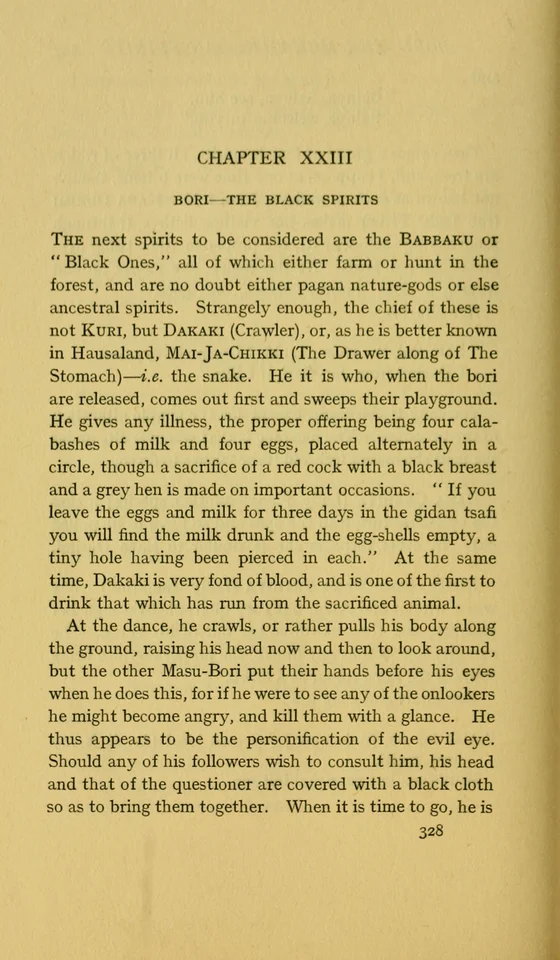
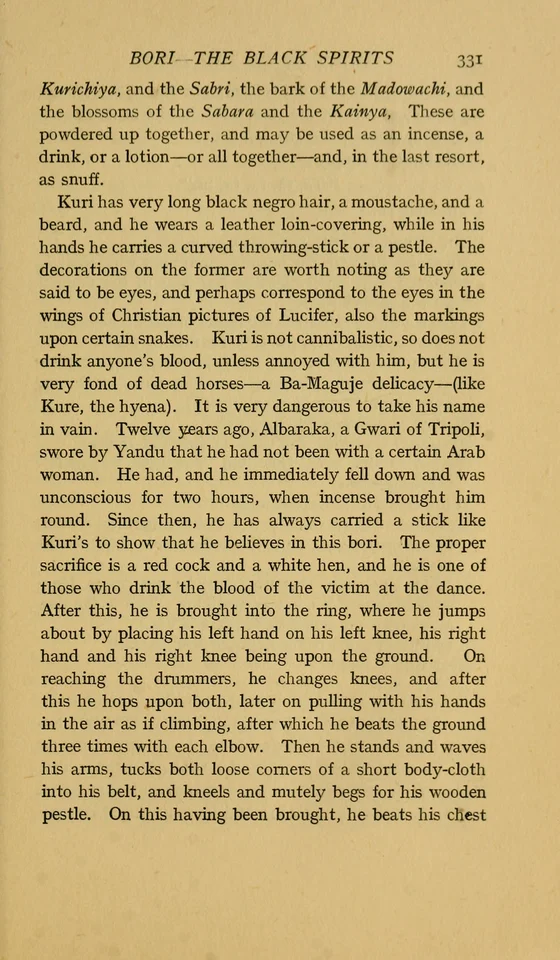
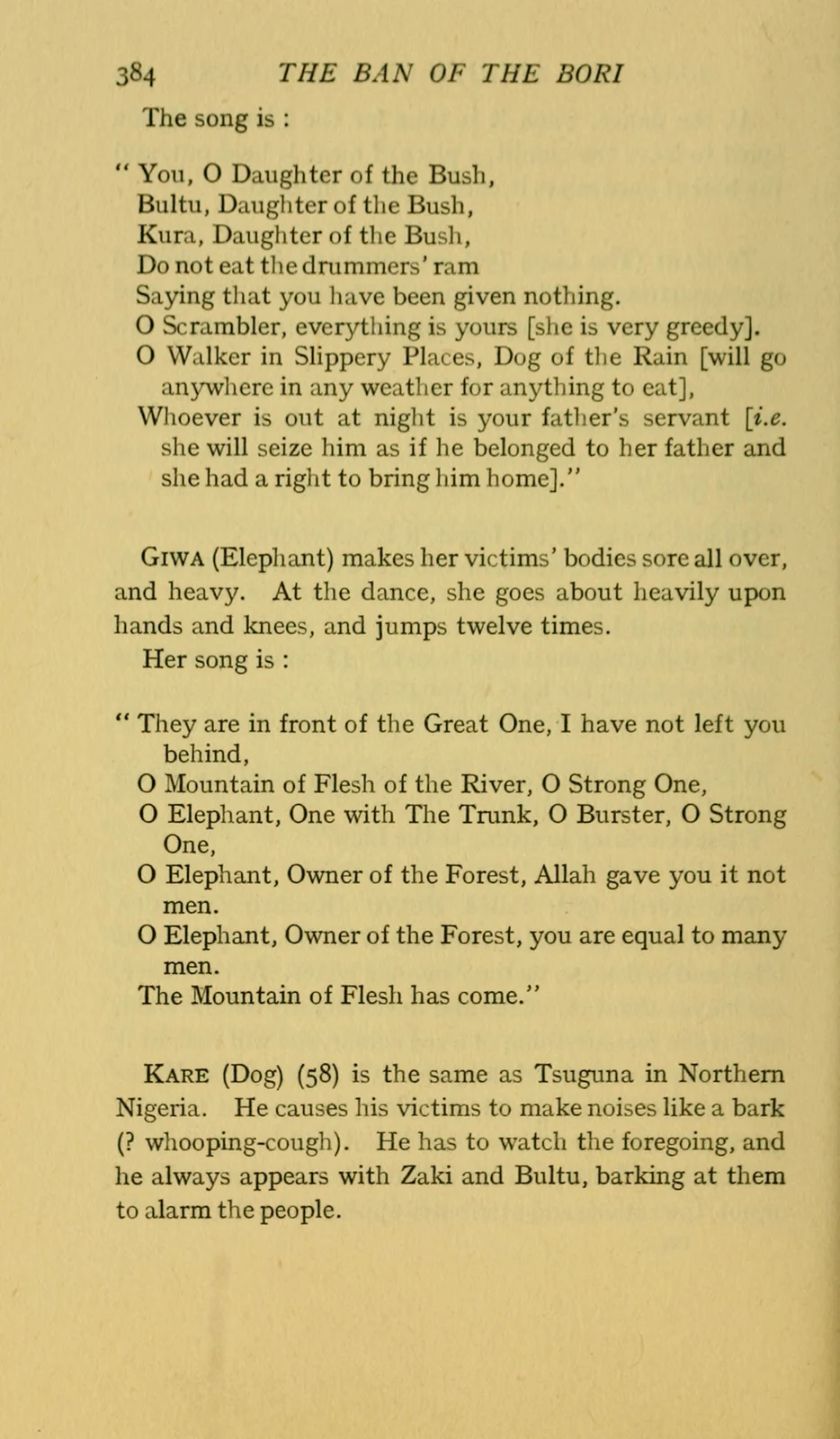
 Kare,1914 historical printed text witness, page384; documentary source-page facsimile
Documentary text facsimile naming Kare and describing ritual/narrative attributes; not a photograph of a spirit or creature artwork. Colonial observer terminology and interpretations belong to the original1914 text.
Selected bibliography
Documented works and useful reading. This is not a list of every appearance.
- 01
The Ban of the Bori
Selected witness pp 382–385; colonial collection with uneven narrator attribution.
Family & connections
A source-supported family tree or inspiration record has not yet been compiled for this profile. Related reading below indicates a connection in subject matter, not a proven lineage or creative influence.
References
Sources supporting this profile. Linked pages have their own scope and editorial standards.
- Historical ritual observation and translated songsThe Ban of the Bori — KareResearch access: 2026-10-05
Image credits
Historical ritual performance photographA human participant enacts Kare beside Zaki and Bultu in photograph58, 1914
The upper photograph58 records participants representing Kare the dog, Zaki the lion and Bultu the hyena on hands and knees. Its caption describes Kare barking behind the two predators. It is a performed animal-spirit relationship, not a photograph of supernatural animals.
Further credits appear with each additional image.