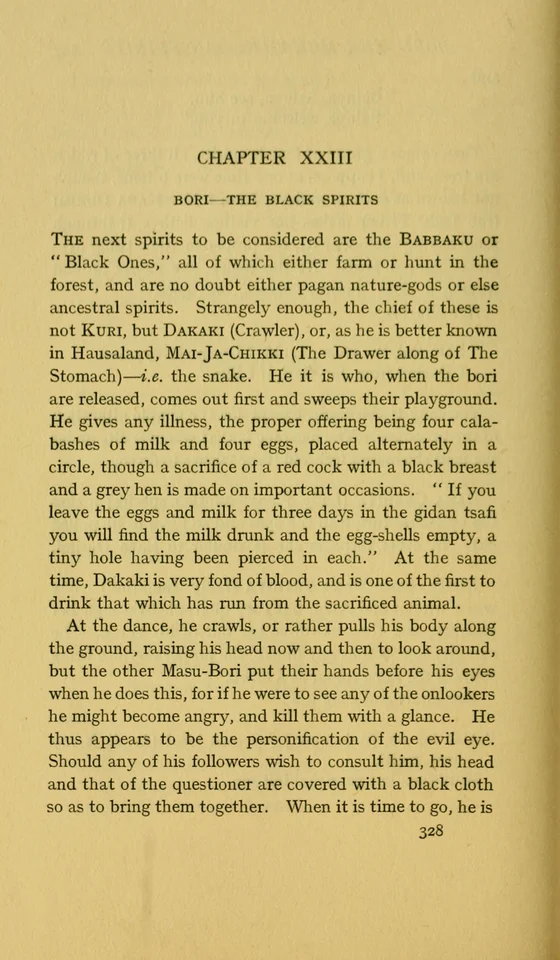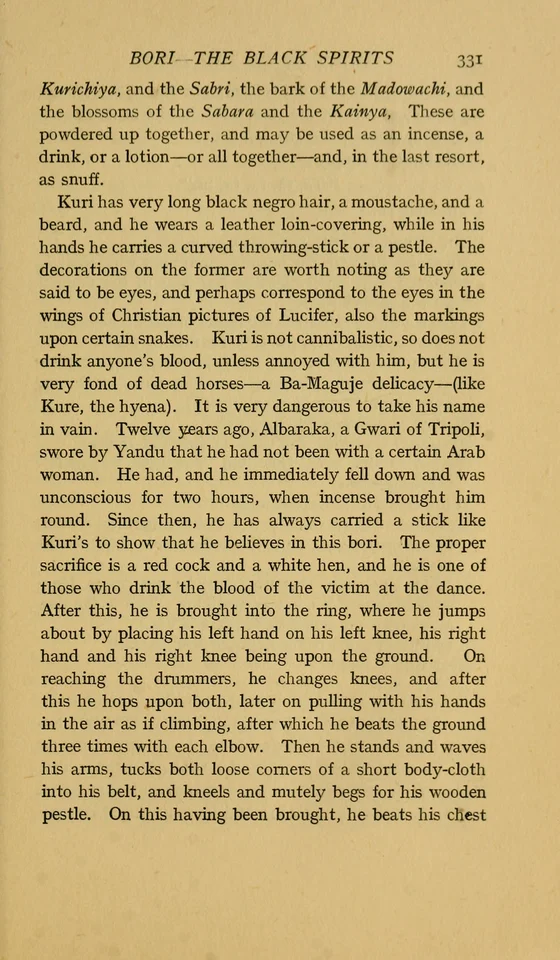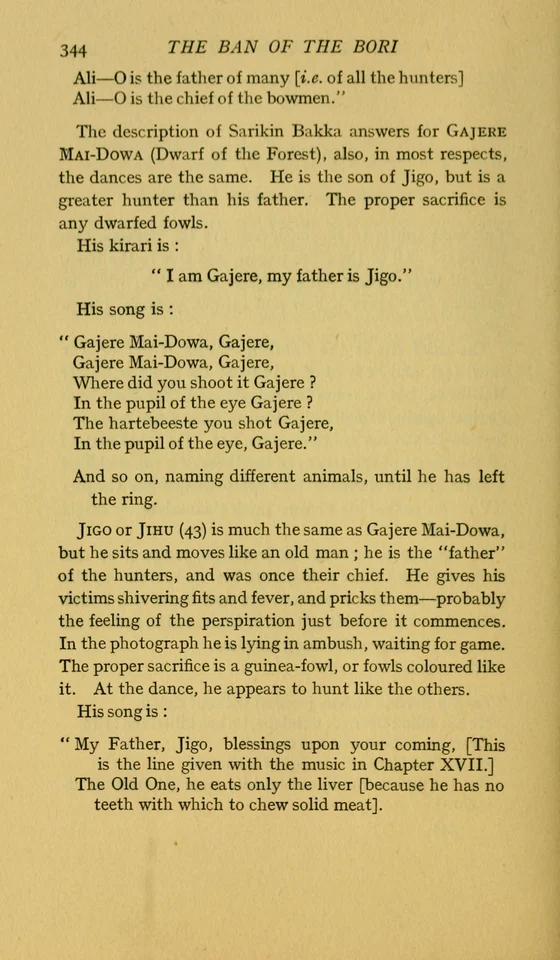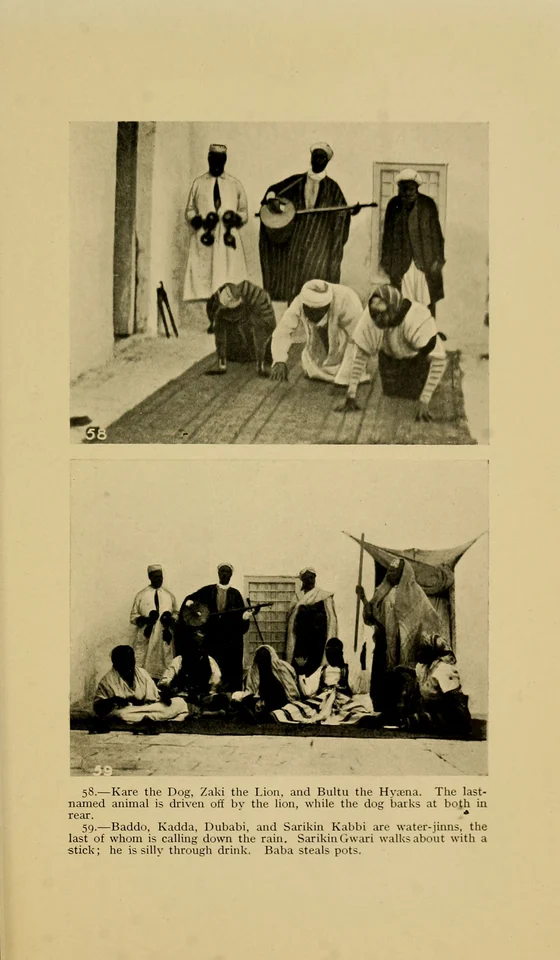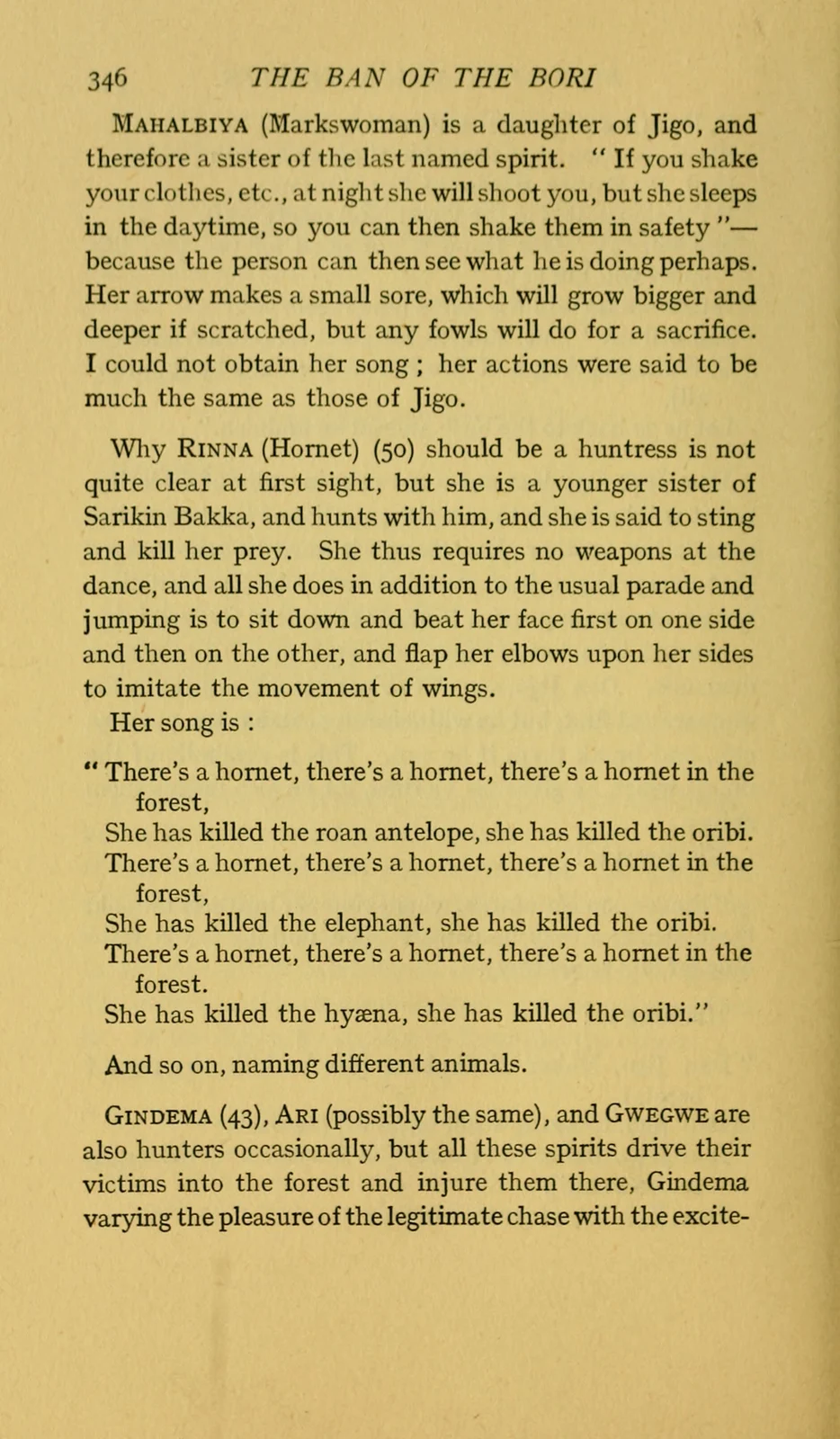
Rinna,1914 historical printed text witness, page346; documentary source-page facsimile
Documentary text facsimile naming Rinna and describing ritual/narrative attributes; not a photograph of a spirit or creature artwork. Colonial observer terminology and interpretations belong to the original1914 text.
Overview
Rinna is the hornet huntress in Tremearne’s account, a younger sister of Sarikin Bakka who hunts with him. The notice explicitly attributes the ability to sting and kill prey to her. Her song expands that power beyond ordinary hornet behavior by naming large game: roan antelope, oribi, elephant and hyena. The musicians continue by naming different animals, making the hunt’s reach part of the spirit’s repeated praise rather than identifying a modern insect species.
Her performance dispenses with the bow and arrows carried by several other hunters. After parading and jumping, the human mount sits down, strikes the face first on one side and then on the other, and flaps the elbows against the sides to imitate wings. The bodily gestures represent the hornet-associated spirit. They are distinct from the song’s narrated killing of large animals and do not require an invented scene in which a human dancer physically becomes a hornet.
The surrounding hunter notices place Rinna within a differentiated company. Sarikin Bakka cares for forest beasts and receives offerings before hunts; Jigo is remembered as the hunters’ father, while his daughter Mahalbiya is another huntress with her own attributed arrow attacks. Rinna’s stated sibling relationship is specifically to Sarikin Bakka. Keeping those relationships separate preserves the source’s hornet huntress without assigning her every weapon, genealogy or illness attributed to neighboring figures.
Origins & earliest records
Tremearne’s historical collection combines accounts and ritual observations in Hausa-associated North African communities and northern Nigeria. Its evolutionary and comparative origin theories are not adopted.
Records & interpretation
The Ban of the Bori, p 346. Ritual movements describe human mounts representing spirits; translated songs and attributed powers are evidence of this recorded representation, not proof of medical causation or uniform contemporary community practice.
Selected bibliography
Documented works and useful reading. This is not a list of every appearance.
- 01
The Ban of the Bori
Selected witness p 346; colonial collection with uneven narrator attribution.
Family, evolution & connections
Sarikin Bakka
Rinna is called Sarikin Bakka’s younger sister and hunting companion. Her hornet-associated representation does not establish a zoological species or assign Jigo as her father through disputed Bakka/Gajere equivalence.
References
Sources supporting this profile. Linked pages have their own scope and editorial standards.
- Historical ritual observation and translated songsThe Ban of the Bori — RinnaResearch access: 2026-10-05
Image credits
Historical text facsimileRinna,1914 historical printed text witness, page346; documentary source-page facsimile
Documentary text facsimile naming Rinna and describing ritual/narrative attributes; not a photograph of a spirit or creature artwork. Colonial observer terminology and interpretations belong to the original1914 text.