
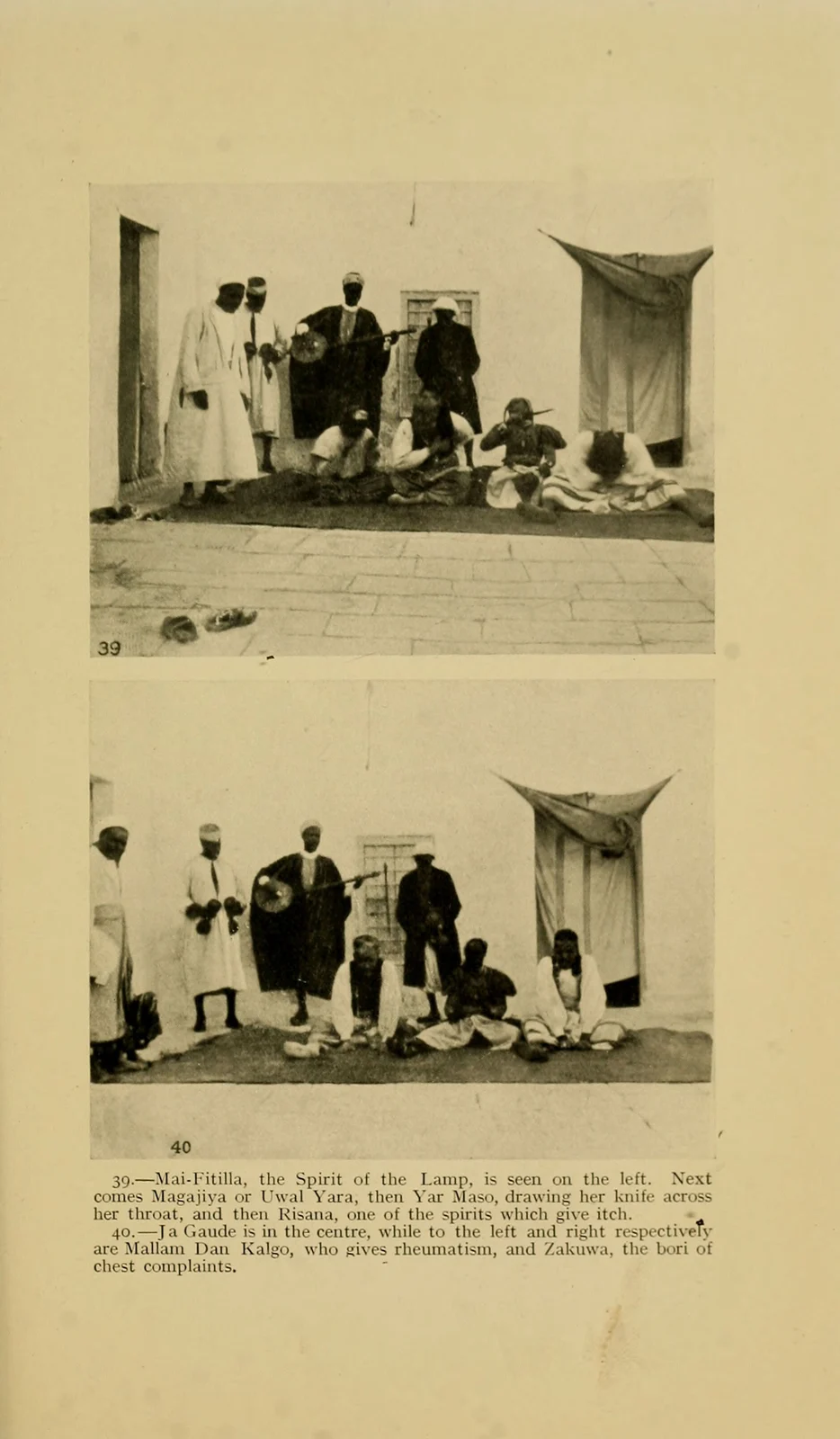
Risana represented by the bent forward participant at the right of photograph39, 1914
The upper photograph39 names Risana as the rightmost seated foreground participant, bent forward. The photograph documents a human representation of the spirit; its original disease attribution is a historical claim, not a medical explanation.
Overview
Risana is one of Kuri’s wives in Tremearne’s account. Her representation moves through the ring, bites the hands, rubs the chest, scratches, sits down and tries to tear the clothing before yelling and making three jumps. The collector records irritation as an illness attributed to her, with a tentative diagnosis of his own that should not be treated as the tradition’s name for a disease.
The more distinctive account concerns her husband’s human mistresses. Risana looks about for them in order to punish them; if she catches one of their souls, she immediately becomes silent. The onlookers then wonder whose soul she has taken, since the victim may show no immediate sign. Her song repeatedly identifies her as Kuri’s wife and asks whom she has seized, linking the representation to this narrated jealousy and uncertain recognition.
Origins & earliest records
A. J. N. Tremearne combines interviews and descriptions of bori performances with comparative interpretation. These selected notices do not consistently name individual speakers; printed attributes are distinguished from his conjectures.
Records & interpretation
Complete selected spirit notice in chapter XXII, printed pp. 325; surrounding chapter context read.
Selected bibliography
Documented works and useful reading. This is not a list of every appearance.
- 01
The Ban of the Bori: Demons and Demon-Dancing in West and North Africa
XXII. Bori—the Mohammedan Spirits, printed pp. 325; attributed narrative and ritual representation.
Family & connections
A source-supported family tree or inspiration record has not yet been compiled for this profile. Related reading below indicates a connection in subject matter, not a proven lineage or creative influence.
References
Sources supporting this profile. Linked pages have their own scope and editorial standards.
- Digitized historical ethnographic accountTremearne — RisanaResearch access: 2026-10-05
Image credits
Historical ritual performance photographRisana represented by the bent forward participant at the right of photograph39, 1914
The upper photograph39 names Risana as the rightmost seated foreground participant, bent forward. The photograph documents a human representation of the spirit; its original disease attribution is a historical claim, not a medical explanation.