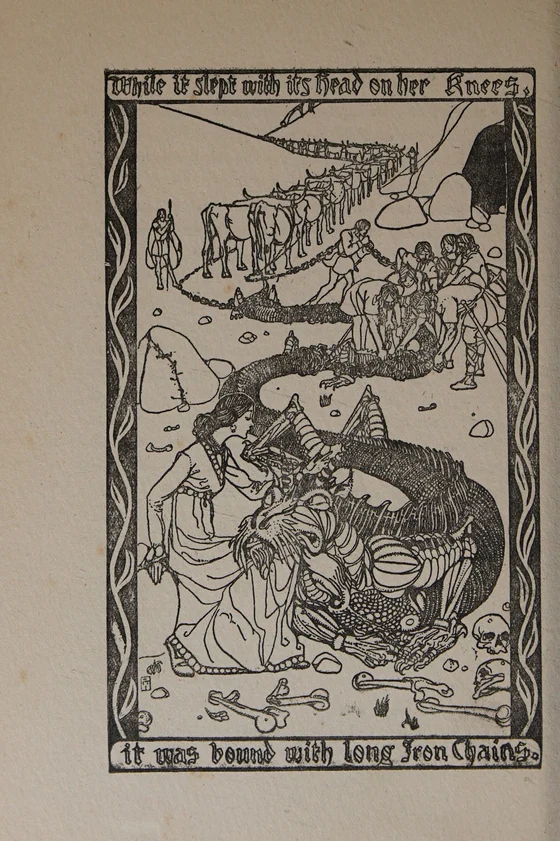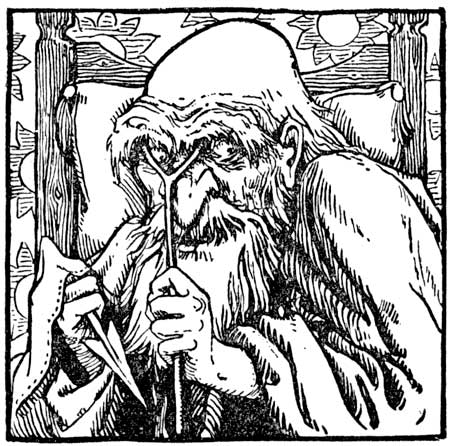
Batten: Ysbaddaden with his eyelids raised
Wooing of Olwen illustration depicts the giant with propped eyelids; named episode and profile anatomy match. John Dickson Batten (1860–1932) credited by title page. 1892 first publication; selected impression undated.
Overview
Ysbaddaden Penkawr, rendered Yspaddaden by Guest, stands between Culhwch and marriage to his daughter Olwen. His castle has successive guarded gates, and he requires attendants to raise his fallen eyebrows on forks before inspecting the visitors. Three poisoned darts beside him become the weapons of repeated attacks as they depart. Bedwyr returns the first through his knee; Menw sends the second through his breast and out his back; Culhwch sends the third through his eye and head. Each injury prompts an extended complaint about the future pain, breathlessness or impaired sight it will cause. The giant nevertheless remains able to bargain. His threatened control over the marriage also affects his own kin: the herdsman Custennin identifies him as an oppressive brother, and Custennin's household says Ysbaddaden has killed twenty-three sons. The surviving son Goreu later becomes central to the giant's defeat.
His demands expand beyond one bridal test into a network of agricultural labour, extraordinary food, vessels, animals and specialist helpers. A wild hill must be cleared, ploughed, sown and ripened within a single day to provide wedding food and drink. Other requirements include a self-playing harp and a basket capable of satisfying many different appetites. Obtaining one object repeatedly depends on another person or animal first being secured, so Culhwch's task reaches across Arthur's company and distant territories. Grooming binds the network to the giant's own body: the tusk of Yskithyrwyn and implements carried by Twrch Trwyth are needed. At the conclusion Kaw strips beard, skin and flesh from his face, and Ysbaddaden acknowledges that the bride was gained through Arthur's achievements against his wishes. He says losing his daughter means losing his life. Goreu then kills him and the castle's treasures are seized. The outcome joins an obstructive father's defeat with an explicit family grievance, rather than depicting customary Welsh marriage practice.
Origins & earliest records
The selected witness is the medieval Welsh tale Culhwch and Olwen, preserved in the Mabinogion manuscript tradition and inspected through Charlotte Guest's nineteenth-century English translation. Its Giant Yspaddaden spelling corresponds to the modern Ysbaddaden used here. The literary record and translation are dated witnesses; they do not supply a recoverable original oral biography of the giant.
Records & interpretation
The raised eyebrows, returned darts, task sequence and final shaving are explicit features of a literary giant. Their narrative relationship explains his importance beyond a list of physical traits. They do not constitute evidence of a historical person with gigantic anatomy, and the story's violence should not be converted into practical customary wedding history.
In the literature
“for with her I lose my life.”
Kilhwch and Olwen; Yspaddaden’s final acknowledgement · Lady Charlotte Guest
The giant connects his daughter’s marriage with the loss of his own life.
Selected bibliography
Documented works and useful reading. This is not a list of every appearance.
- 01
The Mabinogion
Kilhwch and Olwen: poisoned darts, demanded tasks and final shaving. Selected inspected witness; bibliography is not exhaustive.
- 02
The Mabinogion — Kilhwch and Olwen or the Twrch Trwyth
Charlotte Guest’s historical English translation; hosted Project Gutenberg 5160 text does not identify its exact print edition date or printed pagination. The translation’s nineteenth-century publication history is separate from the ebook release in 2004. Locators use the exact named tale and episode/paragraph opening, without invented page numbers.
Family, evolution & connections
Yspaddaden and Custennin: two brothers’ named children
Guest’s Kilhwch and Olwen translation only.
Scroll sideways to see all branches. With a keyboard, focus the tree and use the arrow keys.
- Two explicitly named brothers (shared parent unspecified)
- Olwen
- Custennin son of Dyfnedig
- Goreu son of Custennin
Explicit family relationships in the named translated tale. The grouping represents a stated brother relationship, not an invented parent. Dyfnedig is named as Custennin’s father, but the text here does not explicitly assign him as Yspaddaden’s father. Custennin’s wife reports twenty-three killed sons; their individual names are not supplied.
Custennin son of Dyfnedig
Custennin directly identifies Yspaddaden Penkawr as his brother and says that the giant oppressed him over his possessions. This explicit relationship is preserved without assuming that both brothers share the named father Dyfnedig.
Olwen
Olwen repeatedly identifies Yspaddaden as her father. Her marriage to Kilhwch is followed by the giant’s death; this is the family relationship in Guest’s translated story, not a generalized genealogy of Welsh giants.
Located primary passages
Specific passages supporting details in this entry, grouped by their published witness.
The Mabinogion — Kilhwch and Olwen or the Twrch Trwyth
Charlotte Guest’s historical English translation; hosted Project Gutenberg 5160 text does not identify its exact print edition date or printed pagination. The translation’s nineteenth-century publication history is separate from the ebook release in 2004. Locators use the exact named tale and episode/paragraph opening, without invented page numbers.
- Yspaddaden requires attendants to lift his eyebrows. On successive visits he throws poisoned darts, which Bedwyr, Menw and Kilhwch return, injuring his knee, chest and eye.
- Yspaddaden demands extraordinary wedding preparations and specifically the comb and scissors between Twrch Trwyth’s ears for his hair; the ensuing list makes their recovery dependent on named dogs, huntsmen, equipment and Arthur.
Kilhwch and Olwen or the Twrch Trwyth; Demanded wedding preparations and hunt equipment
- After the marvels are obtained, Kaw shaves away beard, skin and flesh. Yspaddaden acknowledges Olwen belongs to Kilhwch and that the marriage ends his life; Goreu beheads him and takes the castle.
Selected complete creature episodes inspected, not a claim that the entire Mabinogion or every demanded task was read. Modern print page numbers, earliest attestations and biological anatomy are not inferred from the narrative.
Encyclopedia background
An additional attributed reference, separate from the editorial profile above.
Read the open encyclopedia overview
Ysbaddaden Bencawr; "Ysbaddaden, Chief of Giants" (from roots meaning "hawthorn" or "infertile" - or perhaps implying both meanings), is the primary antagonist of the Welsh romance Culhwch and Olwen. A vicious giant residing in a nigh unreachable castle, he is the father of Olwen and uncle of Goreu fab Custennin.
Text from Wikipedia contributors, “Ysbaddaden”. CC BY-SA 4.0. Extracted introduction; formatting changed. Retrieved 5 October 2026. The source article may have changed since retrieval.
References
Sources supporting this profile. Linked pages have their own scope and editorial standards.
- Primary textGuest, The Mabinogion: Kilhwch and Olwen: poisoned darts, demanded tasks and final shavingResearch access: 2026-10-05
Image credits
Historical illustrationBatten: Ysbaddaden with his eyelids raised
Wooing of Olwen illustration depicts the giant with propped eyelids; named episode and profile anatomy match. John Dickson Batten (1860–1932) credited by title page. 1892 first publication; selected impression undated.