Twrch Trwyth
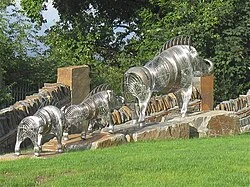
Modern permanent public Twrch Trwyth sculpture in Wales, photographed and credited to sculptor Tony Woodman. Photograph CC BY-SA2.0; UK freedom of panorama covers permanent public sculpture, CDPA1988 section62.
Overview
Twrch Trwyth is pursued for the comb, razor and scissors carried between his ears, necessary to prepare Ysbaddaden for Culhwch's marriage to Olwen. Before the main hunt, Menw takes bird form and approaches the Irish lair to check the implements. He obtains only a bristle, while venom shaken from the angry boar leaves him permanently unwell. Arthur later arrives with a vast host and finds Twrch with seven young pigs. Irish attacks and Arthur's household both fail; Arthur himself fights for nine days and nights without killing even one pig. Asked about their leader, he says a former king was transformed by God for his sins. That explanation is Arthur's statement within the narrative. Another bird-shaped envoy, Gwrhyr, requests negotiation, but the young boar Grugyn refuses and announces an attack on Arthur's country. Grugyn's glittering silver-wire bristles belong to him, not automatically to his father.
The company crosses to Wales, where the pursuit moves through named places and accumulates named deaths. At Cwm Kerwyn, Twrch kills several champions and Arthur's son Gwydre, and is himself wounded. Later losses include men, dogs and royal relatives; his young pigs gradually fall or separate from him. At the Severn, the hunters force Twrch into the water. Mabon son of Modron snatches the razor from horseback, and Kyledyr Wyllt takes the scissors from the opposite side. Recovering the comb requires further pursuit into Cornwall, where earlier hardships are described as slight by comparison. The last implement is finally obtained, but the boar is driven into the deep sea and his destination remains unknown. Arthur then returns to rest and anoint himself. The sequence ends with successful retrieval and an unresolved surviving monster, rather than a simple slaying. Its geographical route, specialised helpers and human costs are essential to the episode's scale.
Origins & earliest records
The selected witness is Culhwch and Olwen within the medieval Welsh Mabinogion manuscript tradition, read through Charlotte Guest's translation originally published during 1838–1849. The National Library of Wales identifies the tale among the early surviving copies in the White Book of Rhydderch. Surviving transcription and later translation dates do not determine the narrative's first oral composition.
Records & interpretation
The sustained hunt, named participants, carried implements and explanation of transformation are literary evidence for an exceptional individual boar. The silver-wire bristles belong specifically to Grugyn, one of his young, and are not transferred to their father here. The account is neither a record of an ordinary wild-boar hunt nor evidence of human biological transformation.
In the literature
“it was never known whither he went”
Kilhwch and Olwen; end of the Twrch Trwyth hunt · Lady Charlotte Guest
The tale closes the boar’s hunt with an unknown destination after it is driven into the sea.
Selected bibliography
Documented works and useful reading. This is not a list of every appearance.
- 01
The Mabinogion
Kilhwch and Olwen: hunt in Ireland, Wales and the Severn. Selected inspected witness; bibliography is not exhaustive.
- 02
The Mabinogion — Kilhwch and Olwen or the Twrch Trwyth
Charlotte Guest’s historical English translation; hosted Project Gutenberg 5160 text does not identify its exact print edition date or printed pagination. The translation’s nineteenth-century publication history is separate from the ebook release in 2004. Locators use the exact named tale and episode/paragraph opening, without invented page numbers.
Family & connections
A source-supported family tree or inspiration record has not yet been compiled for this profile. Related reading below indicates a connection in subject matter, not a proven lineage or creative influence.
Located primary passages
Specific passages supporting details in this entry, grouped by their published witness.
The Mabinogion — Kilhwch and Olwen or the Twrch Trwyth
Charlotte Guest’s historical English translation; hosted Project Gutenberg 5160 text does not identify its exact print edition date or printed pagination. The translation’s nineteenth-century publication history is separate from the ebook release in 2004. Locators use the exact named tale and episode/paragraph opening, without invented page numbers.
- Menw approaches as a bird to confirm the precious objects but carries off only a bristle and is harmed by venom. Arthur later explains the boar as a former king transformed for his sins.
Kilhwch and Olwen or the Twrch Trwyth; Menw’s scouting and Arthur’s account of the swine’s origin
- The boar and seven pigs resist the hunters in Ireland, cross to Wales and kill numerous named champions during successive stands. The narrative traces pursuit through named places and the loss of the accompanying pigs.
- Hunters plunge the boar into the Severn and seize razor and scissors. It reaches Cornwall before the comb is recovered, then is driven into the sea and its destination remains unknown.
Kilhwch and Olwen or the Twrch Trwyth; Severn capture, Cornwall comb recovery and disappearance
Selected complete creature episodes inspected, not a claim that the entire Mabinogion or every demanded task was read. Modern print page numbers, earliest attestations and biological anatomy are not inferred from the narrative.
Encyclopedia background
An additional attributed reference, separate from the editorial profile above.
Read the open encyclopedia overview
Twrch Trwyth (Welsh pronunciation: [tuːɾχ tɾʊɨθ] ; also Welsh: Trwyd) is a fabulous wild boar in Arthurian legend. A richly elaborate account of its hunt is described in the Welsh prose romance Culhwch and Olwen, which was probably written around 1100.
Its hunt involved King Arthur and his hosts and his hound Cafall, and was also deemed to require other recruited men of talent, other hounds, and additional equipment such as a leash, according to the tasks (anoetheu) prescribed by the giant Ysbaddaden, though events did not always unfold as the giant foretold. The boar was brought out of Ireland, driven to Britain, and finally shoved off a cliff into the sea at Cornwall.
The legend, in simpler form, dates much earlier, since Arthur's use of his hound Cavall (Latin: Cavall (base text, MS. MS. H), Latin: caball (MS. K), Latin: caballusMS. D1), Latin: caballus(MSS. D2 G) to hunt the boar (Latin: Troynt (base text, MSS.H K), Troit (MSS.C1 D G Q); or Terit (MSS. C2 L)) is glimpsed in a piece of geographical onomasticon composed in Latin in the ninth century, the Historia Brittonum.
A passing reference in the elegy Gwarchan Cynfelyn (7th century), preserved in the Book of Aneirin, is reckoned to be its earliest mention in literature. Trwyth is also mentioned in several other pieces of poetry from the Middle Welsh period.
The name in Welsh can be construed to mean "the boar Trwyth", and past scholars argued it may be analogous to the boar Triath of Irish mythology (see #Etymology and Irish cognate below).
Text from Wikipedia contributors, “Twrch Trwyth”. CC BY-SA 4.0. Extracted introduction; formatting changed. Retrieved 5 October 2026. The source article may have changed since retrieval.
References
Sources supporting this profile. Linked pages have their own scope and editorial standards.
- Primary textGuest, The Mabinogion: Kilhwch and Olwen: hunt in Ireland, Wales and the SevernResearch access: 2026-10-05
- ReferenceNational Library of Wales: White Book of Rhydderch and its Mabinogion textsResearch access: 2026-10-05
Image credits
Thematic illustrationTwrch Trwyth
Modern permanent public Twrch Trwyth sculpture in Wales, photographed and credited to sculptor Tony Woodman. Photograph CC BY-SA2.0; UK freedom of panorama covers permanent public sculpture, CDPA1988 section62.