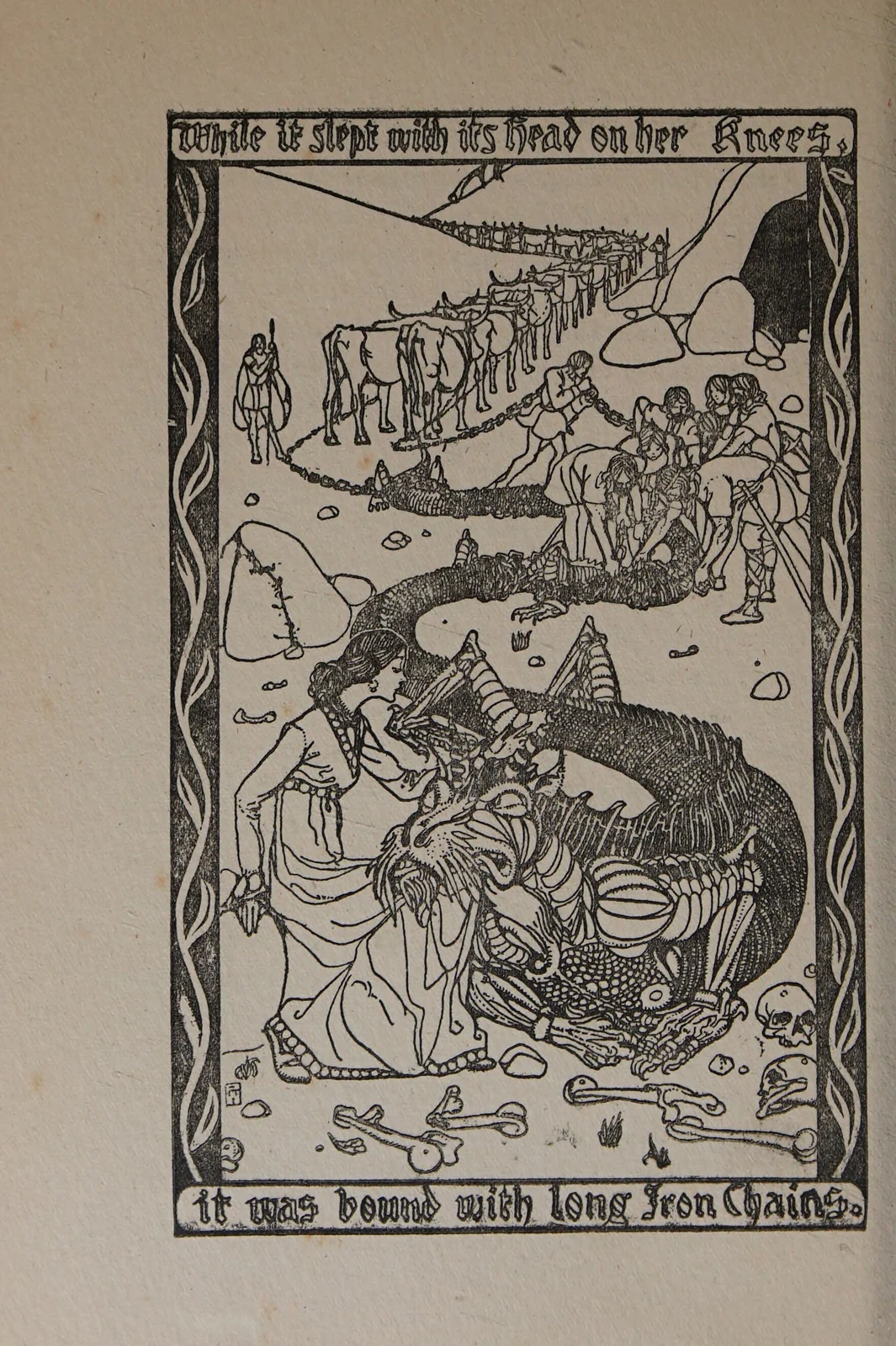
Willy Pogany’s later Afanc illustration: the creature resting on a woman’s knees and being dragged by oxen
Pogany illustrates the later Hu Gadarn and Afanc telling in Thomas’s Welsh Fairy Book, shown here in the 1918 fifth impression of the 1907 work. The woman, chains and ox team belong to this lake-monster variant. The reptilian body is this artist’s interpretation; Peredur’s separate account describes a hidden attacker without specifying its anatomy. The short printed caption identifies the sleeping-and-binding episode.
Overview
The Addanc episode in Peredur begins with its consequences rather than its appearance. At the Palace of the Sons of the King of the Tortures, Peredur sees a dead rider brought in on his horse. A maiden bathes and anoints the body with warm water and precious balsam, restoring him to life; two more riders receive the same treatment. They explain that an Addanc in a cave kills them every day. When they prepare to ride out again, they refuse Peredur's company because he has nobody to restore him if he dies. The repeated losses make the monster an ongoing danger, even to warriors whose deaths are otherwise reversible. Peredur follows and meets a woman who knows his quest. She warns that the Addanc relies on craft: a stone pillar at its cave entrance hides it while permitting it to see and attack everyone approaching with a poisoned dart.
Her proposed gift reverses that imbalance. In exchange for his pledged affection, she gives Peredur a stone allowing him to see the Addanc while remaining unseen himself, then disappears. A later guide identifies the narrow road to the cave. Holding the stone in his left hand and his lance in his right, Peredur enters, pierces the creature and removes its head. His three companions greet him outside and cite a prediction of his victory. He gives them the head, while their offered marriage and half-kingdom do not detain him. This account makes concealment, a projectile and unequal knowledge more significant than exceptional bodily strength. It supplies neither a fish tail nor a beaver, crocodile or composite outline. The broader afanc name may occur in different lake traditions, but those require independently identified witnesses; a modern illustration cannot fill the anatomical silence of this particular medieval cave episode.
Origins & earliest records
The selected medieval narrative is Peredur, preserved within the Welsh Mabinogion manuscript tradition. This entry uses Charlotte Guest's English translation, originally issued with the collection between 1838 and 1849, in Gutenberg's electronic witness. The manuscript attestation, translation history and the beginning of a wider oral afanc tradition are different questions and are not collapsed into one date.
Records & interpretation
The source explicitly describes a cave, a concealed attacker and a poisoned dart, followed by Peredur's use of a special stone. That is literary evidence for this particular monster episode. It neither identifies a zoological species nor establishes its physical outline, so a detailed modern composite image cannot be presented as anatomy verified by this text.
In the literature
“He has a cave”
Peredur; lady’s warning about the Addanc · Lady Charlotte Guest
The lady explains the concealed cave position from which the Addanc attacks.
Selected bibliography
Documented works and useful reading. This is not a list of every appearance.
- 01
The Mabinogion
Peredur the Son of Evrawc: Addanc cave episode. Selected inspected witness; bibliography is not exhaustive.
- 02
The Mabinogion — Peredur the Son of Evrawc
Charlotte Guest’s historical English translation; hosted Project Gutenberg 5160 text does not identify its exact print edition date or printed pagination. The translation’s nineteenth-century publication history is separate from the ebook release in 2004. Locators use the exact named tale and episode/paragraph opening, without invented page numbers.
Family & connections
A source-supported family tree or inspiration record has not yet been compiled for this profile. Related reading below indicates a connection in subject matter, not a proven lineage or creative influence.
Located primary passages
Specific passages supporting details in this entry, grouped by their published witness.
The Mabinogion — Peredur the Son of Evrawc
Charlotte Guest’s historical English translation; hosted Project Gutenberg 5160 text does not identify its exact print edition date or printed pagination. The translation’s nineteenth-century publication history is separate from the ebook release in 2004. Locators use the exact named tale and episode/paragraph opening, without invented page numbers.
- The sons are killed by the Addanc daily and revived by a woman using warm water and balsam; they warn Peredur that he lacks someone to revive him.
- A lady describes its concealed position behind a stone pillar and poisonous darts, then gives Peredur a stone that lets him see unseen. He enters, pierces and beheads the Addanc, returning its head to the three brothers.
Peredur the Son of Evrawc; Lady’s warning through Addanc cave encounter
Selected complete creature episodes inspected, not a claim that the entire Mabinogion or every demanded task was read. Modern print page numbers, earliest attestations and biological anatomy are not inferred from the narrative.
Encyclopedia background
An additional attributed reference, separate from the editorial profile above.
Read the open encyclopedia overview
The Afanc (Welsh pronunciation: [ˈavaŋk], sometimes also called Addanc, [ˈaðaŋk]) is a lake monster from Welsh mythology. Its exact description varies, being described as resembling a crocodile, beaver or dwarf-like creature, or a platypus and is sometimes said to be a demon. The lake in which it dwells is also uncertain and it is variously said to live in Llyn Llion, Llyn Barfog, near Brynberian Bridge or in Llyn yr Afanc, a pool on the Afon Conwy near Betws-y-coed that was named after the creature.
Text from Wikipedia contributors, “Afanc”. CC BY-SA 4.0. Extracted introduction; formatting changed. Retrieved 5 October 2026. The source article may have changed since retrieval.
References
Sources supporting this profile. Linked pages have their own scope and editorial standards.
- Primary textGuest, The Mabinogion: Peredur the Son of Evrawc: Addanc cave episodeResearch access: 2026-10-05
Image credits
Historical illustrationWilly Pogany’s later Afanc illustration: the creature resting on a woman’s knees and being dragged by oxen
Pogany illustrates the later Hu Gadarn and Afanc telling in Thomas’s Welsh Fairy Book, shown here in the 1918 fifth impression of the 1907 work. The woman, chains and ox team belong to this lake-monster variant. The reptilian body is this artist’s interpretation; Peredur’s separate account describes a hidden attacker without specifying its anatomy. The short printed caption identifies the sleeping-and-binding episode.