Polyphemus
Image associated with the exact linked encyclopedia article; consult credited file description for its interpretation.
Overview
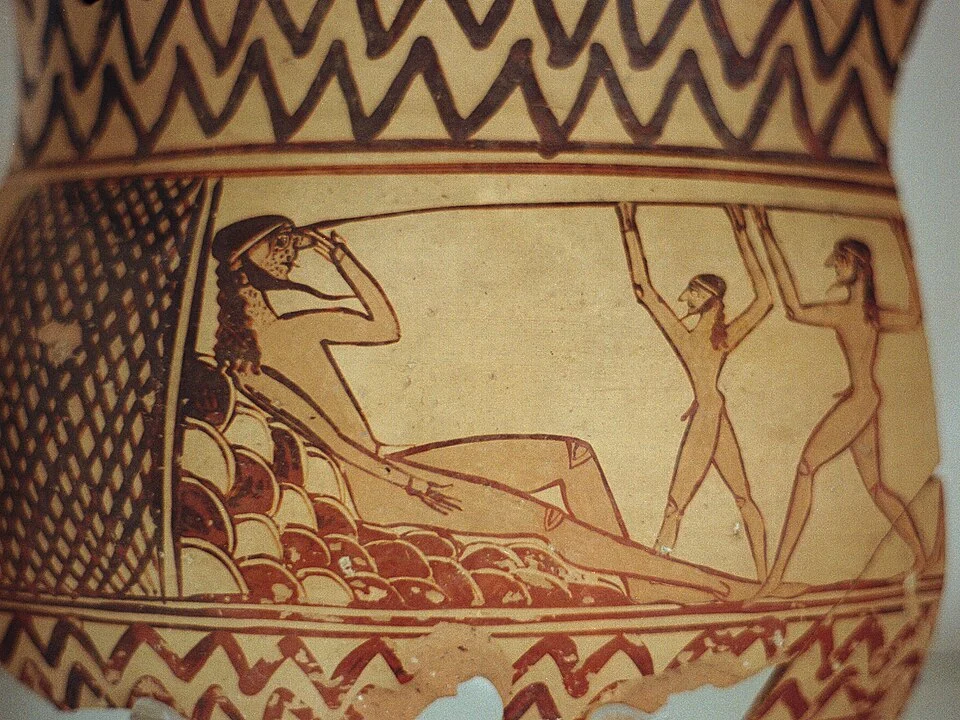
Odysseus and his companions enter the cave of a Cyclops whose sheep, food and immense strength give him control over the space. Polyphemus rejects the visitors’ appeal to hospitality and eats members of the party. The entrance stone is too heavy for the captives to move, so killing the occupant would leave them imprisoned.
Odysseus instead gets him drunk, uses a false name and blinds his single eye. The survivors escape beneath sheep while Polyphemus feels the animals’ backs. The trick works until Odysseus reveals his own identity, enabling the Cyclops to appeal to Poseidon against him. This named pastoral figure should not be conflated with every Cyclops described in other Greek genealogies or stories.
Theocritus’s eleventh idyll presents a younger Polyphemus coping with love for the sea-nymph Galatea. His flock returns without its distracted shepherd while he sings beside the shore. In his song he blames rejection on his continuous shaggy eyebrow, single eye and broad nose, then advertises his cattle, abundant milk and cheese, musical skill and wooded cave. These descriptions belong to the lover’s attempt to recommend himself. He wishes he could enter Galatea’s sea, considers learning to swim, and finally counsels himself to return to ordinary pastoral work rather than pursue someone who avoids him.
The poem addresses Nicias and makes Polyphemus an example of song easing lovesickness. Its ending supplies relief through music, not a successful marriage or a battle with Odysseus. The cave, flocks and single eye carry into this Hellenistic portrayal, while the particular narrative concern changes from Homer’s captivity and escape to frustrated courtship.
The sixth idyll offers another framing: Daphnis and Damoetas perform competing pastoral songs about the Cyclops. Daphnis imagines Galatea teasing Polyphemus by throwing apples at his flock; Damoetas answers in the Cyclops’s voice, claiming that he deliberately ignores her to provoke jealousy. That performed speaker admires his reflected beard, teeth and one eye and dismisses Telemus’s ominous prophecy. The scene ends with the herdsmen exchanging instruments and neither losing. These are dramatic songs within a singing contest, rather than the narrator’s straightforward report of Galatea’s behaviour.
Origins & earliest records
Odyssey IX supplies the cave captivity and escape; Theocritus Idylls VI and XI provide separate Hellenistic pastoral portrayals. Lang’s hosted prose translation follows the 1889 Macmillan edition.
Records & interpretation
Homer’s named Cyclops appears in Odysseus’s narrated encounter. Theocritus XI addresses Nicias with a song-as-remedy example, while VI places Cyclops songs in a herdsmen’s contest. Different speakers and literary frames are preserved.
In the literature
“The Cyclops, hearing this, seized a rock that projected from the side of the mountain”
Chapter XXII, Polyphemus episode, escape of Ulysses
Excerpt describing Polyphemus after Ulysses reveals his name; source retells the Odyssey.
“Polyphemus is son to Neptune by the nymph Thoosa,”
Book I, Jove’s reply; paragraph beginning “And Jove said” · Samuel Butler
The divine council identifies Polyphemus’ parentage.
“Noman is killing me by fraud; no man is killing me by force.”
Book IX, Polyphemus’ cry; paragraph beginning “But Polyphemus shouted” · Samuel Butler
Butler preserves the wordplay through the invented name Noman.
“His cheese-racks were loaded with cheeses, and he had more lambs and kids than his pens could hold.”
Book IX, cave visit; paragraph beginning “We soon reached his cave” · Samuel Butler
The cave contains a substantial dairy and livestock before the violence of the encounter.
Selected bibliography
Documented works and useful reading. This is not a list of every appearance.
- 01
Odyssey, Odyssey, Book IX
Selected primary passage; wording is summarized independently, and incompatible later versions are not silently combined.
- 02
Theocritus, Idylls VI and XI (Lang edition pp. 35–37, 59–63)
Complete two idylls: paired herdsmen’s dramatic contest and Nicias-addressed love song; framing distinguished from the Cyclops’s own claims.
- 03
The Odyssey
Butler prose translation, originally published 1900 as confirmed by the second-edition preface; hosted corrected reprint. No unverified reprint date assigned.
- 04
Bulfinch’s Mythology: The Age of Fable (revised by E. E. Hale)
Exact contiguous excerpt checked against the linked primary e-text on 2026-10-05; only whitespace normalized. Work first published 1855; date of the Hale revision used by this e-text is not specified.
Family, evolution & connections
Polyphemus’s maternal line — Odyssey 1
Zeus’s complete response to Athena at Odyssey 1.63–79, Murray translation.
Scroll sideways to see all branches. With a keyboard, focus the tree and use the arrow keys.
- Phorcys
- Thoosa, nymph and daughter of Phorcys
Explicit Thoosa–Phorcys and Thoosa–Polyphemus statements form the maternal line; Poseidon’s paternity is retained in the child label. No mother of Thoosa, siblings of Polyphemus or offspring are supplied here. Sexual union is not labelled a marriage. This one Cyclops’s genealogy does not establish the parentage of all Cyclopes.
Poseidon
The Odyssey identifies Polyphemus as the son of the sea god and the nymph Thoosa; Butler’s translation uses the Roman name Neptune. This family connection helps explain the god’s hostility toward Odysseus after the Cyclops is blinded. The naming convention should not be mistaken for a separate alternative father.
Thoosa
Zeus expressly identifies the nymph Thoosa as Polyphemus’s mother and says she lay with Poseidon. This supports the named maternal relation; it does not make every Cyclops a child of this pair.
Phorcys
The same speech identifies Thoosa as Phorcys’s daughter. Polyphemus’s maternal-grandfather relationship follows these two explicit parentage statements; no mother of Thoosa is supplied in this passage.
Located primary passages
Specific passages supporting details in this entry, grouped by their published witness.
Primary source witness
Butler prose translation, originally published 1900 as confirmed by the second-edition preface; hosted corrected reprint. No unverified reprint date assigned.
- The divine council identifies Polyphemus’ parentage.
This passage documents one ancient literary version. Translation publication dates are not ancient composition dates or earliest-attestation claims.
Primary source witness
Butler prose translation, originally published 1900 as confirmed by the second-edition preface; hosted corrected reprint. No unverified reprint date assigned.
- Butler preserves the wordplay through the invented name Noman.
Book IX, Polyphemus’ cry; paragraph beginning “But Polyphemus shouted”
- The cave contains a substantial dairy and livestock before the violence of the encounter.
Book IX, cave visit; paragraph beginning “We soon reached his cave”
This passage documents one ancient literary version. Translation publication dates are not ancient composition dates or earliest-attestation claims.
Bulfinch’s Mythology: The Age of Fable (revised by E. E. Hale)
Exact contiguous excerpt checked against the linked primary e-text on 2026-10-05; only whitespace normalized. Work first published 1855; date of the Hale revision used by this e-text is not specified.
- Excerpt describing Polyphemus after Ulysses reveals his name; source retells the Odyssey.
Literary witness only. Bulfinch is a nineteenth-century reteller rather than the ancient origin text. Matching is limited to the specified profile and does not cross franchise, culture or animal-species boundaries.
Encyclopedia background
An additional attributed reference, separate from the editorial profile above.
Read the open encyclopedia overview
Polyphemus ( ; Ancient Greek: Πολύφημος, romanized: Polúphēmos, Epic Greek: [polypʰɛːmos]; Latin: Polyphēmus [pɔlʏˈpʰeːmʊs]) is the one-eyed giant son of Poseidon and Thoosa in Greek mythology, one of the Cyclopes described in Homer's Odyssey. His name can mean either "abounding in songs and legends", "many-voiced", or "very famous".
Polyphemus first appeared as a savage man-eating giant in the ninth book of the Odyssey. The satyr play Cyclops by Euripides is dependent on this episode with some differences in the story and while also being more comedic in nature. Later Classical writers that presented him in their poems linked his name with the nymph Galatea as he tried to seduce her. Often he was portrayed as unsuccessful in these, and as unaware of his disproportionate size and musical failings. In the work of even later authors, however, he is presented as both a successful lover and skilled musician. From the Renaissance on, art and literature reflect all of these interpretations of the giant.
Text from Wikipedia contributors, “Polyphemus”. CC BY-SA 4.0. Extracted introduction; formatting changed. Retrieved 5 October 2026. The source article may have changed since retrieval.
References
Sources supporting this profile. Linked pages have their own scope and editorial standards.
- Primary textOdyssey: Odyssey, Book IX (Theoi Classical Texts Library or Project Gutenberg transcription)Research access: 2026-10-05
- Primary textTheocritus, Bion and Moschus: Lang 1889 edition transcriptionResearch access: 2026-10-05
Image credits
Reference illustrationPolyphemus
Image associated with the exact linked encyclopedia article; consult credited file description for its interpretation.