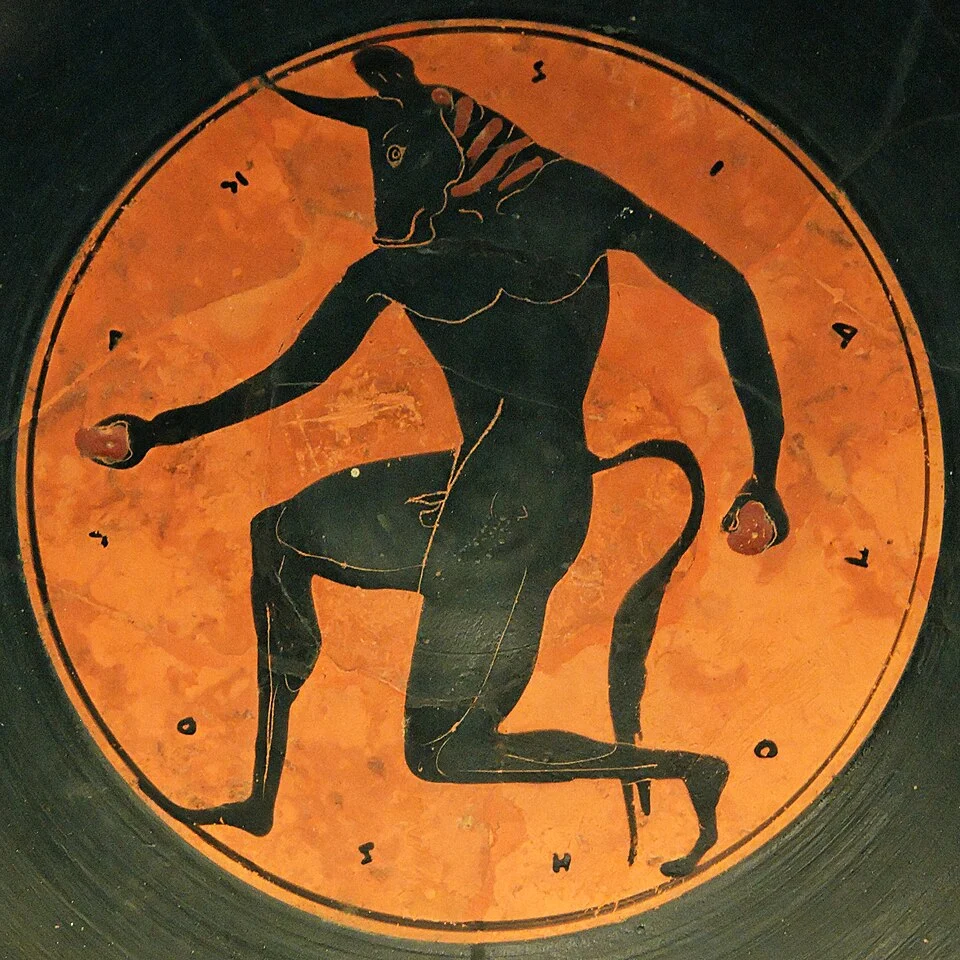
Minotaur
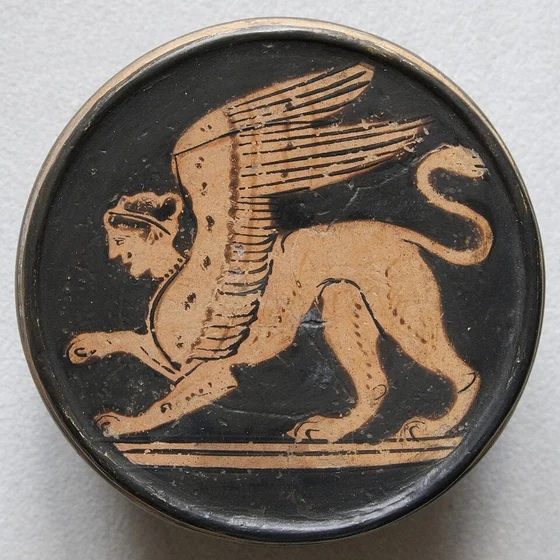
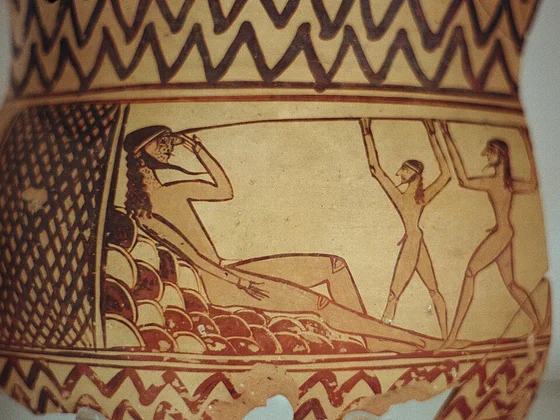
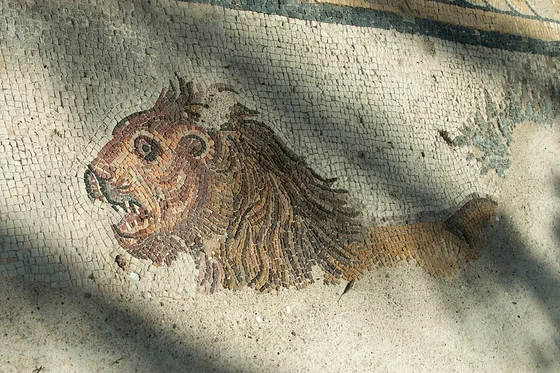
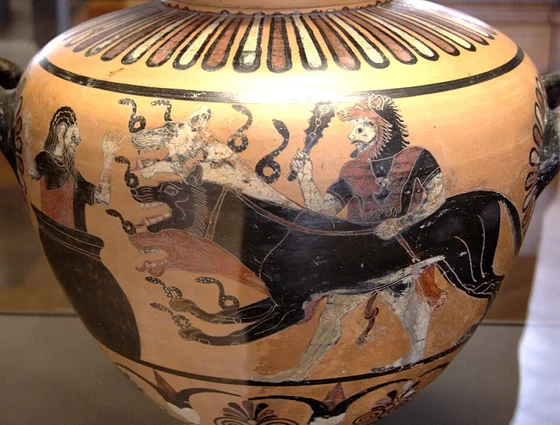
Image associated with the exact linked encyclopedia article; consult credited file description for its interpretation.
Overview
The Minotaur is the bull-faced Asterius confined in Daedalus’s Labyrinth. The Library gives him a human body beneath the bull’s face and identifies Pasiphae as his mother. This is a particular being within the Cretan royal story, rather than a population of interchangeable bull-headed creatures. His confinement connects a family’s hidden catastrophe with Athens’s deadly obligation to Minos and with the escape of Theseus and Ariadne.
In Library III.1.3–4, Minos promises Poseidon that he will sacrifice a bull sent from the sea as a sign supporting his claim to kingship. He keeps the beautiful animal and substitutes another. The angered god makes the bull savage and causes Pasiphae to desire it. Daedalus constructs a hollow wooden cow covered with hide; the union enabled by this device produces Asterius. Minos then follows oracular instructions by imprisoning him in the Labyrinth, whose winding construction obstructs the route out. The architectural trap is therefore part of the narrative’s explanation of both concealment and danger.
Library III.15.7–8 supplies the tribute’s background. After the death of his son Androgeus, Minos attacks Athens, and a prolonged crisis ends with the Athenians submitting to his demands. Seven young men and seven young women are sent unarmed as food for the Minotaur. This passage calls the tribute annual. Plutarch’s Life of Theseus 15 instead gives a nine-year interval and records two possible fates inside the building: destruction by the Minotaur or death after being unable to find an exit. Those differences belong to the surviving accounts and should remain visible.
The Epitome 1.7–10 follows Theseus on the third tribute voyage, while noting both his inclusion among those sent and a version in which he volunteers. Ariadne offers help in return for his promise to take her to Athens as his wife. She obtains the escape method from Daedalus and gives Theseus a thread, which he fastens at the entrance and draws behind him. In this telling he finds the Minotaur deep within the Labyrinth and kills him with his fists. He follows the thread back and leaves with Ariadne and the young captives. On Naxos, Dionysus takes Ariadne; Theseus subsequently forgets the agreed white sails, and Aegeus dies after mistaking the returning black sail for news of his son’s death.
Plutarch deliberately preserves conflicting explanations. In chapter 16 he reports Philochorus’s account of a prison and athletic prizes: the captives fall into the hands of a harsh general named Taurus. In chapter 19, Theseus defeats Taurus at wrestling, and Minos releases the youths and cancels the tribute. Another account, attributed to Demon, has Taurus killed in a naval battle. These are reported alternative interpretations, not independent confirmation that a historical general explains every Minotaur tradition. Plutarch also retains the familiar Ariadne-and-thread narrative alongside them.
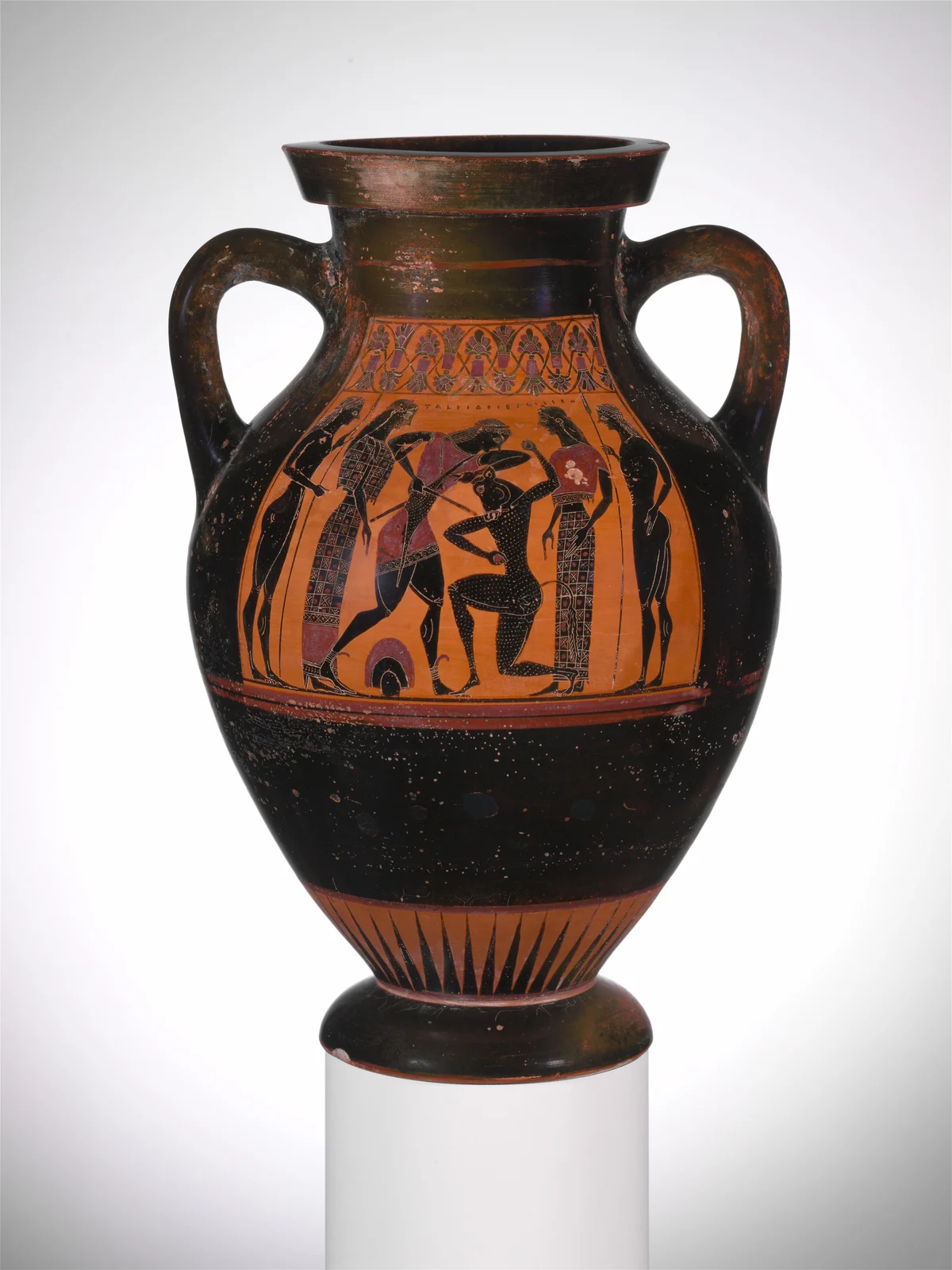
An Attic black-figure amphora in the Metropolitan Museum, accession 47.11.5, supplies an earlier material witness than these surviving prose accounts. The museum dates it to about 540–530 BCE, identifies Taleides’s potter signature and attributes its painting to the Taleides Painter. It identifies the obverse as Theseus killing the Minotaur. Such an object documents ancient representation of the encounter; its date does not by itself establish the first telling or prove the depicted events.
Dante gives the creature a later setting in Inferno XII. At a broken descent into the region of violent sinners, the Minotaur bites himself in rage when he sees the travellers. Virgil provokes him by invoking the Athenian who killed him and the sister who helped that attacker. While the creature rages, Dante and Virgil descend past him toward the river of blood. The passage reuses the Cretan encounter within a Christian afterlife poem, emphasizing anger and obstruction rather than retelling the entire Labyrinth episode.
Origins & earliest records
The selected Attic amphora is dated by its holding museum to about 540–530 BCE. It demonstrates an Archaic representation of Theseus and the Minotaur before the surviving prose accounts discussed here. The Library, its Epitome and Plutarch transmit older material, but their composition and transmission are separate questions from the first oral telling. This selection does not establish an absolute earliest appearance.
Records & interpretation
Ancient pottery and preserved texts document the story’s representation and transmission. The Library supplies a narrative parentage through Pasiphae and Poseidon’s bull; this is a mythic family relationship, not a biological lineage. Plutarch’s human-Taurus alternatives remain attributed interpretations. Neither those accounts nor the existence of Cretan archaeological sites independently verifies a bull-headed being or the events of its imprisonment.
Additional images
 View larger
 Theseus attacks the bull-headed Minotaur on Taleides’s Attic amphora, about540–530BCE
The amphora’s obverse shows Theseus attacking a kneeling, bull-headed Minotaur among other figures. Its signature identifies the potter Taleides; the painting is separately attributed to the Taleides Painter. This is an Archaic artistic witness to the hybrid form, rather than an excavated creature or a picture of the labyrinth’s layout.
In the literature
“Here the Minotaur roamed, and was fed with human victims.”
Chapter XIII, “Theseus”, account of the Cretan tribute
Describes the labyrinth and sacrificial tribute. This e-text elsewhere reverses the usual bull-head/human-body description, so that problematic description is deliberately excluded.
“And when he us beheld, he bit himself,”
InfernoXII.14 · Henry Wadsworth Longfellow
The infernal Minotaur bites himself in anger on seeing Dante and Virgil.
Selected bibliography
Documented works and useful reading. This is not a list of every appearance.
- 01
The Library III.1.3–4 and III.15.7–8
Birth, confinement, Androgeus background and annual tribute in the located passages.
- 02
The Library, Epitome 1.7–10
Third voyage, Ariadne’s agreement and thread, killing with fists, departure and returning sails. University of Victoria transcription identifies its Perseus source and edition.
- 03
Life of Theseus 15–19
Nine-year tribute and separately attributed alternatives, including Philochorus, Hellanicus and Demon. These writers are encountered through Plutarch here, not through independently inspected complete works.
- 04
Divine Comedy, Inferno XII
Complete canto inspected; Minotaur encounter precedes the centaurs and river of blood.
- 05
Bulfinch’s Mythology: The Age of Fable (revised by E. E. Hale)
Exact contiguous excerpt checked against the linked primary e-text on 2026-10-05; only whitespace normalized. Work first published 1855; date of the Hale revision used by this e-text is not specified.
- 06
The Library (Bibliotheca)
Pseudo-Apollodorus, The Library, James George Frazer translation, Loeb Classical Library 121–122; Harvard University Press / William Heinemann, 1921.
- 07
The Library, Epitome: Theseus and the Minotaur
Frazer1921 historical English translation; University of Victoria transcription identifies original1921 publication and Perseus markup. Selected paragraphs only, not full Library/Epitome reading.
- 08
Life of Theseus, chapters15–19
Plutarch, Life of Theseus, Bernadotte Perrin translation, Loeb1914; root inspected parent edition statement. Independently reread chapters15–19; underlying reported Philochorus, Demon, Hellanicus and Cleidemus not separately inspected.
- 09
Inferno
Dante, Inferno, Henry Wadsworth Longfellow translation explicitly identified in Gutenberg1001. Historical translation first published1867; selected digital print edition unspecified. Complete cantosIX andXII independently read, not the complete Inferno.
Family, evolution & connections
The Minotaur’s stated parents — Library 3.1.4
Library 3.1.3–4, Frazer’s English translation: Poseidon’s bull and Pasiphae’s child.
Scroll sideways to see all branches. With a keyboard, focus the tree and use the arrow keys.
- Pasiphae and Poseidon’s bull (joint stated parents)
Explicit coupling and birth statements establish the named maternal and bull paternal relationship. Minos is not the biological father in this account. The child Asterius is distinct from Europa’s husband of the same name. No later offspring, zoological ancestry or merger with rationalizing accounts is inferred.
Cretan bull
The Library describes Pasiphae’s union with the bull and the birth of Asterius, called the Minotaur. That provides the creature’s named parentage inside the narrative. The account belongs to mythic genealogy rather than zoology; it does not establish that human and cattle reproduction could produce such a being.
Pasiphae
Library 3.1.4 states that Pasiphae gives birth to the Minotaur after coupling with the bull. Minos confines the child, but is not identified as its biological father in this passage.
Asterius, the child called Minotaur
Frazer’s Library 3.1.4 calls Pasiphae’s child Asterius and identifies him as the Minotaur. This child is distinct from the earlier Cretan prince Asterius in 3.1.2, who marries Europa and raises her children; the shared name does not merge their identities.
Located primary passages
Specific passages supporting details in this entry, grouped by their published witness.
Bulfinch’s Mythology: The Age of Fable (revised by E. E. Hale)
Exact contiguous excerpt checked against the linked primary e-text on 2026-10-05; only whitespace normalized. Work first published 1855; date of the Hale revision used by this e-text is not specified.
- Describes the labyrinth and sacrificial tribute. This e-text elsewhere reverses the usual bull-head/human-body description, so that problematic description is deliberately excluded.
Literary witness only. Bulfinch is a nineteenth-century reteller rather than the ancient origin text. Matching is limited to the specified profile and does not cross franchise, culture or animal-species boundaries.
The Library III.1.3–4 and III.15.7–8
Pseudo-Apollodorus, The Library, James George Frazer translation, Loeb Classical Library 121–122; Harvard University Press / William Heinemann, 1921.
- The Minotaur is also named Asterius and has a bull face with the rest of the body human.
- Minos confines the Minotaur within the Labyrinth in obedience to oracles.
- Daedalus constructs the winding Labyrinth.
A version-specific primary witness, not an earliest-attestation claim or proof of zoological existence.
The Library III.1.3–4 and III.15.7–8
Frazer1921 historical English translation; University of Victoria transcription identifies original1921 publication and Perseus markup. Selected paragraphs only, not full Library/Epitome reading.
- Minos promises Poseidon’s emergent bull as a sacrifice but substitutes another. Poseidon makes the bull savage and causes Pasiphae’s passion. Daedalus constructs a hollow wooden cow; their union produces Asterius, called the Minotaur, and Minos confines him in Daedalus’s labyrinth.
- The account gives alternative reports of Androgeus’s death. Minos’s campaign, famine and pestilence precede an oracle-directed settlement requiring seven unarmed youths and seven maidens as Minotaur food. The paragraph explicitly says this tribute is annual.
Distinctive cause and birth narrative complements earlier isolated body description; not a claim of earliest attestation. Annual frequency belongs to this version; Plutarch’s nine-year cycle remains separately attributed. The daughters of Hyacinth and Scylla episodes are not conflated with Minotaur victims.
The Library, Epitome 1.7–10
Frazer1921 historical English translation; University of Victoria transcription identifies original1921 publication and Perseus markup. Selected paragraphs only, not full Library/Epitome reading.
- Theseus joins the third tribute, with volunteering offered as a variant. Ariadne promises help conditional on marriage and removal to Athens; Daedalus supplies the clue technique. Theseus fastens the thread at the entrance, finds the Minotaur in the last part, kills him with his fists and retraces the thread. Ariadne’s removal by Dionysus and Theseus’s forgotten white sails follow.
Fists are this translation’s explicit means; no sword imported from another witness. Full specified return sequence read, later Daedalus narrative not claimed completely reviewed.
Life of Theseus 15–19
Plutarch, Life of Theseus, Bernadotte Perrin translation, Loeb1914; root inspected parent edition statement. Independently reread chapters15–19; underlying reported Philochorus, Demon, Hellanicus and Cleidemus not separately inspected.
- Plutarch presents the nine-year tribute and dramatic monster/labyrinth-death version, then reports Philochorus’s dungeon and human general Taurus account and Aristotle’s enslavement account. Theseus’s selection has volunteering and Minos-selected variants. The Ariadne-thread killing tradition is followed by Demon’s naval killing of Taurus, Philochorus’s wrestling victory and Cleidemus’s political/naval account.
These incompatible versions are reported alternatives, not proof that a bull-headed being and Taurus are historically one person. No separate reading of the named lost/reported works asserted.
Primary source witness
Dante, Inferno, Henry Wadsworth Longfellow translation explicitly identified in Gutenberg1001. Historical translation first published1867; selected digital print edition unspecified. Complete cantosIX andXII independently read, not the complete Inferno.
- The Minotaur lies at the broken descent, bites himself in rage and reacts to Virgil’s taunt about the Athenian killer and his sister. Virgil tells Dante to descend while the creature rages; the guard is overcome through provocation and passage rather than newly killed.
Dante’s infernal guard is a medieval reuse of the Cretan figure, not another ancient account of the original slaying.
Encyclopedia background
An additional attributed reference, separate from the editorial profile above.
Read the open encyclopedia overview
In Greek mythology, the Minotaur (Ancient Greek: Μινώταυρος, romanized: Mīnṓtauros), also known as Asterion or Asterius, is a mythical creature portrayed during classical antiquity with the head and tail of a bull and the body of a man or, as described by Roman poet Ovid, a being "part man and part bull". He dwelt at the center of the Labyrinth, which was an elaborate maze-like construction designed by the architect Daedalus and his son Icarus, upon command of King Minos of Crete. According to tradition, every nine years the people of Athens were compelled by King Minos to choose fourteen young noble citizens (seven men and seven women) to be offered as sacrificial victims to the Minotaur in retribution for the death of Minos's son Androgeus. The Minotaur was eventually slain by the Athenian hero Theseus, who managed to navigate the labyrinth with the help of a golden thread offered to him by the King's daughter, Ariadne.
Text from Wikipedia contributors, “Minotaur”. CC BY-SA 4.0. Extracted introduction; formatting changed. Retrieved 5 October 2026. The source article may have changed since retrieval.
References
Sources supporting this profile. Linked pages have their own scope and editorial standards.
- Primary literary translationFrazer’s Library III: birth and tribute passagesResearch access: 2026-10-05
- Primary literary translationFrazer’s Epitome 1.7–10, University of Victoria transcriptionResearch access: 2026-10-05
- Primary textThe Library, Epitome 1.7–9: Theseus and the MinotaurResearch access: 2026-10-05
- Primary literary translationPlutarch, Life of Theseus 15–19, Perrin translationResearch access: 2026-10-05
- Edition metadataLacusCurtius edition statement: Bernadotte Perrin translationResearch access: 2026-10-05
- Primary literary translationDante, Inferno XII, Longfellow translationResearch access: 2026-10-05
- Museum collection recordMetropolitan Museum, Taleides amphora 47.11.5Research access: 2026-10-05
Image credits
Reference illustrationMinotaur
Image associated with the exact linked encyclopedia article; consult credited file description for its interpretation.
Further credits appear with each additional image.