Hrungnir
Image associated with the exact linked encyclopedia article; consult credited file description for its interpretation.
Overview
A horse race with Odin carries Hrungnir into Ásgarðr, where hospitality turns into drunken threats. Thor challenges him, but the giant insists that killing an unarmed guest would bring little honour. They arrange a duel at Grjótúnagarðar. Hrungnir arrives with a broad stone shield, a massive whetstone and a sharp, three-sided heart of stone; his head is also stone.
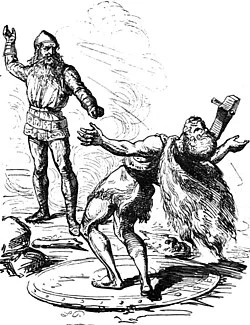
Þjálfi tricks him into standing on his shield to guard against a supposed attack from below. Thor's hammer shatters the thrown whetstone and crushes the giant, while a fragment lodges in Thor's head. Hrungnir's fallen leg traps the god until the young Magni removes it. The story contrasts the giant's solid body with tactical vulnerability, and makes the duel consequential even after his defeat.
Brodeur’s complete chapter makes the dangerous guest’s drinking a prolonged scene. Hrungnir demands the vessels normally used by Thor, threatens to carry Valhall to Jötunheim and destroy Ásgard, and excepts Freyja and Sif from his proposed slaughter because he intends to take them home. Freyja alone dares pour his drink. When Thor arrives, Hrungnir invokes Odin’s invitation and protection, then insists on meeting armed at the border rather than being killed as an unarmed visitor. The giants anticipate wider consequences from the duel because the narrator calls him their strongest champion.
The weapons collide in flight: Thor’s hammer breaks Hrungnir’s thrown whetstone, and one portion is said to account for flint rocks while another becomes lodged in Thor’s head. Mjöllnir itself crushes Hrungnir’s stone skull. The wounded god survives under the dead giant’s foot until Magni lifts it. The chapter continues beyond Hrungnir’s death into Gróa’s unfinished attempt to remove the fragment, then quotes Haustlöng verses describing the painted-shield representation of the conflict. These are distinct prose and poetic presentations within Brodeur’s translation, not independent observations of a stone-bodied creature.
Origins & earliest records
Snorri's early-thirteenth-century Prose Edda is the selected medieval prose witness, with supporting skaldic verse quoted in the same section. This profile uses Anderson's 1901 edition of his 1879 translation. The account's embedded poetry indicates an earlier literary layer, but its exact relation to prior oral performance is not reduced to a single origin date.
Records & interpretation
The source specifies the giant's unusual anatomy and weaponry and narrates their effects in combat. It also connects a sign called Hrungnir's heart with the three-sided heart. Such textual associations support study of mythic imagery; they do not identify archaeological stone shapes as physical remains of a giant or establish a biological kind.
In the literature
“Even his head was of stone.”
Poetical Diction, Thor and Hrungner; printed p. 171 · Rasmus B. Anderson
The stone-headed giant prepares to face Thor.
Selected bibliography
Documented works and useful reading. This is not a list of every appearance.
- 01
The Younger Edda
Poetical Diction: Thor and Hrungner, pp. 169–175. Selected inspected witness; bibliography is not exhaustive.
- 02
Prose Edda: Skáldskaparmál XVII, pp. 115–121
Complete duel, aftermath and attached Haustlöng verses; historical English witness, original Old Norse not independently collated.
- 03
The Younger Edda — Poetical Diction, Thor and Hrungner
Chicago: Scott, Foresman and Company, 1901 selected edition; translation copyright 1879 and preface September 1879 appear in the inspected text. Rasmus B. Anderson’s English translation of the medieval Prose Edda, traditionally associated with Snorri Sturluson. The edition preserves different spelling conventions and has its own chapter and numbered-section sequence.
Family & connections
A source-supported family tree or inspiration record has not yet been compiled for this profile. Related reading below indicates a connection in subject matter, not a proven lineage or creative influence.
Located primary passages
Specific passages supporting details in this entry, grouped by their published witness.
The Younger Edda — Poetical Diction, Thor and Hrungner
Chicago: Scott, Foresman and Company, 1901 selected edition; translation copyright 1879 and preface September 1879 appear in the inspected text. Rasmus B. Anderson’s English translation of the medieval Prose Edda, traditionally associated with Snorri Sturluson. The edition preserves different spelling conventions and has its own chapter and numbered-section sequence.
- Hrungner follows Odin’s Sleipner race into Asgard, becomes drunk and threatens the gods; under Odin’s hospitality protection he challenges Thor to an armed duel.
Poetical Diction, Thor and Hrungner; pp. 169–171; race, feast and challenge
- Hrungner has a stone heart, head and shield. His flint weapon shatters against Mjolner, injuring Thor, but the hammer crushes the giant’s skull and his fallen foot pins Thor.
Poetical Diction, Thor and Hrungner; pp. 171–173; stone body and weapon duel
- Magne removes the foot and receives Goldfax; Groa loosens the stone fragment in Thor’s head but forgets her healing after news of Orvandel, leaving the wound unresolved.
Poetical Diction, Thor and Hrungner; pp. 173–174; Magne’s rescue and Groa’s interrupted healing
Complete selected prose episodes read; quoted poetic extracts inspected but not used to invent earliest dates or a modern standardized taxonomy. Section numbers belong to this 1901 translation and can differ from other editions. Translator’s introductory racial and theological interpretations are not treated as source narrative.
Encyclopedia background
An additional attributed reference, separate from the editorial profile above.
Read the open encyclopedia overview
Hrungnir (Old Norse: [ˈhruŋɡnɪɹ], 'brawler') is a jötunn in Norse mythology. He is described as made of stone and is ultimately killed in a duel with the thunder god Thor.
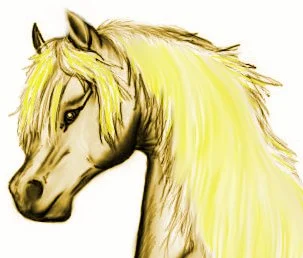
Prior to his demise, Hrungnir engaged in a wager with Odin in which Odin stakes his head on his horse, Sleipnir, being faster than Hrungnir's steed Gullfaxi. During the race, which Sleipnir wins, Hrungnir enters Ásgard, and there becomes drunk and abusive. After they grow weary of him, the gods call on the god Thor to battle Hrungnir. He is slain by Thor's hammer Mjölnir.
Hrungnir is comparable to the Hurrian Ullikummi, a stone-giant who grew so quickly that he reached the heavens. He was slain by the thunder-god Teshub who is equivalent also to the Luwian Tarḫunz and Hittite Tarḫunna.
Text from Wikipedia contributors, “Hrungnir”. CC BY-SA 4.0. Extracted introduction; formatting changed. Retrieved 5 October 2026. The source article may have changed since retrieval.
References
Sources supporting this profile. Linked pages have their own scope and editorial standards.
- Primary textAnderson's Younger Edda: Poetical Diction: Thor and Hrungner, pp. 169–175Research access: 2026-10-05
- Primary historical literary translationBrodeur1916: complete Skáldskaparmál XVIIResearch access: 2026-10-05
Image credits
Historical illustrationHrungnir
Image associated with the exact linked encyclopedia article; consult credited file description for its interpretation.