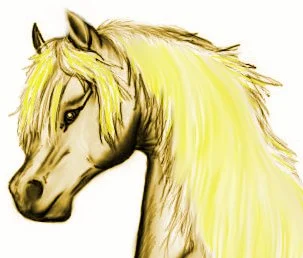
Gullfaxi
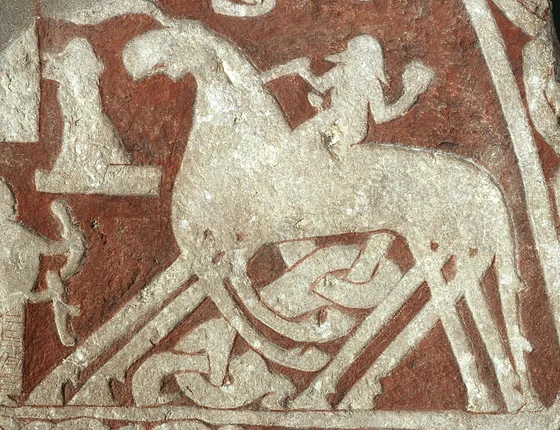
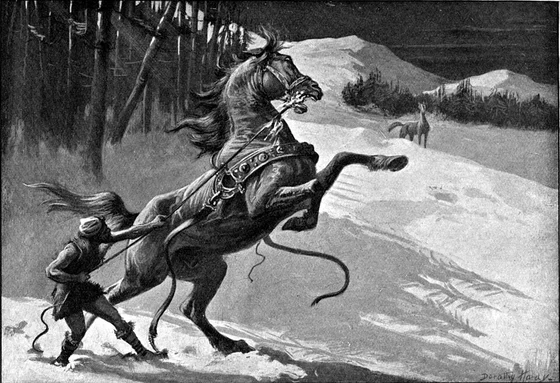
Image associated with the exact linked encyclopedia article; consult credited file description for its interpretation.
Overview
Odin rides Sleipnir into the giant Hrungnir’s territory and praises his horse. Hrungnir replies that his own Gold-Mane has a better pace. Their rivalry draws the giant into pursuit and eventually into the gods’ stronghold, where drinking and boasts lead to a challenge from Thor. Gullfaxi thus carries a hostile visitor across the boundary between the giant’s home and the divine gathering.
After Thor kills Hrungnir, the fallen giant’s foot pins him down. Magni, only three nights old in this account, lifts the foot and receives Gold-Mane as a reward. Odin objects that Thor gave the fine horse to a giantess’s son instead of to him. The story gives the named animal two owners and a consequential gift exchange, while leaving its breeding and later fate undescribed.
The race begins with a wager over horses rather than a formal prize for the winner. Hrungnir admires Odin’s mount but insists that Gold-Mane has the better pace; anger makes him jump onto it and chase Odin. Brodeur’s prose explicitly places Odin first on the next hill. Hrungnir’s arrival inside Ásgard follows his furious pursuit and inattention. Thus the account records both the giant’s claim and a narrated moment favouring Sleipnir, rather than confirming that Gullfaxi is unequivocally the faster horse. The subsequent challenge concerns a duel between Thor and Hrungnir, not another horse race.
The transfer to Magni comes after ordinary helpers fail to free Thor. Thjálfi and then the assembled gods cannot lift the fallen giant’s foot, whereas Thor and Járnsaxa’s three-night-old son throws it aside. Thor welcomes him, predicts greatness and explicitly gives him the horse previously owned by Hrungnir. Odin’s objection is directed at the choice of recipient. The passage does not describe Magni riding Gullfaxi afterwards or assign the horse Sleipnir’s eight legs, airborne movement or a shared parentage.
Origins & earliest records
This profile follows Skáldskaparmál, sections XVII, in Snorri Sturluson’s Prose Edda, composed around 1220 and translated here by Arthur Gilchrist Brodeur in 1916. The work explains poetic language using inherited narratives. Its composition date records a medieval witness, not the beginning of the subject’s oral history.
Records & interpretation
Skáldskaparmál XVII distinguishes Hrungnir’s boast of superior pace, Odin’s lead on the next hill and the later gift of Gold-Mane to Magni. It provides no further race, riding episode or breeding account for the horse.
In the literature
“he had one, called Goldfax, that could take much longer paces;”
The Poetical Diction, “Thor and Hrungner”, paragraph beginning “Brage told Æger…” · Rasmus Björn Anderson
Hrungnir boasts of Gullfaxi’s stride in comparison with Sleipnir.
“I will give you the horse Goldfax, that belonged to Hrungner.”
The Poetical Diction, “Thor and Hrungner”, paragraph beginning “Brage told Æger…” · Rasmus Björn Anderson
Thor rewards his son Magni with Hrungnir’s horse.
Selected bibliography
Documented works and useful reading. This is not a list of every appearance.
- 01
Prose Edda: Skáldskaparmál XVII, pp. 115–121
Complete chapter read through Gróa episode and attached Haustlöng verses; horse race and gift occur in prose pp. 115–118. Original Old Norse not independently collated.
- 02
The Younger Edda
Chicago: Scott, Foresman and Company, 1901; translation copyright 1879, with translator’s preface dated September 1879.
Family, evolution & connections
Sleipnir
In Thor and Hrungner, Odin praises Sleipner and Hrungner claims his own horse Goldfax can take longer strides. The giant rides after Odin and reaches Asgard. This compares two named mounts through a specific contest in the same text. It supplies no kinship, common ancestor or assertion that the horses’ appearances caused one another’s creation.
Located primary passages
Specific passages supporting details in this entry, grouped by their published witness.
Primary source witness
Chicago: Scott, Foresman and Company, 1901; translation copyright 1879, with translator’s preface dated September 1879.
- Hrungnir boasts of Gullfaxi’s stride in comparison with Sleipnir.
The Poetical Diction, “Thor and Hrungner”, paragraph beginning “Brage told Æger…”
- Thor rewards his son Magni with Hrungnir’s horse.
The Poetical Diction, “Thor and Hrungner”, paragraph beginning “Brage told Æger…”
This documents Snorri’s literary account in Anderson’s translation, not zoological existence or a universal account of all Norse traditions.
Primary source witness
Rasmus Björn Anderson translation, Chicago: Scott, Foresman and Company, 1901; translation copyright 1879.
- Odin objects to Thor’s choice to reward Magni with Gullfaxi.
Version-specific detail in the translated literary narrative; not an earliest-attestation or real-fauna claim.
Encyclopedia background
An additional attributed reference, separate from the editorial profile above.
Read the open encyclopedia overview
Gullfaxi (Old Norse: [ˈɡulːˌfɑkse]) is a horse in Norse mythology. Its name means "golden mane".
It was originally owned by Hrungnir, and was later given to Magni by Thor as a reward for lifting off the leg of Hrungnir, which lay over the unconscious Thor and strangled him:
'And I will give thee,' he said, 'the horse Gold-Mane, which Hrungnir possessed.'
Then Odin spake and said that Thor did wrong to give the good horse to the son of a giantess, and not to his father.
—Skáldskaparmál (17)
Gullfaxi is equally fast on land, in the air and on the water, but not quite as fast as Sleipnir, Odin's horse.
Text from Wikipedia contributors, “Gullfaxi”. CC BY-SA 4.0. Extracted introduction; formatting changed. Retrieved 5 October 2026. The source article may have changed since retrieval.
References
Sources supporting this profile. Linked pages have their own scope and editorial standards.
- Primary textThe Prose Edda: Skáldskaparmál XVII (Brodeur translation)Research access: 2026-10-05
Image credits
Reference illustrationGullfaxi
Image associated with the exact linked encyclopedia article; consult credited file description for its interpretation.