Gullinbursti
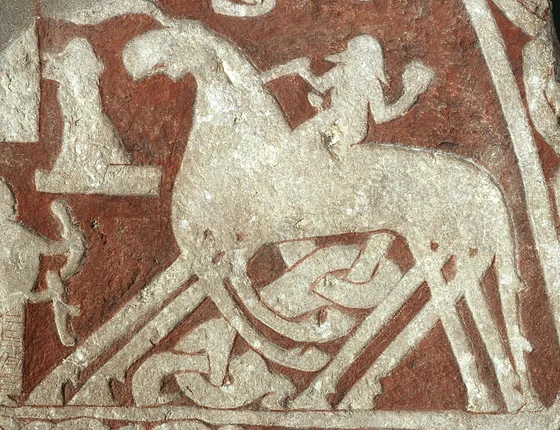
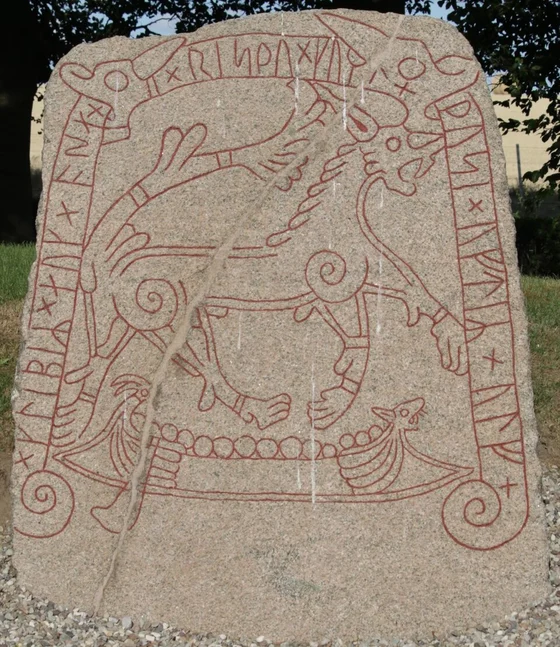
Image associated with the exact linked encyclopedia article; consult credited file description for its interpretation.
Overview
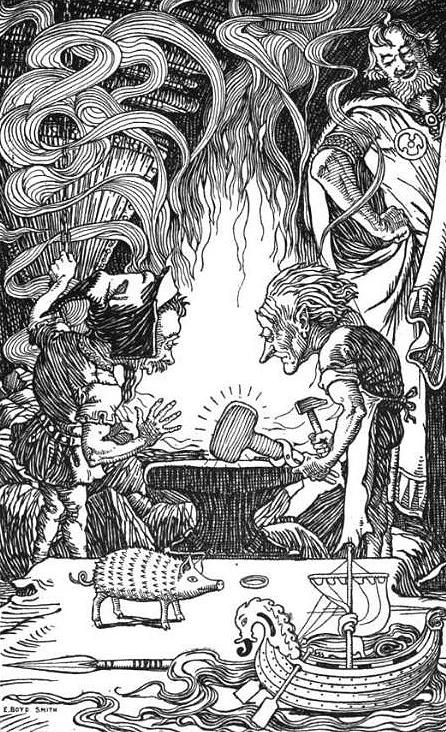
In Snorri’s account of the gods’ treasures, Loki wagers his head that the dwarf Sindri cannot produce gifts equal to those already made by the sons of Ívaldi. Sindri places a pigskin in the furnace while his brother Brokkr works the bellows. A biting fly tries to interrupt the work, but the first object emerges as a boar with golden mane and bristles.
The boar is given to Freyr and can travel through air and water better than a horse. Its shining bristles provide light even in darkness. Gylfaginning also places Freyr’s boar, called Gold-Mane or Fearful-Tusk in Brodeur’s translation, at Baldr’s funeral. These passages connect the animal with divine mobility, light and skilled manufacture; they do not present it as a wild population of golden pigs.
The contest begins with Loki cutting Sif’s hair, which forces him to obtain replacement hair and other treasures from Ívaldi’s sons. His subsequent wager is made with Brokkr over Sindri’s ability to match those works. Brokkr’s uninterrupted bellows work allows the pigskin to emerge as the shining boar despite the first fly bite. The later interruption affects the hammer’s handle, not the already finished animal. At the presentation, Odin, Thor and Freyr judge the competing gifts. The boar’s light and movement are announced with the other treasures’ virtues, but the hammer wins the verdict as the strongest defence against the frost-giants.
The funeral passage gives the boar another setting: Freyr arrives driving a chariot with it, among divine mourners, giants and other named mounts. Brodeur renders the names as Gold-Mane and Fearful-Tusk, while Anderson’s selected 1901 edition prints Gullinburste and Slidrugtanne. This comparison preserves the named ceremonial appearance alongside the forging episode. Neither passage says that the boar is slain on Baldr’s pyre; the separately mentioned horse led to the fire belongs to Baldr.
Origins & earliest records
Snorri Sturluson’s Skáldskaparmál XXXV narrates the forging contest, while Gylfaginning XLIX places Freyr’s boar at Baldr’s funeral. The selected English witnesses are Brodeur’s 1916 translation and Anderson’s 1901 edition, whose translation was first published in 1879. These are two translations of the prose work, not two independently collected oral traditions.
Records & interpretation
Complete forging and judgement episode, plus the selected funeral procession passage, establish different uses of the boar in the same medieval prose work. Naming and translation differences remain visible; Freyr’s animal is distinguished from Baldr’s horse.
In the literature
“That was now a boar, and its bristles were of gold.”
The Poetical Diction, “Loke’s Wager with the Dwarfs”, paragraph beginning “Why is gold called Sif’s hair?” · Rasmus Björn Anderson
The smith produces the golden-bristled boar; its identity is corroborated by the Balder funeral passage naming Gullinburste.
Selected bibliography
Documented works and useful reading. This is not a list of every appearance.
- 01
Prose Edda: Skáldskaparmál, sections XXXV; Gylfaginning XLIX
Selected public-domain prose witness; chapter numbering follows the linked translation. Not an exhaustive bibliography.
- 02
The Younger Edda: “Loke’s Wager with the Dwarfs,” pp. 189–192; “The Death of Balder,” section 51, pp. 133–134
Complete wager chapter compared with Brodeur XXXV; selected funeral passage distinguishes Freyr’s chariot-boar from Baldr’s sacrificed horse.
- 03
The Younger Edda
Chicago: Scott, Foresman and Company, 1901; translation copyright 1879, with translator’s preface dated September 1879.
Family & connections
A source-supported family tree or inspiration record has not yet been compiled for this profile. Related reading below indicates a connection in subject matter, not a proven lineage or creative influence.
Located primary passages
Specific passages supporting details in this entry, grouped by their published witness.
Primary source witness
Chicago: Scott, Foresman and Company, 1901; translation copyright 1879, with translator’s preface dated September 1879.
- The smith produces the golden-bristled boar; its identity is corroborated by the Balder funeral passage naming Gullinburste.
This documents Snorri’s literary account in Anderson’s translation, not zoological existence or a universal account of all Norse traditions.
Primary source witness
Rasmus Björn Anderson translation, Chicago: Scott, Foresman and Company, 1901; translation copyright 1879.
- The golden-bristled boar can run in air and over the sea.
- The boar’s bristles illuminate darkness.
Version-specific detail in the translated literary narrative; not an earliest-attestation or real-fauna claim.
Primary source witness
Rasmus Björn Anderson translation, Chicago: Scott, Foresman and Company, 1901; translation copyright 1879.
- The Balder funeral names the boar drawing Freyr’s chariot, corroborating its identity.
Version-specific detail in the translated literary narrative; not an earliest-attestation or real-fauna claim.
Encyclopedia background
An additional attributed reference, separate from the editorial profile above.
Read the open encyclopedia overview
Gullinbursti (Old Norse, meaning "Gold Mane" or "Golden Bristles") is a boar in Norse mythology.
When Loki had Sif's hair, Freyr's ship Skíðblaðnir, and Odin's spear Gungnir fashioned by the Sons of Ivaldi, he bet his own head with Brokkr that his brother Eitri (Sindri) would not have been able to make items to match the quality of those mentioned above.
So to make gifts to Freyr, Eitri threw a pig's skin into a furnace as Brokkr worked on the bellows, and together they manufactured the boar Gullinbursti which had bristles in its mane that glowed in the dark.
The story of Gullinbursti's creation is related in the Skáldskaparmál section of Snorri Sturluson's Prose Edda.
According to Húsdrápa, Freyr rode Gullinbursti to Baldr's funeral, while in Gylfaginning, Snorri states that Freyr rode to the funeral in a chariot pulled by the boar.
The boar is also known as Slíðrugtanni (Old Norse: meaning "Sharp Tooth" or "Fearsome Tooth") (sometimes anglicized to "Slidrugtanni").
The cult of Freyr and Gullinbursti also existed in the British Isles. Accounts have been preserved describing Scottish Christmas celebrations in the 8th–11th centuries. On the eve of the feast, all the men of a kin group gathered at a long table headed by their chieftain. The principal ritual dish of the banquet was a boar’s head, a practice associated with the veneration of Freyr. It was placed on a large platter and ceremonially carried into the hall where the festivities were held. The privilege of carving the head was reserved for the most respected guests. After the meal, the men left the house carrying torches and lit a ritual bonfire, after which they joined hands and formed a circle. Accompanied by the sound of bagpipes, they performed a dance whose rhythm gradually intensified and became increasingly frenzied. In a state of ecstatic excitement, the dancers cried out: “Haile, Yule, Haile” and “Thor is with us!”. Once the fire had burned out, the participants returned to the hall and continued the feast.
Text from Wikipedia contributors, “Gullinbursti”. CC BY-SA 4.0. Extracted introduction; formatting changed. Retrieved 5 October 2026. The source article may have changed since retrieval.
References
Sources supporting this profile. Linked pages have their own scope and editorial standards.
- Primary textThe Prose Edda: Skáldskaparmál XXXV; Gylfaginning XLIX (Brodeur translation)Research access: 2026-10-05
- Primary textGylfaginning XLIX: Freyr’s Gold-Mane at Baldr’s funeralResearch access: 2026-10-05
- Primary text in historical translationAnderson’s Younger Edda (1901 edition)Research access: 2026-10-05
Image credits
Reference illustrationGullinbursti
Image associated with the exact linked encyclopedia article; consult credited file description for its interpretation.