A sourced illustration has not yet been added. This gap is included in the coverage record.
Overview
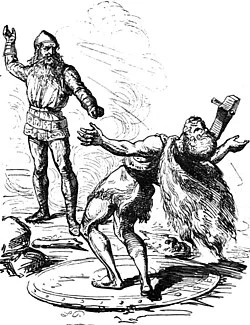
The giants fear the consequences if Hrungnir loses his challenge to Thor, so they construct a huge man of clay at the appointed battlefield. Anderson's rendering gives its dimensions as nine rasts tall and three rasts broad beneath the arms, retaining the older distance unit without assigning a precise modern height. Unable to find a suitable heart, the makers use one from a mare.
When Thor approaches, that heart trembles and the clay figure becomes overwhelmingly afraid. He stands beside Hrungnir, but Þjálfi attacks him while Thor faces the stone-headed opponent. The account disposes of Mökkurkálfi's defeat briefly and contemptuously. His exceptional scale therefore does not imply invulnerability. The artificial body and borrowed animal heart belong to this specific attempted reinforcement, rather than a general Norse recipe or an established population of clay giants.
Origins & earliest records
The selected account occurs in the Prose Edda's Hrungnir episode, compiled in the early thirteenth century. Anderson's 1901 edition is the inspected English witness, following his 1879 translation. The prose identifies the artificial figure by name, but this entry does not claim independent earlier attestation or mistake a modern translated measurement for an exact original height.
Records & interpretation
The clay body, borrowed heart and battlefield defeat are explicit features of a medieval literary episode. They establish an artificial monster within the story and a contrast between outward magnitude and fear. They do not provide evidence of an excavated automaton, an actual gigantic animal organ or practical techniques for creating life from clay.
In the literature
“a man of clay”
Poetical Diction, Thor and Hrungner; printed p. 171 · Rasmus B. Anderson
The giants construct a clay ally for the duel.
Selected bibliography
Documented works and useful reading. This is not a list of every appearance.
- 01
The Younger Edda
Poetical Diction: Thor and Hrungner, pp. 171–173. Selected inspected witness; bibliography is not exhaustive.
- 02
The Younger Edda — Poetical Diction, Thor and Hrungner
Chicago: Scott, Foresman and Company, 1901 selected edition; translation copyright 1879 and preface September 1879 appear in the inspected text. Rasmus B. Anderson’s English translation of the medieval Prose Edda, traditionally associated with Snorri Sturluson. The edition preserves different spelling conventions and has its own chapter and numbered-section sequence.
Family & connections
A source-supported family tree or inspiration record has not yet been compiled for this profile. Related reading below indicates a connection in subject matter, not a proven lineage or creative influence.
Located primary passages
Specific passages supporting details in this entry, grouped by their published witness.
The Younger Edda — Poetical Diction, Thor and Hrungner
Chicago: Scott, Foresman and Company, 1901 selected edition; translation copyright 1879 and preface September 1879 appear in the inspected text. Rasmus B. Anderson’s English translation of the medieval Prose Edda, traditionally associated with Snorri Sturluson. The edition preserves different spelling conventions and has its own chapter and numbered-section sequence.
- The giants build a huge clay man at Grjottungard and place a mare’s heart inside him because no suitable heart can be found; the named Mokkerkalfe trembles before Thor.
Poetical Diction, Thor and Hrungner; pp. 171–172; construction and fear
- Mokkerkalfe stands beside Hrungner but is defeated by Thjalfe while Thor fights the stone giant; the short statement gives the clay ally little honour.
Poetical Diction, Thor and Hrungner; pp. 172–173; duel and defeat
Complete selected prose episodes read; quoted poetic extracts inspected but not used to invent earliest dates or a modern standardized taxonomy. Section numbers belong to this 1901 translation and can differ from other editions. Translator’s introductory racial and theological interpretations are not treated as source narrative.
Encyclopedia background
An additional attributed reference, separate from the editorial profile above.
Read the open encyclopedia overview
Hrungnir (Old Norse: [ˈhruŋɡnɪɹ], 'brawler') is a jötunn in Norse mythology. He is described as made of stone and is ultimately killed in a duel with the thunder god Thor.
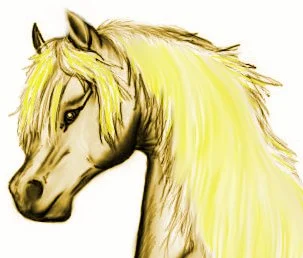
Prior to his demise, Hrungnir engaged in a wager with Odin in which Odin stakes his head on his horse, Sleipnir, being faster than Hrungnir's steed Gullfaxi. During the race, which Sleipnir wins, Hrungnir enters Ásgard, and there becomes drunk and abusive. After they grow weary of him, the gods call on the god Thor to battle Hrungnir. He is slain by Thor's hammer Mjölnir.
Hrungnir is comparable to the Hurrian Ullikummi, a stone-giant who grew so quickly that he reached the heavens. He was slain by the thunder-god Teshub who is equivalent also to the Luwian Tarḫunz and Hittite Tarḫunna.
Text from Wikipedia contributors, “Hrungnir”. CC BY-SA 4.0. Extracted introduction; formatting changed. Retrieved 5 October 2026. The source article may have changed since retrieval.
References
Sources supporting this profile. Linked pages have their own scope and editorial standards.
- Primary textAnderson's Younger Edda: Poetical Diction: Thor and Hrungner, pp. 171–173Research access: 2026-10-05
Image credits
A sourced illustration has not yet been added. This gap is included in the coverage record.