Iron Hans
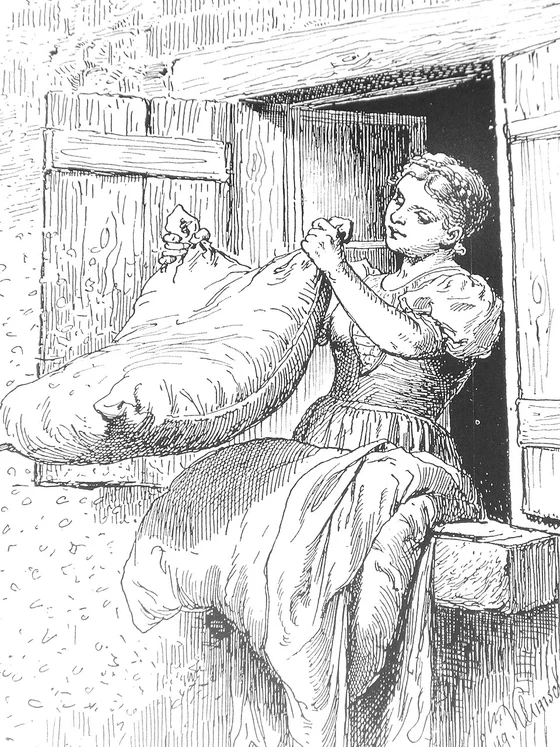
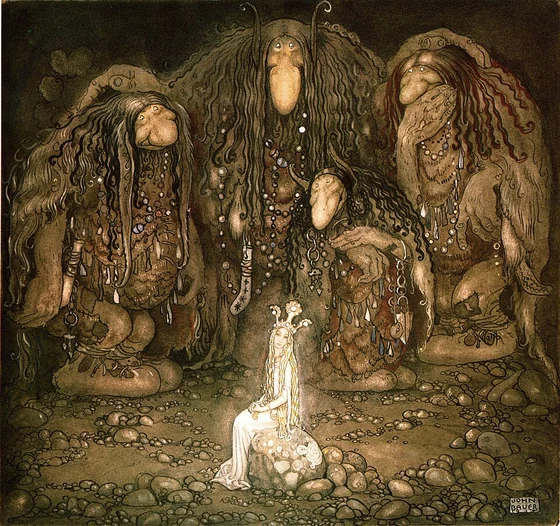
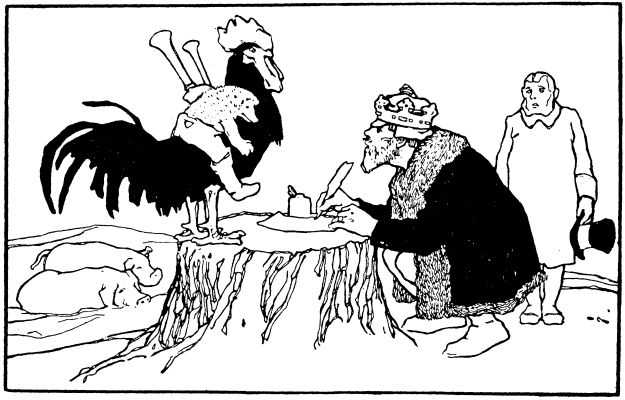
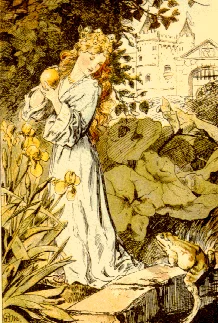
Image associated with the exact linked encyclopedia article; consult credited file description for its interpretation.
Overview
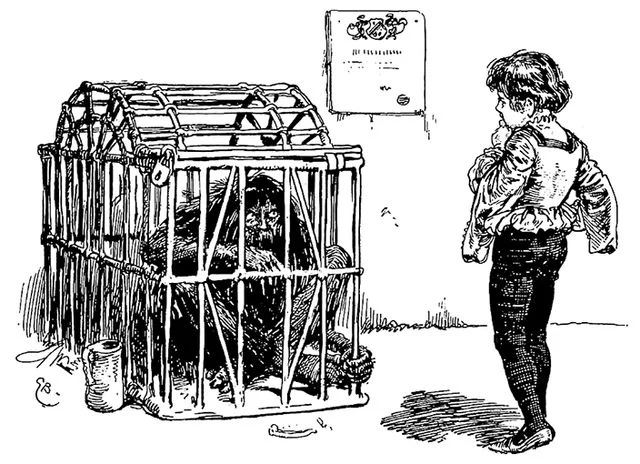
Iron Hans appears as Iron John in Hunt’s Grimm tale 136. A king’s forest becomes dangerous after huntsmen and hounds disappear. A visiting huntsman sees an arm rise from a pool and drag his dog beneath the water. With three men and buckets he drains the pool and finds a wild man whose body is compared to rusty iron, with hair covering his face and hanging to his knees. This describes colour and appearance: his body is not said to be manufactured from metal. The captured man is placed in an iron cage at the royal court.
The king’s eight-year-old son loses a golden ball inside the cage. After repeated visits, the boy follows the captive’s instruction to take the key from beneath his mother’s pillow. He frees the wild man, hurts his finger while opening the door and receives the ball. Fearing punishment, the boy asks to go with him. Iron John carries him into the forest and gives him the task of keeping a golden well uncontaminated.
Over three days, the boy first dips his injured finger, then loses a hair into the water, and finally lets his hair fall into it while looking at his reflection. Each contact turns what touches the water to gold. Iron John knows that the task has been broken and sends him out into the world, but promises assistance if called. The youth works first in a royal kitchen and then for a gardener, hiding his golden hair under a cap. The princess notices its shine; when she gives him coins for flowers, he passes the money to the gardener’s children.
During a war, Iron John supplies a powerful horse and a troop of soldiers equipped in iron armour. The boy wins the battle and returns the borrowed resources before resuming his obscure position. At a subsequent three-day festival, he appears in red armour on a chestnut horse, then in white on a white horse, and finally in black on a black horse. Each day he catches the princess’s golden apple. On the last day a pursuing knight wounds his leg, and his helmet falls, exposing the hair that helps identify him.
The apples and wound establish his identity, and he marries the princess. His parents attend the celebration. A splendid king then arrives and reveals that he is Iron John, released from the wild-man enchantment through the youth’s actions, and gives him his treasures. The selected tale does not name the enchanter or explain a wider race of iron beings. Its disappearance story, dangerous captive, demanding guardian and generous royal helper are stages in one individual’s narrative, not interchangeable descriptions of all forest wild men.
Origins & earliest records
This entry follows tale 136 in the Grimm brothers’ Household Tales, using Margaret Hunt’s 1884 English translation. The collection was repeatedly revised during the nineteenth century and mediates material from storytellers and earlier literature. Its publication and translation dates identify the selected witness, not the beginning of every related oral narrative.
Records & interpretation
Complete tale 136 in Margaret Hunt’s Grimm translation read from opening through ending. The passage supplies this narrative’s events and relationships, not observational evidence for a biological species. Rust-like appearance is distinguished from the iron cage and soldiers’ armour. The final king is the freed wild man; no unnamed enchanter, forest deity or metal species is supplied.
In the literature
“I am Iron John, and was by enchantment a wild man,”
Tale 136 Iron John; paragraph beginning “The King had him summoned into his presence, and he came and…” · Margaret Hunt
The restored king explains Iron John’s wild-man form at the marriage feast.
Selected bibliography
Documented works and useful reading. This is not a list of every appearance.
- 01
Household Tales, tale 136: Iron John
Complete selected English tale read, including the ending and transformation sequence. The translation is a located literary witness, not a claim to the first oral telling.
- 02
Household Tales: 136 Iron John
Margaret Hunt’s English translation, London: George Bell and Sons, 1884; Gutenberg e-text identifies Hunt. Translation date corroborated by the Wikisource scanned title page and National Library of New Zealand catalogue.
Family, evolution & connections
Golden Bird’s Fox
In Hunt’s Iron John, the wild helper appears at the wedding as a stately king and says the youth freed him from enchantment. The Golden Bird’s fox finally becomes the princess’s brother. Both endings reveal human identities behind earlier helpers, but neither makes the two figures relatives or establishes transmission between the stories.
Located primary passages
Specific passages supporting details in this entry, grouped by their published witness.
Household Tales, tale 136: Iron John
Margaret Hunt’s English translation, London: George Bell and Sons, 1884; Gutenberg e-text identifies Hunt. Translation date corroborated by the Wikisource scanned title page and National Library of New Zealand catalogue.
- The restored king explains Iron John’s wild-man form at the marriage feast.
- Iron John is found beneath the pool with an iron-colored body and long hair.
- The golden well changes the prince’s hair after he lets it touch the water.
Tale 136 Iron John; paragraph beginning “On the third day, the boy sat by the well, and did…”
This describes the version printed in Hunt’s translation; German tale origin and other versions require separate evidence.
Encyclopedia background
An additional attributed reference, separate from the editorial profile above.
Read the open encyclopedia overview
"Iron John" (also "Iron Hans"; German: Der Eisenhans) is a German fairy tale found in the collections of the Brothers Grimm, tale number 136, about an iron-skinned wild man and a prince. The original German title is Eisenhans, a compound of Eisen "iron" and Hans (like English John, a common short form of the personal name Johannes). It represents Aarne–Thompson type 502, "The wild man as a helper".
Most people see the story as a parable about a boy maturing into adulthood. The story also became the basis for the book Iron John: A Book About Men by Robert Bly which spawned the mythopoetic men's movement in the early 1990s. The book spent 62 weeks on The New York Times Best Seller list.
Text from Wikipedia contributors, “Iron John”. CC BY-SA 4.0. Extracted introduction; formatting changed. Retrieved 5 October 2026. The source article may have changed since retrieval.
References
Sources supporting this profile. Linked pages have their own scope and editorial standards.
- Primary textGrimm/Hunt, complete tale 136Research access: 2026-10-05
Image credits
Reference illustrationIron Hans
Image associated with the exact linked encyclopedia article; consult credited file description for its interpretation.