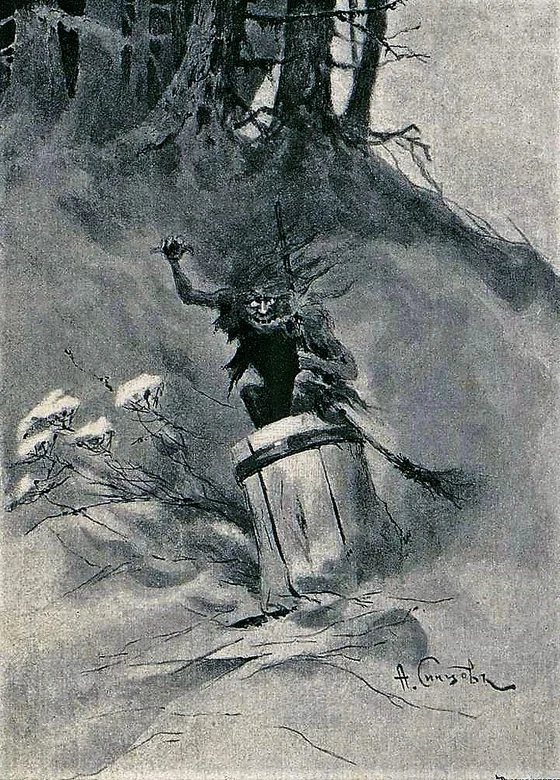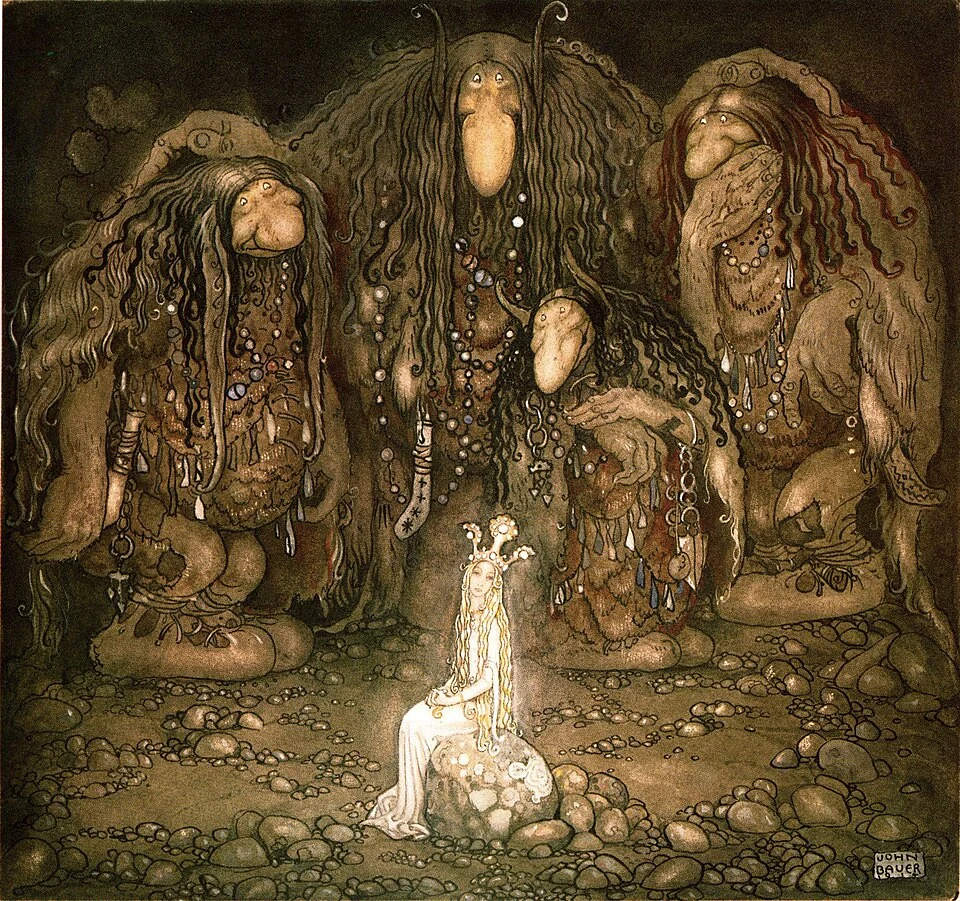
Troll
Image associated with the exact linked encyclopedia article; consult credited file description for its interpretation.
Overview
Norwegian collected tales give trolls different homes, appetites and weaknesses. In The Three Billy-Goats Gruff, a troll occupies the space below a bridge and threatens each goat crossing it. His eyes are compared to saucers and his nose to a poker. The smaller goats persuade him to wait for a larger meal; the largest wounds him with its horns and throws his crushed body into the stream. The episode turns a journey towards better pasture into a contest between hunger and strength. In Boots Who Ate a Match with the Troll, the danger is initially territorial: a sturdy troll claims a wood and threatens anyone cutting its trees. Boots frightens him by squeezing whey from cheese and pretending it is water from a stone. The troll becomes a powerful helper, and invites the boy home. His enormous water pails expose another difference in strength, but Boots again solves the problem through a claim the troll takes literally. They cook porridge and compete at eating, while Boots secretly fills his bag. The troll's attempt to copy the boy's apparent method of making more room proves fatal.
These episodes should not be compressed into a single biological template. The troll at the bridge and the troll who keeps a house and treasure have different narrative settings. East o' the Sun and West o' the Moon gives the antagonists a household and a marriage plan; their inability to wash a stained shirt becomes decisive, whereas the human heroine succeeds. In Lord Peter, a clever cat delays a troll with a long account of farming, then induces him to look towards the rising sun; that particular troll bursts. Dasent's introductory essay generalises from such episodes, but his broad theory of ancient natural powers is a nineteenth-century interpretation. The individual tales provide firmer evidence for particular bodies and behaviours. Their recurring contrast is often practical intelligence against superior force, though the collection also preserves powerful adversaries and human beings who need help from other creatures.
Origins & earliest records
Asbjørnsen and Moe's Norwegian collections and Dasent's English Popular Tales from the Norse shaped the selected international witnesses. The English translation first appeared in 1859; the inspected electronic text includes a notice to a second edition without a complete dated title page. These editions do not establish the oral tradition's origin.
Records & interpretation
The individual tales directly document a bridge-dweller, a territorial wood-owner, a household of antagonists and a sun-vulnerable troll. These are distinct literary witnesses rather than measured members of one animal species. Dasent's introductory mythological theory is explicitly separate from the narratives; no zoological specimens or fixed universal anatomy are supplied.
In the literature
“The first night there came a Troll with three heads and three rods”
THE THREE PRINCESSES OF WHITELAND; paragraph beginning “Yes, he did as the Princess told him; he…” · George Webbe Dasent
An ordeal in “The Three Princesses of Whiteland”; this head count is tale-specific.
“here dwells a Troll with three heads who owns this wood.”
KATIE WOODENCLOAK; paragraph beginning ““Now, when we get into this wood, mind you…” · George Webbe Dasent
The bull warns Katie about a territorial troll in “Katie Woodencloak”.
Selected bibliography
Documented works and useful reading. This is not a list of every appearance.
- 01
Popular Tales from the Norse
Tales IV, V, XXXVII and XLII: East o' the Sun and West o' the Moon; Boots Who Ate a Match with the Troll; Three Billy-Goats Gruff; Lord Peter. Introduction distinguished as translator's interpretation.
Family & connections
A source-supported family tree or inspiration record has not yet been compiled for this profile. Related reading below indicates a connection in subject matter, not a proven lineage or creative influence.
Located primary passages
Specific passages supporting details in this entry, grouped by their published witness.
Popular Tales from the Norse
English collection first published 1859; hosted text includes prefatory material for a second edition.
- An ordeal in “The Three Princesses of Whiteland”; this head count is tale-specific.
THE THREE PRINCESSES OF WHITELAND; paragraph beginning “Yes, he did as the Princess told him; he…”
- The bull warns Katie about a territorial troll in “Katie Woodencloak”.
KATIE WOODENCLOAK; paragraph beginning ““Now, when we get into this wood, mind you…”
Attests this published account; does not establish zoological existence, consensus belief or earliest origin.
Encyclopedia background
An additional attributed reference, separate from the editorial profile above.
Read the open encyclopedia overview
A troll is a being in Nordic folklore, including Norse mythology. In Old Norse sources, beings described as trolls dwell in isolated areas of rocks, mountains, or caves, live together in small family units, and are rarely helpful to human beings.
In later Scandinavian folklore, trolls became beings in their own right, where they live far from human habitation, are not Christianized, and are considered dangerous to human beings. Depending on the source, their appearance varies greatly; trolls may be ugly and slow-witted, or look and behave exactly like human beings, with no particularly grotesque characteristic about them.
In Scandinavian folklore, trolls are sometimes associated with particular landmarks (sometimes said to have been formed by a troll having been exposed to sunlight). Trolls are depicted in a variety of media in modern popular culture.
Text from Wikipedia contributors, “Troll”. CC BY-SA 4.0. Extracted introduction; formatting changed. Retrieved 5 October 2026. The source article may have changed since retrieval.
References
Sources supporting this profile. Linked pages have their own scope and editorial standards.
- Primary textPopular Tales from the NorseResearch access: 2026-10-05
- Primary passagePopular Tales from the Norse, The Three Billy-Goats GruffResearch access: 2026-10-05
Image credits
Reference illustrationTroll
Image associated with the exact linked encyclopedia article; consult credited file description for its interpretation.