Golden Bird’s Fox
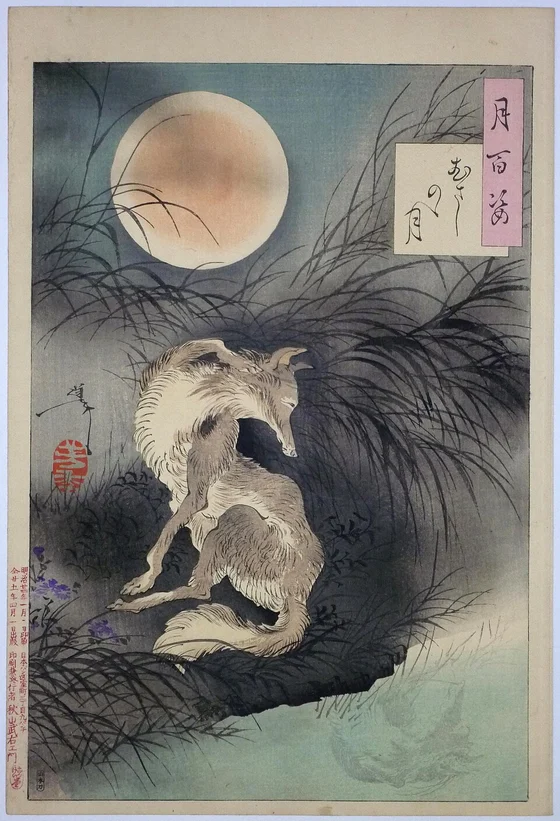
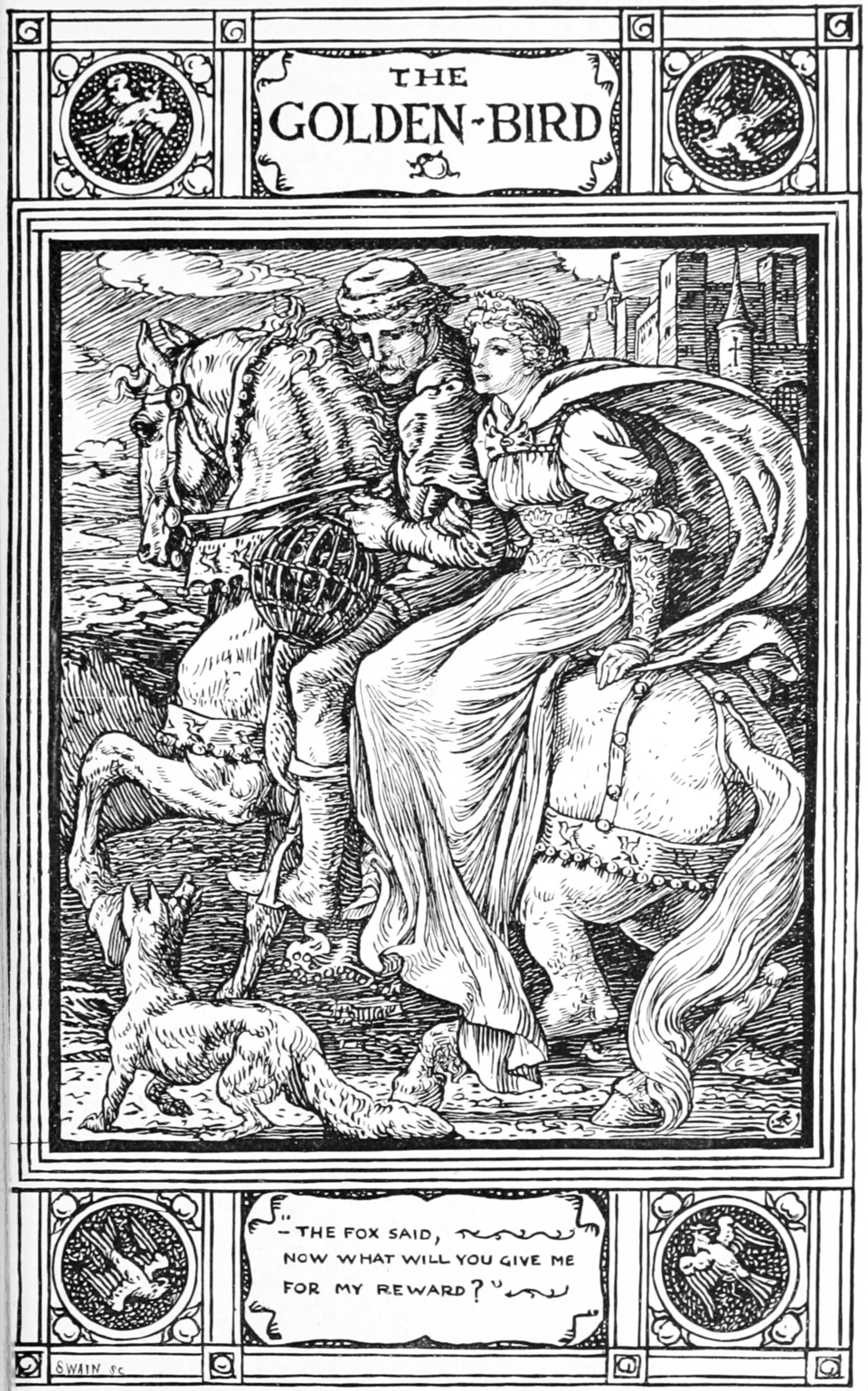
Image associated with the exact linked encyclopedia article; consult credited file description for its interpretation.
Overview
The fox offers guidance after the prince spares him and provides extraordinary travel by carrying the young man on his tail. His warnings distinguish plain cages and saddles from tempting golden objects. Each ignored instruction creates another task, yet the fox continues to solve difficulties, including moving an obstructing mountain and recovering the prince after his brothers throw him into a well. A related Irish telling in Jacobs’s More Celtic Fairy Tales, The Greek Princess and the Young Gardener, gives a separately situated fox helper. Its body resists an arrow as if made of hammered iron, and it offers guidance even to the elder brothers who refuse its request for food. The youngest shares his meal, then rides the fox’s outspread tail on journeys that overtake the wind. The fox also puts palace guards to sleep and removes a heap of clay which grows by two shovelfuls whenever the boy removes one.
The helper finally asks to be shot and have his head and feet removed. The prince initially refuses out of gratitude, but later performs the requested act and releases the princess’s enchanted brother from fox form. This story-specific transformation gives the animal a concealed human relationship. It remains distinct from general fox-trickster traditions, where deception may serve a very different narrative purpose. Jacobs’s adaptation has a different release scene: the helper asks for removal of his head and tail, rather than Hunt’s head and feet. The grateful youngest cannot bring himself to act, so the eldest brother performs the blows. The transformed young man is again the rescued princess’s brother, but the later tale omits the brothers’ murderous well plot and gives this eldest brother a constructive part in the restoration. Its source note identifies Kennedy’s Fireside Stories, pp. 47–56, and compares Campbell’s Mac Iain Direach. The common helper structure is therefore recorded alongside differences in action and outcome, without treating the two English texts as interchangeable transcripts.
Origins & earliest records
This entry follows tale 57 in the Grimm brothers’ Household Tales, using Margaret Hunt’s 1884 English translation. The collection was repeatedly revised during the nineteenth century and mediates material from storytellers and earlier literature. Its publication and translation dates identify the selected witness, not the beginning of every related oral narrative.
Records & interpretation
The numbered tale supplies the being’s appearance, speech and actions in a collected literary narrative. It documents storytelling and editorial transmission, rather than biological existence or actual animal behaviour. Different editions and related oral tales may alter transformations, endings or motives; the selected passage is identified so those differences can be compared.
In the literature
“the Fox was changed into a man,”
Tale 57 The Golden Bird; paragraph beginning “But how did it fare with the poor Fox? Long afterwards the…” · Margaret Hunt
The fox’s requested beheading releases him from enchantment and reveals the princess’s brother.
Selected bibliography
Documented works and useful reading. This is not a list of every appearance.
- 01
Household Tales, tale 57: The Golden Bird
Specific public-domain collected tale inspected. The selected English edition is a literary witness, not a transcript of a universal oral version.
- 02
More Celtic Fairy Tales: The Greek Princess and the Young Gardener, pp. 110–124; note XXXVII
Related fox-helper episode inspected in full; the adaptation credits Kennedy and compares Campbell. Head-and-tail release by the elder brother differs from Hunt's Grimm telling.
- 03
Household Tales: 57 The Golden Bird
Margaret Hunt’s English translation, London: George Bell and Sons, 1884; Gutenberg e-text identifies Hunt. Translation date corroborated by the Wikisource scanned title page and National Library of New Zealand catalogue.
Family, evolution & connections
Princess of the Golden Castle
At the end of Hunt’s Golden Bird, the fox is released from an enchantment and identified as the brother of the princess whom the youngest prince has married. That late revelation supplies an explicit sibling relationship. Earlier animal assistance is consequently performed by an enchanted human, rather than by an unnamed biological fox species.
Six Swan Brothers
The Golden Bird eventually identifies its fox helper as the princess’s enchanted brother. Six Swans identifies six transformed princes from the outset and centers their sister’s labor to restore them. These tales both maintain human sibling identities through animal bodies, but their rescue conditions and the timing of the revelation differ; no common natural ancestry is implied.
Located primary passages
Specific passages supporting details in this entry, grouped by their published witness.
Household Tales, tale 57: The Golden Bird
Margaret Hunt’s English translation, London: George Bell and Sons, 1884; Gutenberg e-text identifies Hunt. Translation date corroborated by the Wikisource scanned title page and National Library of New Zealand catalogue.
- The fox’s requested beheading releases him from enchantment and reveals the princess’s brother.
- The fox carries the youngest prince on his tail.
- The fox requests a violent action that will eventually release his enchantment.
This describes the version printed in Hunt’s translation; German tale origin and other versions require separate evidence.
References
Sources supporting this profile. Linked pages have their own scope and editorial standards.
- Primary textGrimm/Hunt, Household Tales, tale 57Research access: 2026-10-05
- Primary textMore Celtic Fairy Tales, selected 1895 edition: The Greek Princess and the Young Gardener and note XXXVIIResearch access: 2026-10-05
Image credits
Reference illustrationGolden Bird’s Fox
Image associated with the exact linked encyclopedia article; consult credited file description for its interpretation.