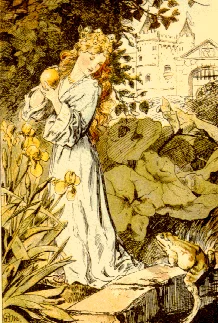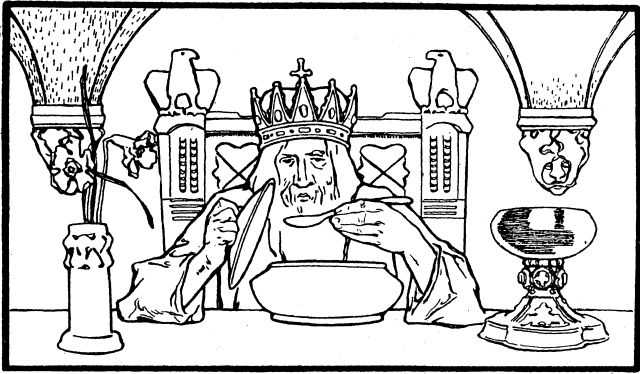
The White Snake, historical tale illustration by Otto Ubbelohde
Historical illustration to the exact Grimm tale by Otto Ubbelohde; the king at his table with a covered dish. The snake itself is not exposed in this episode, so this is tale context rather than a visible creature depiction.
Overview
The white snake in Grimm tale 17 is first seen as food on a covered dish. A king renowned for knowing hidden things has it brought after dinner and eats alone. His trusted servant secretly opens the dish and tastes a small piece. Immediately the sparrows outside become intelligible to him. The tale explicitly identifies eating the snake as the cause of his understanding animal language; it does not make the snake itself a speaking adviser or give it a personal history.
The new ability saves him when he is accused of stealing the queen’s ring. Listening to ducks in the courtyard, he hears one complain that she swallowed a ring beneath the queen’s window. He takes that duck to the cook to be killed, and the ring is recovered while it is prepared for roasting. This first use of the gift is not a rescue of the animal. Cleared of suspicion, the servant chooses a horse and travel money instead of a court position.
On the journey he saves three fish trapped in reeds, takes another path to prevent his horse from trampling the ant-king’s people, and hears three young ravens lament after their parents drive them from the nest before they can fly. He kills his horse to feed the ravens and continues on foot. The account therefore includes both protection and the death of an animal; describing the hero as saving every creature would conceal part of the story.
The grateful helpers later meet three demands associated with winning a princess. The fish recover a ring thrown into the sea, delivering it inside a mussel shell. The ants gather ten sacks of scattered millet before sunrise. The grown ravens fetch a golden apple from the Tree of Life beyond the sea at the end of the world. After the youth and princess share the apple, her resistance becomes love and they live together happily to old age.
The snake’s brief appearance enables the chain of understanding, intervention and repayment. No second snake is identified as its relative, and its white colour is not matched to a zoological species or a diagnosed pigmentation condition. The located tale supports a magical food motif and specific animal helpers, rather than a universal claim that eating snakes grants knowledge.
Origins & earliest records
This entry follows tale 17 in the Grimm brothers’ Household Tales, using Margaret Hunt’s 1884 English translation. The collection was repeatedly revised during the nineteenth century and mediates material from storytellers and earlier literature. Its publication and translation dates identify the selected witness, not the beginning of every related oral narrative.
Records & interpretation
Complete Grimm tale 17 in Hunt’s translation read, including its ending. The textual evidence supports these particular narrative actions; animal speech, knowledge and extraordinary bodily events are not presented as zoological observations.
In the literature
“Eating the snake had given him power of understanding the language of animals.”
Tale 17 The White Snake; paragraph beginning “This had gone on for a long time, when one day the…” · Margaret Hunt
Tasting the white snake lets the servant understand animals.
Selected bibliography
Documented works and useful reading. This is not a list of every appearance.
- 01
Household Tales, tale 17: The White Snake
Complete selected tale read from opening through ending. This English witness is distinguished from other editions and related oral narratives.
- 02
Household Tales: 17 The White Snake
Margaret Hunt’s English translation, London: George Bell and Sons, 1884; Gutenberg e-text identifies Hunt. Translation date corroborated by the Wikisource scanned title page and National Library of New Zealand catalogue.
Family, evolution & connections
Golden Bird’s Fox
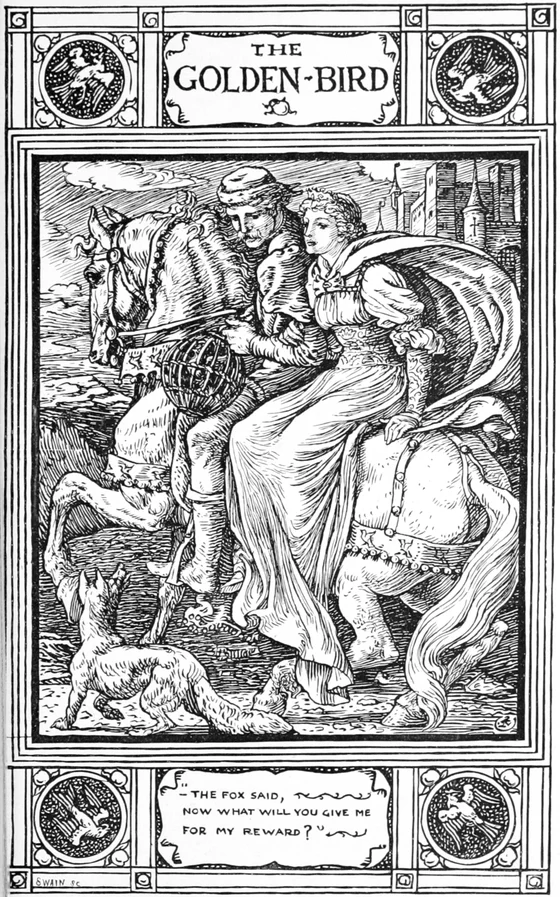
The White Snake makes animal speech intelligible after a servant tastes the hidden dish, enabling reciprocal assistance from creatures he helps. The Golden Bird’s fox speaks directly to the princes without a comparable acquired skill. Both narratives use animal advice, but the snake supplies a capacity rather than personally acting as an advising helper.
Giant Who Had No Heart in His Body
Hunt’s White Snake servant saves fish and feeds young ravens, who later retrieve a ring and life-tree apple. Dasent’s Boots helps a salmon and raven, who retrieve the giant’s egg and church keys. The roles and objects differ; reciprocal animal help is a comparison, not demonstrated borrowing.
Located primary passages
Specific passages supporting details in this entry, grouped by their published witness.
Household Tales, tale 17: The White Snake
Margaret Hunt’s English translation, London: George Bell and Sons, 1884; Gutenberg e-text identifies Hunt. Translation date corroborated by the Wikisource scanned title page and National Library of New Zealand catalogue.
- Tasting the white snake lets the servant understand animals.
Tale 17 The White Snake; paragraph beginning “This had gone on for a long time, when one day the…”
- Rescued ravens bring the servant a golden apple in repayment.
This describes the version printed in Hunt’s translation; German tale origin and other versions require separate evidence.
References
Sources supporting this profile. Linked pages have their own scope and editorial standards.
- Primary textGrimm/Hunt, complete tale 17Research access: 2026-10-05
Image credits
Thematic illustrationThe White Snake, historical tale illustration by Otto Ubbelohde
Historical illustration to the exact Grimm tale by Otto Ubbelohde; the king at his table with a covered dish. The snake itself is not exposed in this episode, so this is tale context rather than a visible creature depiction.