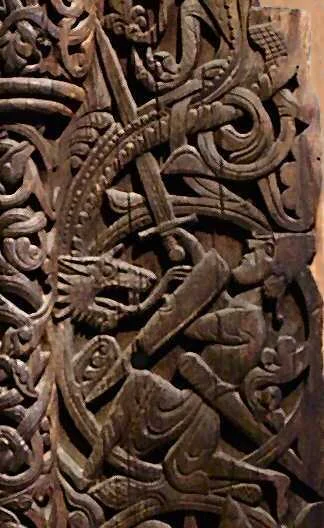
Fáfnir
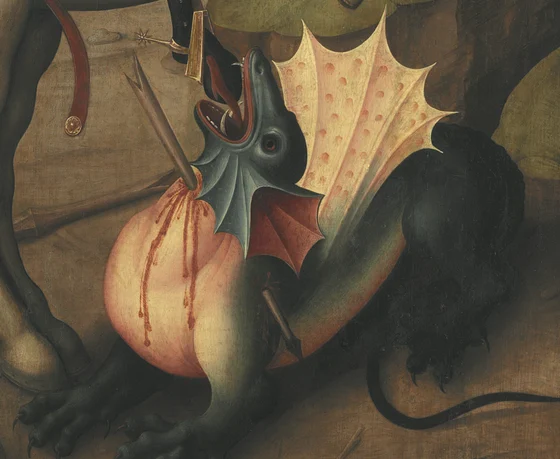
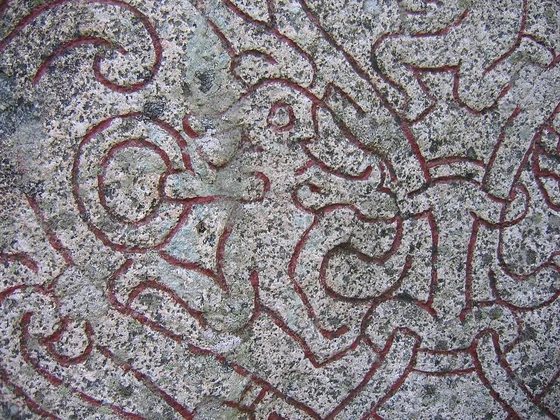
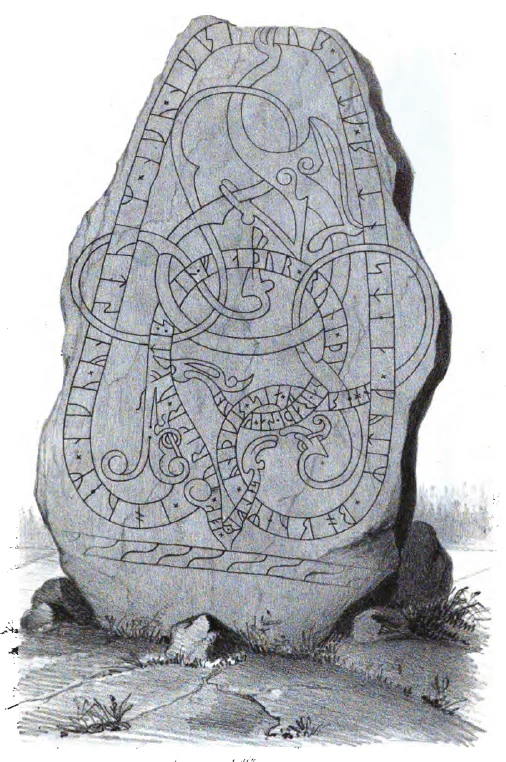
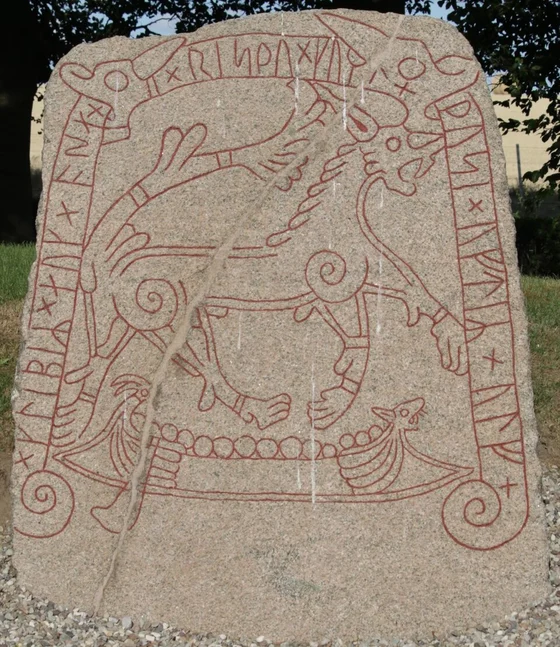
Image associated with the exact linked encyclopedia article; consult credited file description for its interpretation.
Overview
Fáfnir’s monstrous form emerges from a family dispute rather than from an account of a separate dragon species. After the gods pay compensation for an otter’s death, Fáfnir and Reginn kill their father Hreiðmarr for the treasure. Fáfnir takes possession and withdraws to Gnita Heath, where he becomes a serpent and guards the gold. The Helm of Terror belongs to this fearful possession of the hoard.
Reginn equips Sigurðr with the sword Gramr and directs him against his brother. Sigurðr strikes upward from a pit beneath Fáfnir’s route to water. While roasting the heart, he tastes its juice and understands birds warning that Reginn plans betrayal. The narrative therefore connects the serpent’s defeat with dangerous knowledge and a continuing curse; obtaining the gold does not end its consequences.
Völsunga saga supplies a more extended death scene than Skáldskaparmál’s compact account. In chapter XIV, Regin tells Sigurd that Fafnir alone murdered Hreidmar, contrasting with the Edda passage’s initial description of both brothers plotting their father’s death. Regin also calls Fafnir an ordinary-sized lingworm while urging the attack. Chapter XVIII exposes that minimisation: Sigurd finds an immense track, and the narrator reports a thirty-fathom cliff beside the creature’s drinking place. A visiting old man advises extra pits to drain the blood, correcting Regin’s hazardous instructions.
As Fafnir approaches, the earth shakes and venom spreads before him. Sigurd strikes beneath the left shoulder; the wounded serpent lashes his head and tail, breaking surrounding objects. He then questions Sigurd about his name, ancestry and motive. Sigurd first conceals his identity and later acknowledges it. Fafnir discusses the Norns, warns that the treasure will destroy its owner, and identifies Regin’s manipulation. He also boasts of the terrifying appearance and poison that formerly kept every challenger away. The conversation ends with Sigurd refusing to abandon the wealth and Fafnir dying.
Chapter XIX continues beyond the death. Heart-blood enables Sigurd to understand birds warning of Regin’s betrayal, and he kills the smith. The translators identify their inserted bird songs as material from Reginsmal; this editorial addition is not left indistinguishable from the surrounding saga prose. Sigurd finds an underground, iron-built store containing the gold, sword, helmet and armour. Grani refuses to carry the loaded chests until Sigurd mounts, then departs as though unburdened. This saga account elaborates the hoard’s setting and its removal without giving Fafnir wings or a fire-breathing attack.
Origins & earliest records
This profile follows Skáldskaparmál, sections XL, in Snorri Sturluson’s Prose Edda, composed around 1220 and translated here by Arthur Gilchrist Brodeur in 1916. The work explains poetic language using inherited narratives. Its composition date records a medieval witness, not the beginning of the subject’s oral history.
Records & interpretation
Located Edda and Völsunga saga passages document distinct narrative versions. The saga translation’s edition basis and identified poetic insertions remain distinguished from its prose.
In the literature
“took on him the likeness of a serpent (dragon), and lay brooding over the gold.”
The Poetical Diction, “The Niflungs and Gjukungs”, paragraph beginning “What more is there…” · Rasmus Björn Anderson
Fáfnir adopts dragon form after obtaining his father’s gold.
Selected bibliography
Documented works and useful reading. This is not a list of every appearance.
- 01
Prose Edda: Skáldskaparmál, sections XL
Selected public-domain prose witness; chapter numbering follows the linked translation. Not an exhaustive bibliography.
- 02
The Story of the Volsungs, chapters XIV, XVIII–XIX
Version compared with Brodeur’s Edda; translator-inserted Reginsmal bird songs explicitly identified for chapter XIX.
- 03
The Younger Edda
Chicago: Scott, Foresman and Company, 1901; translation copyright 1879, with translator’s preface dated September 1879.
Family, evolution & connections
Textual genealogy: Hreidmar’s three sons in Volsunga saga XIV
The three sons explicitly named and ordered by Regin in chapterXIV.
Scroll sideways to see all branches. With a keyboard, focus the tree and use the arrow keys.
- Hreidmar
- Regin (third son)
Preserve the stated father and three sons; retain local links for Fafnir and Otter, with Regin as an external named node. Selected saga-text parentage, not biological phylogeny. Mother and further ancestry are not supplied. Different animal forms do not define a zoological family. Grani’s separate association with Sleipnir’s kin is deliberately excluded because no exact generation is stated.
Ótr
Regin’s account in chapter XIV names Fafnir as Hreidmar’s first son, Otter as the second and Regin as the third. Otter’s day-time animal appearance and Fafnir’s later dragon form therefore belong to brothers in this particular family narrative. Their different transformations do not establish zoological kinship between dragons and otters, and the ordering is preserved as an explicit textual statement rather than inferred from appearance.
Regin (Volsunga saga)
Regin identifies himself as the third of Hreidmar’s sons after Fafnir and Otter. He also reports that Fafnir murdered their father and kept the gold, leaving Regin without a share before he became a royal smith. This connects family conflict with the dragon’s treasure-guarding role in the selected saga account; it is not a universal genealogy for treasure dragons or a reconstruction of an earlier oral version.
Hreidmar (Volsunga saga)
In Regin’s chapter XIV narrative, Hreidmar is the father and Fafnir his first son. The same account makes Fafnir’s killing of his father part of the dispute over the gold paid for Otter’s death. The connection records named parentage and the local narrative consequence. It neither treats becoming a dragon as hereditary biology nor silently supplies an unnamed mother.
Located primary passages
Specific passages supporting details in this entry, grouped by their published witness.
Primary source witness
Chicago: Scott, Foresman and Company, 1901; translation copyright 1879, with translator’s preface dated September 1879.
- Fáfnir adopts dragon form after obtaining his father’s gold.
The Poetical Diction, “The Niflungs and Gjukungs”, paragraph beginning “What more is there…”
This documents Snorri’s literary account in Anderson’s translation, not zoological existence or a universal account of all Norse traditions.
Primary source witness
Rasmus Björn Anderson translation, Chicago: Scott, Foresman and Company, 1901; translation copyright 1879.
- Fáfnir and Regin plan the killing of Hreidmar over the ransom gold.
- Sigurd attacks the dragon from a pit in its path to water.
- The dragon’s heart blood on Sigurd’s tongue lets him understand birds.
- The narrative explains the poetic kenning for gold as Fáfnir’s bed.
Version-specific detail in the translated literary narrative; not an earliest-attestation or real-fauna claim.
Encyclopedia background
An additional attributed reference, separate from the editorial profile above.
Read the open encyclopedia overview
In Germanic heroic legend and folklore, Fáfnir was a dwarf who had shapeshifted into a Germanic dragon (a worm or serpent) to protect a treasure, eventually being slain by one of the Völsungs, usually said to be Sigurð.
In Nordic mythology, Fáfnir is the son of Hreiðmarr and the brother of Regin and Ótr. He is attested throughout the Völsung Cycle, where he commits patricide out of greed, taking the ring and hoard of the dwarf Andvari and shapeshifting into a dragon. Fáfnir's brother, Regin, later assists Sigurð in obtaining the sword Gram by which Fáfnir is killed. Fáfnir has been identified with an unnamed dragon killed by a Völsung in other Germanic works, including Beowulf, the Nibelunglied and a number of skaldic poems. Fáfnir and his killing by Sigurð are further represented in numerous medieval carvings from the British Isles and Scandinavia, and a single axe head in a Scandinavian style found in Russia. The story of Fáfnir has continued its influence in modern literature, such as in the works of J.R.R Tolkien, who drew inspiration from the tale of Fáfnir in his portrayals of Smaug and Gollum.
Text from Wikipedia contributors, “Fáfnir”. CC BY-SA 4.0. Extracted introduction; formatting changed. Retrieved 5 October 2026. The source article may have changed since retrieval.
References
Sources supporting this profile. Linked pages have their own scope and editorial standards.
- Primary textThe Prose Edda: Skáldskaparmál XL (Brodeur translation)Research access: 2026-10-05
- Primary historical translated literary narrativeMorris and Magnússon: Völsunga saga, chapters XIV, XVIII–XIXResearch access: 2026-10-05
Image credits
Reference illustrationFáfnir
Image associated with the exact linked encyclopedia article; consult credited file description for its interpretation.