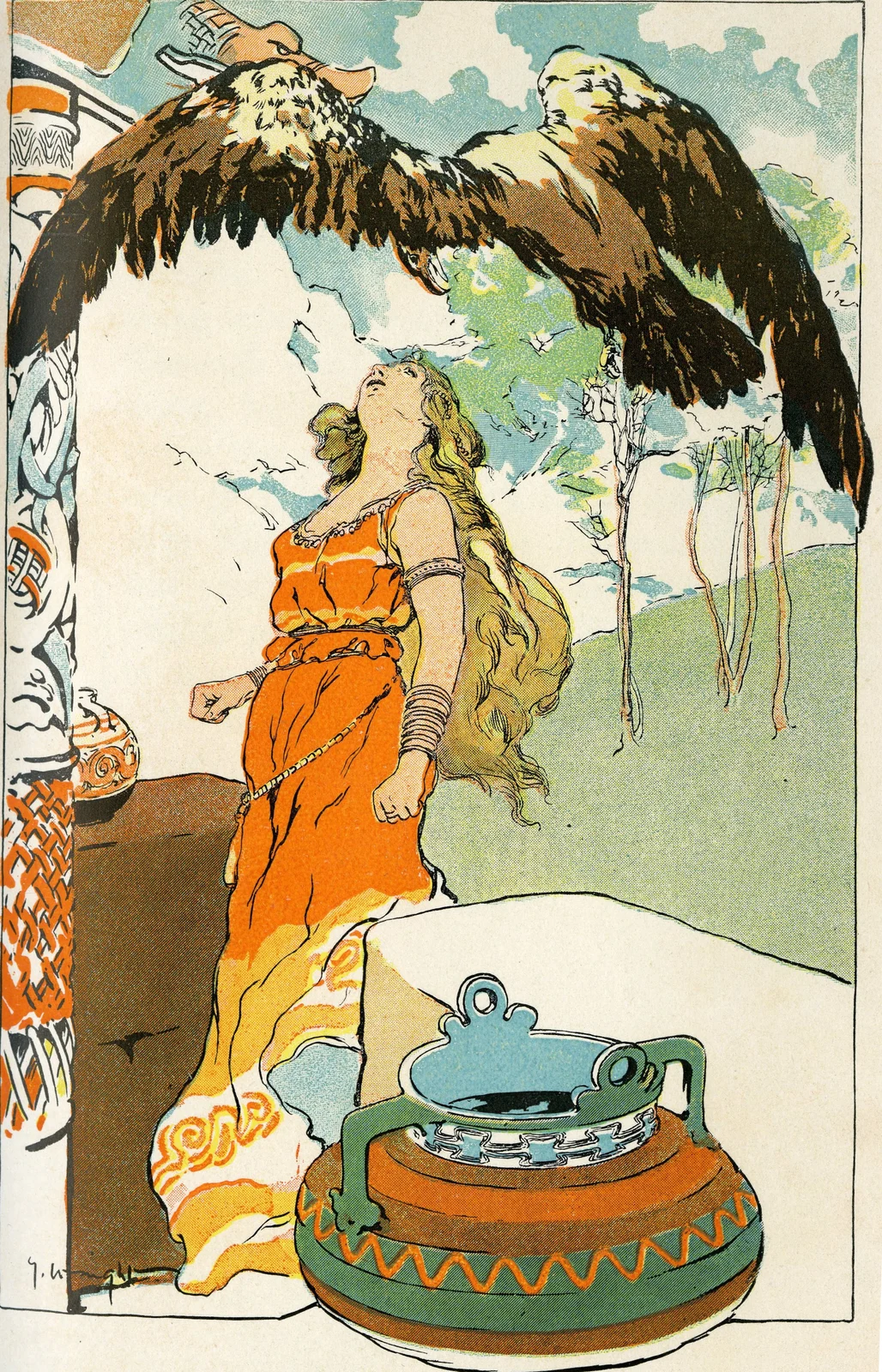
Þjazi in eagle form approaches Iðunn, George Hand Wright, 1902
The giant appears as the enormous eagle hovering above Iðunn. This is Wright’s illustration for Mabie’s retelling of the abduction; the bird’s expression and Iðunn’s clothing are artistic choices, not a zoological identification.
Overview
Þjazi first interferes with an ox being cooked by Odin, Hœnir and Loki. From an oak, an enormous eagle demands food, then takes more than Loki tolerates. When Loki strikes it with a pole, his hands become attached and he is dragged across the landscape. Release depends on promising to deliver Iðunn and her apples outside the gods' protection.
After the abduction, the gods begin ageing. Loki rescues Iðunn in falcon form, carrying her as a nut; Þjazi pursues as an eagle but burns his feathers in a fire prepared at Ásgarðr and is killed. Skaði, his daughter, arrives armed to demand atonement. Odin makes stars from her father's eyes. Brage also names his father Olvaldi and brothers Iði and Gangr: the sons divide inherited gold by equal numbers of mouthfuls, explaining poetic names for gold as the giants' speech or mouth-measure.
Arthur Gilchrist Brodeur’s 1916 translation presents the episode inside a conversation about the gods and poetic language. Ægir visits their hall and sits beside Bragi, who recounts the journey of Odin, Hœnir and Loki. The eagle does more than interrupt a meal: it claims responsibility for the ox repeatedly failing to cook. Its bargain is that the travelers must let it eat its fill. When it descends, its first portions are both shoulders and both hams, prompting Loki’s violent response.
The pole attaches to the eagle’s back while Loki’s hands remain fixed to its other end. His feet strike rocks and trees during the flight, and the strain threatens his arms. The promised release requires him to lure Iðunn outside Ásgarðr with her apples. He accomplishes this by claiming to have found excellent apples for her to compare with her own. Þjazi then takes her to his home, Thrymheimr. The kidnapping depends on coercing one traveler and deceiving another, not on a freely negotiated exchange with Iðunn.
The gods notice their rapid ageing and trace Iðunn’s last known movements to Loki. Threatened at their assembly, he offers to retrieve her if Freyja lends him her bird plumage. Brodeur calls this a hawk’s plumage, while the earlier summary uses falcon; neither English label establishes an exact zoological species. Þjazi is away rowing at sea when Loki arrives, leaving Iðunn alone. Turning her into a nut allows him to carry her in his claws. The source gives no separate winged transformation to Iðunn herself.
The pursuit has a precisely arranged conclusion. Seeing the approaching birds, the gods gather wood shavings outside Ásgarðr. Loki flies into the enclosure and drops close to the wall before they ignite the pile. Þjazi cannot stop his momentum, catches fire and loses the ability to fly. The gods then kill him at their gate. In this sequence the burning feathers disable the pursuer; the account additionally states his killing by the assembled gods rather than leaving his fate as an unexplained disappearance.
Skaði comes equipped for war, and the ensuing settlement is more than an exchange of treasure. She may select a husband by seeing only his feet. Believing the finest pair belong to Baldr, she actually chooses Njörðr. She also demands that the gods make her laugh, and Loki succeeds with a humiliating comic performance involving a goat. Odin’s placement of her father’s eyes as two stars is another part of the atonement. The episode ends with reconciliation, not Þjazi’s resurrection.
Bragi’s account of Ölvaldi’s sons immediately turns family history into an explanation of poetic diction: their measured mouthfuls of inherited gold support expressions identifying gold with the giants’ speech. Later in the same chapter, Odin and Suttungr both take eagle form in the separate pursuit over the mead of poetry. Those are named characters in another episode. Their shared animal guise provides a comparison within the text but does not make them relatives of Þjazi or interchangeable manifestations of a single eagle being.
Origins & earliest records
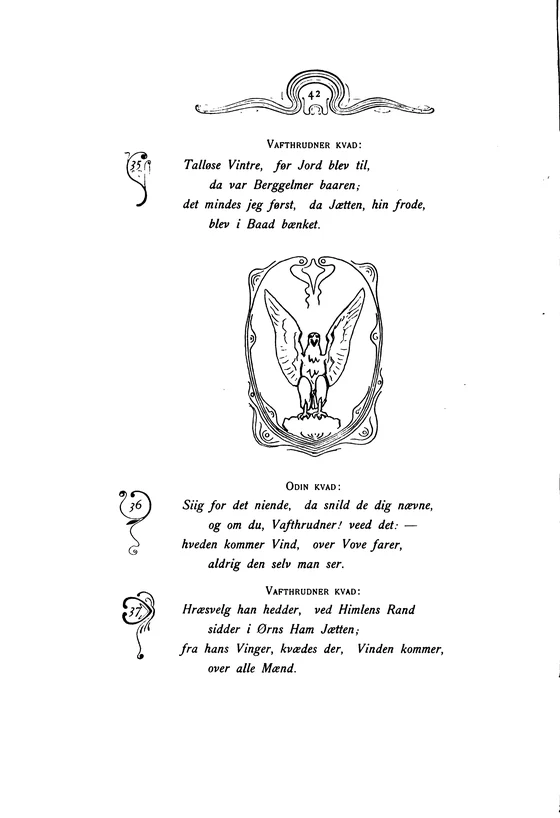
The selected witness is the early-thirteenth-century Prose Edda in Rasmus B. Anderson's translation, first published in 1879 and represented here by the 1901 edition. Its prose also quotes poetic material about the abduction. This provides layered literary attestation, but does not mean Snorri invented the story or that its earliest oral form can be dated. A second located English witness is Arthur Gilchrist Brodeur’s 1916 Prose Edda, Skáldskaparmál I, especially pp.89–92; its title identifies the American-Scandinavian Foundation edition.
Records & interpretation
Prose narration and embedded verse preserve the giant's eagle guise, his role in the abduction and the consequences of his death. These are evidence for a mythic narrative and poetic references. The stars made from his eyes are part of that account, not astronomical confirmation of the figure or zoological evidence for a transforming eagle. Complete Brodeur Skáldskaparmál I read in transcription through p.97, including the full Þjazi account, its family discussion, the separate mead narrative and the closing instruction about poetic interpretation. Brodeur’s title page was checked. The Old Norse manuscripts and all embedded poetry have not been collated for this expansion.
In the literature
“caught fire in his feathers”
Brage’s Talk, chapters II–III; printed p. 157 · Rasmus B. Anderson
The pursuing eagle catches fire at the walls of Asgard.
Selected bibliography
Documented works and useful reading. This is not a list of every appearance.
- 01
The Younger Edda
Brage's Talk, chapters II–III, pp. 155–159; poetic extracts, pp. 184–186. Selected inspected witness; bibliography is not exhaustive.
- 02
The Prose Edda — Skáldskaparmál I
Complete chapter I, pp.89–97, read in transcription; Þjazi’s narrative and family discussion appear pp.89–92. Distinct from the earlier Anderson witness; no original-language collation claimed.
- 03
The Younger Edda — Brage’s Talk, chapters II–III
Chicago: Scott, Foresman and Company, 1901 selected edition; translation copyright 1879 and preface September 1879 appear in the inspected text. Rasmus B. Anderson’s English translation of the medieval Prose Edda, traditionally associated with Snorri Sturluson. The edition preserves different spelling conventions and has its own chapter and numbered-section sequence.
Family, evolution & connections
Olvaldi’s sons and Thjazi’s daughter in Snorri
Named family in Brage’s Talk III, Anderson translation; external relatives remain named text nodes.
Scroll sideways to see all branches. With a keyboard, focus the tree and use the arrow keys.
- Olvaldi (Olvalde)
- Skadi (Skade)
- Idi (Ide)
- Gangr (Gang)
Explicit father, sons and daughter statements; spellings modernized in node labels. No mother, birth order or wider genealogy inferred. Skadi’s marriage settlement is not treated as descent. This is textual genealogy, not biological phylogeny.
Skadi
Anderson’s Younger Edda, Brage’s Talk chapter III, identifies Skade as Thjasse’s daughter and describes her arrival at Asgard to avenge his death. Her later marriage settlement follows that stated relationship. This records textual parentage, with the translation’s spellings distinguished from Thjazi and Skadi, and supplies no unnamed mother or additional descendants.
Olvaldi, Idi and Gangr
In Brage’s Talk chapter III, Brage names Thjasse’s father Olvalde and lists Thjasse, Ide and Gang as the sons who divide their father’s gold by equal mouthfuls. The connection records that named family and its inheritance narrative. Modernized names are supplied for recognition; no mother, birth order or further kinship is inferred from the gold kennings.
Located primary passages
Specific passages supporting details in this entry, grouped by their published witness.
The Younger Edda — Brage’s Talk, chapters II–III
Chicago: Scott, Foresman and Company, 1901 selected edition; translation copyright 1879 and preface September 1879 appear in the inspected text. Rasmus B. Anderson’s English translation of the medieval Prose Edda, traditionally associated with Snorri Sturluson. The edition preserves different spelling conventions and has its own chapter and numbered-section sequence.
- An eagle prevents the travellers’ ox from cooking, drags Loki after the latter’s blow and forces a pledge to bring Idunn and her apples; the text identifies the captor as the giant Thjasse.
- Loki retrieves Idunn in nut form while wearing Freyja’s falcon guise; Thjasse pursues as an eagle, whose feathers ignite at Asgard before the gods kill him.
- Skadi demands settlement for her father’s death, and Odin places Thjasse’s eyes in the sky as two stars; the account also explains gold kennings through his family’s mouthful division of their inheritance.
Complete selected prose episodes read; quoted poetic extracts inspected but not used to invent earliest dates or a modern standardized taxonomy. Section numbers belong to this 1901 translation and can differ from other editions. Translator’s introductory racial and theological interpretations are not treated as source narrative.
Encyclopedia background
An additional attributed reference, separate from the editorial profile above.
Read the open encyclopedia overview
In Norse mythology, Þjazi (Old Norse: [ˈθjɑt͡se]; anglicized as Thiazi, Thiazzi, Thjazi, Tjasse or Thiassi) was a jötunn. He was a son of the jötunn Ölvaldi, brother of Iði and Gangr, and the father of Skaði. His most notable misdeed was the kidnapping of the goddess Iðunn, which is related in both the Prose Edda and the skaldic poem Haustlöng.
Saturn's moon Thiazzi was named after him.
Text from Wikipedia contributors, “Þjazi”. CC BY-SA 4.0. Extracted introduction; formatting changed. Retrieved 5 October 2026. The source article may have changed since retrieval.
References
Sources supporting this profile. Linked pages have their own scope and editorial standards.
- Primary textAnderson's Younger Edda: Brage's Talk, chapters II–III, pp. 155–159; poetic extracts, pp. 184–186Research access: 2026-10-05
- Historical literary translationBrodeur (1916): complete Skáldskaparmál IResearch access: 2026-10-05
- Historical edition titleBrodeur Prose Edda: 1916 title pageResearch access: 2026-10-05
Image credits
Historical illustrationÞjazi in eagle form approaches Iðunn, George Hand Wright, 1902
The giant appears as the enormous eagle hovering above Iðunn. This is Wright’s illustration for Mabie’s retelling of the abduction; the bird’s expression and Iðunn’s clothing are artistic choices, not a zoological identification.