A sourced illustration has not yet been added. This gap is included in the coverage record.
Overview
Loki visits Geirröðr's hall in a borrowed falcon guise and delays escaping until he is caught. The giant notices something unusual about the captive bird's eyes, locks him in a chest and starves him for three months. Loki eventually identifies himself and promises to bring Thor without his hammer or strength-belt. The proposed visit is therefore secured through coercion rather than ordinary hospitality.
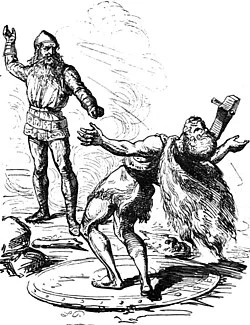
On the way, the giantess Gríðr warns Thor and lends her strength-belt, steel gloves and staff Gríðarvölr. After river and lodging traps fail, Geirröðr invites him to a hall lined with fires and throws a red-hot iron wedge with tongs. Thor catches it and hurls it back. The projectile passes through the iron pillar behind which Geirröðr hides, through the giant and onward through the wall. His defeat depends on the reversal of his carefully staged attack.
Origins & earliest records
The Prose Edda, compiled in the early thirteenth century, is the selected prose witness; its section also quotes Þórsdrápa. The inspected English text is Anderson's 1901 edition of the 1879 translation. This Geirröðr is the giant in Thor's visit, and should not be merged with similarly named human rulers in other Eddic narratives.
Records & interpretation
The narrative supplies imprisonment, deceptive invitation and a heated-iron attack, while the accompanying verse supplies another literary register. These support a source-specific profile of Thor's opponent. They are not records of a real giant or a surviving weapon demonstration, and the dramatic penetration of pillar and wall remains a narrated feat.
In the literature
“starved him for three months”
Poetical Diction, Thor’s Journey to Geirrod’s; printed p. 177 · Rasmus B. Anderson
Geirrod imprisons Loki until the captive promises to bring Thor without his usual equipment.
Selected bibliography
Documented works and useful reading. This is not a list of every appearance.
- 01
The Younger Edda
Poetical Diction: Thor's Journey to Geirrod's, pp. 176–183. Selected inspected witness; bibliography is not exhaustive.
- 02
The Younger Edda — Poetical Diction, Thor’s Journey to Geirrod’s
Chicago: Scott, Foresman and Company, 1901 selected edition; translation copyright 1879 and preface September 1879 appear in the inspected text. Rasmus B. Anderson’s English translation of the medieval Prose Edda, traditionally associated with Snorri Sturluson. The edition preserves different spelling conventions and has its own chapter and numbered-section sequence.
Family, evolution & connections
Geirrodr’s daughters in Snorri
Thor’s Journey to Geirrod’s, Anderson translation, pp. 178–179.
Scroll sideways to see all branches. With a keyboard, focus the tree and use the arrow keys.
Both women are explicitly identified as Geirrod’s daughters in the prose. The collective profile links from both named daughters; it is not a third child. No mother or additional descendants are supplied. Textual parentage only.
Located primary passages
Specific passages supporting details in this entry, grouped by their published witness.
The Younger Edda — Poetical Diction, Thor’s Journey to Geirrod’s
Chicago: Scott, Foresman and Company, 1901 selected edition; translation copyright 1879 and preface September 1879 appear in the inspected text. Rasmus B. Anderson’s English translation of the medieval Prose Edda, traditionally associated with Snorri Sturluson. The edition preserves different spelling conventions and has its own chapter and numbered-section sequence.
- Loki is caught in falcon guise at Geirrod’s hall, imprisoned and starved until he promises to lure Thor there without hammer or strength belt; Grid warns Thor and lends protective equipment.
Poetical Diction, Thor’s Journey to Geirrod’s; pp. 176–177; capture and forced pledge
- Geirrod hurls a red-hot iron wedge at Thor, who catches it with Grid’s gloves and throws it through the protecting iron post, Geirrod and the hall wall.
Poetical Diction, Thor’s Journey to Geirrod’s; p. 179; heated iron contest
Complete selected prose episodes read; quoted poetic extracts inspected but not used to invent earliest dates or a modern standardized taxonomy. Section numbers belong to this 1901 translation and can differ from other editions. Translator’s introductory racial and theological interpretations are not treated as source narrative.
Encyclopedia background
An additional attributed reference, separate from the editorial profile above.
Read the open encyclopedia overview
Geirröðr (also Geirröd) is a jötunn in Norse mythology. He is the father of the jötnar Gjálp and Greip, who are killed by the thunder-god Thor, and the possible father of the jötnar Eistla, Angeyja, Ulfrún, Eyrgjafa, Imd, Atla and Járnsaxa.
Geirröðr is mentioned in the skaldic poem Þórsdrápa, written by Eilíf Godrúnarson (late 10th c. AD), itself cited in Skáldskaparmál (early 13th c.) where it is preceded by Snorri Sturluson's account of the myth, and in Gesta Danorum by Saxo Grammaticus (early 13th c.).
Saturn's moon Geirrod is named after him.
Text from Wikipedia contributors, “Geirröðr”. CC BY-SA 4.0. Extracted introduction; formatting changed. Retrieved 5 October 2026. The source article may have changed since retrieval.
References
Sources supporting this profile. Linked pages have their own scope and editorial standards.
- Primary textAnderson's Younger Edda: Poetical Diction: Thor's Journey to Geirrod's, pp. 176–183Research access: 2026-10-05
Image credits
A sourced illustration has not yet been added. This gap is included in the coverage record.