A sourced illustration has not yet been added. This gap is included in the coverage record.
Overview
Gjálp appears first when Thor crosses the swelling river Vimur. He sees her astride the stream's upper course and understands that she is causing its rise. A thrown stone interrupts the threat, and he reaches the bank using Gríðr's borrowed staff and a shrub. Greip is not given the same river action, so the two sisters should not be assigned identical feats.
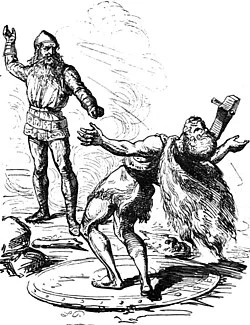
At Geirröðr's lodging, Thor sits on the only available seat and finds himself being raised toward the roof. He braces the borrowed staff against the rafters and forces himself downward. A crash and screams reveal the two giantesses beneath the seat, whose backs he breaks. The paired plot gives them dangerous agency within the household's ambush, while the surviving prose supplies little independent appearance or personal history for either sister.
Brodeur’s 1916 translation places the story in Skáldskaparmál XVIII, where Bragi answers Ægir’s question about Thor’s further exploits. Its prose locates Gjálp with one leg in each of two ravines across the river; Thor’s successful stone throw interrupts the spate, and his grasp of a rowan-clump produces a saying about the tree as his deliverance. The lodging is specifically a goat-fold in Brodeur’s preferred reading. His footnote records a manuscript alternative, guest-house, preferred by Anderson and other translators. This difference concerns the setting of the ambush, not a separate adventure.
The following translated Þórsdrápa is attributed to Eilífr Guðrúnarson and is printed in brackets, with Brodeur’s editorial note distinguishing such material. It gives Thjálfi a place in the difficult crossing, whereas the preceding prose has Loki holding Thor’s belt. Its account of the hall attack describes the backs and breast-bones of both women being broken under force against the roof. These verse particulars supplement the prose without making Greip the separately named river attacker or supplying either sister with an independent appearance, childhood or later return.
Origins & earliest records
The selected prose appears in Snorri's early-thirteenth-century Edda, together with quoted verse connected to the journey. Anderson's 1901 edition of his 1879 translation is the inspected English witness. Treating the sisters as a paired entry avoids inventing two full biographies from their short shared episode, while preserving Gjálp's separately attributed role at the river.
Records & interpretation
The named river threat and the concealed lifting of the seat are literary evidence for the giantesses' part in the ambush. The source gives actions and kinship rather than a detailed physical portrait. It does not substantiate real manipulation of a river, and absent features such as wings or additional heads should not be supplied as anatomy.
In the literature
“he had broken the backs of both of them.”
Poetical Diction, Thor’s Journey to Geirrod’s; printed p. 178 · Rasmus B. Anderson
Thor counters the daughters’ attempt to crush him against the roof.
Selected bibliography
Documented works and useful reading. This is not a list of every appearance.
- 01
The Younger Edda
Poetical Diction: Thor's Journey to Geirrod's, pp. 178–183. Selected inspected witness; bibliography is not exhaustive.
- 02
The Prose Edda: Skáldskaparmál XVIII, pp. 121–129
Complete prose and accompanying translated Þórsdrápa; goat-fold/guest-house manuscript alternatives distinguished in the p. 123 footnote. Editorial brackets retained as a qualification.
- 03
The Younger Edda — Poetical Diction, Thor’s Journey to Geirrod’s
Chicago: Scott, Foresman and Company, 1901 selected edition; translation copyright 1879 and preface September 1879 appear in the inspected text. Rasmus B. Anderson’s English translation of the medieval Prose Edda, traditionally associated with Snorri Sturluson. The edition preserves different spelling conventions and has its own chapter and numbered-section sequence.
Family, evolution & connections
Geirrodr’s daughters in Snorri
Thor’s Journey to Geirrod’s, Anderson translation, pp. 178–179.
Scroll sideways to see all branches. With a keyboard, focus the tree and use the arrow keys.
Both women are explicitly identified as Geirrod’s daughters in the prose. The collective profile links from both named daughters; it is not a third child. No mother or additional descendants are supplied. Textual parentage only.
Geirröðr
Anderson’s Thor’s Journey to Geirrod’s calls Gjalp Geirrod’s daughter and then names Gjalp and Greip together as his daughters beneath the rising seat. Their encounter with Thor illustrates their part in this particular narrative, but the family connection rests on explicit parentage. The text does not name their mother or establish other children for the genealogy.
Located primary passages
Specific passages supporting details in this entry, grouped by their published witness.
The Younger Edda — Poetical Diction, Thor’s Journey to Geirrod’s
Chicago: Scott, Foresman and Company, 1901 selected edition; translation copyright 1879 and preface September 1879 appear in the inspected text. Rasmus B. Anderson’s English translation of the medieval Prose Edda, traditionally associated with Snorri Sturluson. The edition preserves different spelling conventions and has its own chapter and numbered-section sequence.
- The prose explicitly singles out Gjalp as causing the river’s rise; Thor throws a stone at her and reaches the bank with help from a shrub. Greip is not named as the cause in this prose passage.
Poetical Diction, Thor’s Journey to Geirrod’s; pp. 177–178; Vimur river episode
- Both daughters, Gjalp and Greip, raise Thor’s seat. He braces Grid’s staff against the rafters and forces the seat downward, breaking both backs.
Poetical Diction, Thor’s Journey to Geirrod’s; pp. 178–179; seat raised toward the roof
Complete selected prose episodes read; quoted poetic extracts inspected but not used to invent earliest dates or a modern standardized taxonomy. Section numbers belong to this 1901 translation and can differ from other editions. Translator’s introductory racial and theological interpretations are not treated as source narrative.
Encyclopedia background
An additional attributed reference, separate from the editorial profile above.
Read the open encyclopedia overview
Gjálp (Old Norse: [ˈɡjɑːlp]; or Gialp) and Greip (Old Norse: Greip) are two jötnar in Norse mythology and the daughters of the jötunn Geirröðr. They are killed by the thunder god Thor for trying to kill him.
Text from Wikipedia contributors, “Gjálp and Greip”. CC BY-SA 4.0. Extracted introduction; formatting changed. Retrieved 5 October 2026. The source article may have changed since retrieval.
References
Sources supporting this profile. Linked pages have their own scope and editorial standards.
- Primary textAnderson's Younger Edda: Poetical Diction: Thor's Journey to Geirrod's, pp. 178–183Research access: 2026-10-05
- Primary text in historical English translationBrodeur 1916: Geirröðr journey and ÞórsdrápaResearch access: 2026-10-05
Image credits
A sourced illustration has not yet been added. This gap is included in the coverage record.