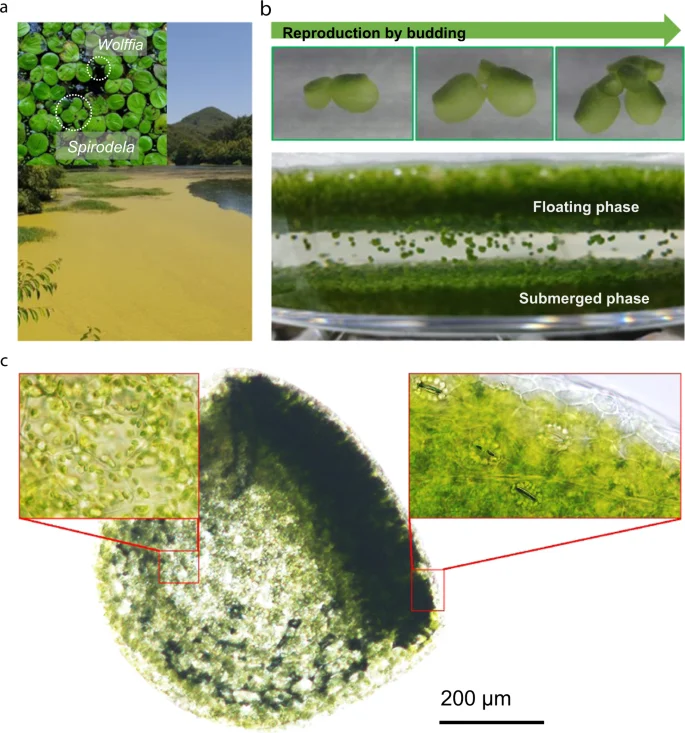
Wolffia growth and Wolffia australiana microscopy with a mixed duckweed lake comparison, Park and coauthors2021figure1
The figure combines budding and growth photographs with a Wolffia australiana micrograph comparing its upper and lower surfaces. Panel a is a South Korean lake containing both Spirodela and Wolffia, rather than a field record identified specifically as W. australiana. Its mixed duckweed scene should not be read as this species’ exclusive habitat.
Overview
Wolffia australiana is a minute aquatic flowering plant with a granule-like vegetative body, rather than a familiar arrangement of roots, stem and leaves. It propagates mainly by budding. Microscopy presented in a 2021 genomic study shows stomata on the upper surface and their absence from the underside. The researchers used accession 8730 from the Rutgers Duckweed Stock Cooperative, a cultured research accession rather than newly designated species type material. Its unusual body is a specialized plant form, not evidence that it precedes other flowering plants.
The study combined long-read, mate-pair and linked-read sequencing to improve a draft nuclear genome. An independent sequence-based estimate placed genome size at approximately 440 million bases. The final super-scaffold N50 was about 1.17 million bases, and the authors explicitly stated that further work was needed to resolve the genome into chromosome-containing scaffolds. They predicted 22,293 genes, with additional protein variants reflecting alternative transcripts. Although the organism’s external anatomy is greatly reduced, its genome is not correspondingly stripped of all repetitive material: repeated sequences make up a substantial share of the assembly.
Comparisons with other plants identified missing or reduced components of several hormone and developmental pathways. Some genes associated with root development in other model plants were not recovered, while other families were expanded. These patterns suggest candidate explanations for rootlessness and aquatic adaptation. They do not demonstrate that deleting any one gene would produce the Wolffia body plan. The authors also found only one NLR-family gene in their annotation, but explicitly cautioned that this does not necessarily mean diminished resistance to pathogens.
The investigation additionally compared gene expression in floating and submerged material. It reported 698 differentially expressed genes, including elevated expression of several transport, carbohydrate-metabolism and possible low-oxygen-response components in the submerged phase. One floating biological replicate was excluded during quality control, a relevant limit when interpreting the comparison. The suggested contribution of these genes to survival in low-oxygen conditions remains a hypothesis based on expression and known functions from other systems, rather than direct experimental validation of each candidate.
The study’s six-gene phylogeny places Wolffia with sampled aquatic monocots, separately from the aquatic water lily. It therefore also illustrates that living in water is not a sufficient basis for grouping all aquatic plants into one close lineage. Estimates of divergence and gene-family change depend on the selected genes, calibration and comparative genomes; they should not be read as a fossil date for the modern species.
Origins & earliest records
Account centered on Park and colleagues’ 2021 draft-genome and expression study of accession 8730; no original taxonomic description examined.
Evidence & interpretation
Genome assembly and annotation, comparative gene inventories, six-gene Bayesian analysis and floating-versus-submerged RNA sequencing. Proposed functional links remain distinct from validated physiology.
Selected bibliography
Documented works and useful reading. This is not a list of every appearance.
- 01
Genome of the world’s smallest flowering plant, Wolffia australiana, helps explain its specialized physiology and unique morphology
Communications Biology 4, 900; complete main Results/Discussion/Conclusions and Methods. Accession 8730; BioProject PRJNA611905. CC BY 4.0 adaptation credited.
Family, evolution & connections
Selected plants in Park et al.’s 2021 duckweed nuclear-gene tree
Eight retained species from Figure 2a: one moss, one lycophyte, water lily, Arabidopsis and four monocots. Other sampled dicots and monocots are pruned.
Scroll sideways to see all branches. With a keyboard, focus the tree and use the arrow keys.
- Selected sampled plants
- Remaining sampled vascular plants
- Selaginella moellendorffii
- Selected sampled flowering plants
- Nymphaea colorata
- Remaining sampled flowering plants
- Selected sampled monocots
- Oryza sativa
- Selected sampled Alismatales
- Zostera marina
- Spirodela / Wolffia pair
- Spirodela polyrhiza
BEAST Bayesian inference using six highly conserved nuclear genes shared by Wolffia, Spirodela, rice and Zostera. ProtTest selected the LG model. The analysis fixes the moss-root calibration at 496 million years; dates are not reproduced here. This small-marker historical hypothesis is distinct from a genome-wide species-tree analysis. Figure colors represent posterior probability, but no exact probabilities are extracted from colors. Green/red numbers are gene-family gains/losses, not support; horizontal bars are divergence-time intervals. Calibration and broad model uncertainty do not date living species or identify direct ancestors.
Taxonomic classification
A hierarchy of classified groups, not a chain of direct ancestors.
- FamilyAraceae
- GenusWolffia
- SpeciesWolffia australiana
References
Sources supporting this profile. Linked pages have their own scope and editorial standards.
- ResearchPark et al. 2021, primary watermeal genomic study (CC BY 4.0)Research access: 2026-10-05
Image credits
Scientific plant photograph and microscopy figureWolffia growth and Wolffia australiana microscopy with a mixed duckweed lake comparison, Park and coauthors2021figure1
The figure combines budding and growth photographs with a Wolffia australiana micrograph comparing its upper and lower surfaces. Panel a is a South Korean lake containing both Spirodela and Wolffia, rather than a field record identified specifically as W. australiana. Its mixed duckweed scene should not be read as this species’ exclusive habitat.