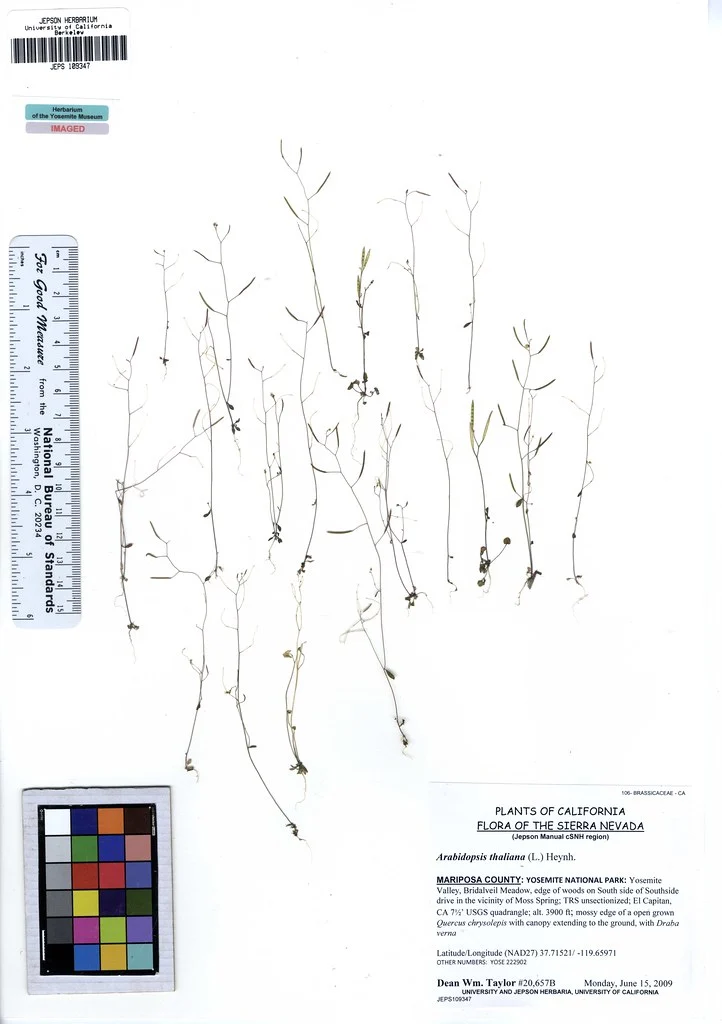
Arabidopsis thaliana pressed plants on herbarium sheet JEPS 109347, with Yosemite collection label, ruler and colour scale
The sheet contains several pressed plants with slender flowering and fruiting stems. Its label records a collection near Moss Spring in Yosemite National Park, California, on 15 June 2009. The barcode, collection label, ruler and colour scale are retained. This is a preserved field specimen, rather than one of the experimental strains in the pan-genome study.
Overview
Arabidopsis thaliana is a flowering plant in the mustard family, widely used for experiments because of its relatively small genome, short generation time and abundant seed production. Its laboratory role does not imply genetic uniformity. Populations occupy different environments, and particular seed lines, usually called accessions or ecotypes, capture some of that variation. In 2023, Minghui Kang and colleagues assembled genomes of 32 selected ecotypes from Europe, Asia, Africa and North America, including six described as relict ecotypes. Plants grown from their seeds supplied leaf material for sequencing.
The resulting assemblies ranged from 129.4 to 144.9 million base pairs and were organized into five chromosome-scale sequences using an existing reference assembly. Predicted protein-coding gene counts varied between approximately 27,200 and 28,700. The authors then compared gene families across the sample. Some were present in every assembled ecotype, while others occurred in only a subset. Variable families were enriched in categories associated with stress responses and were linked statistically with environmental variables. Such associations help select hypotheses for testing; they do not establish the function of every variable gene or encompass all populations of the species.
The investigators also built a graph-based pan-genome, which incorporates alternative sequence paths instead of forcing every accession into one reference sequence. This captured tens of thousands of structural differences, including insertions, deletions and more complex alternatives. Many overlapped genes or their surrounding regulatory regions, and larger differences were often associated with transposable elements. A single reference genome can therefore miss variants relevant to a comparison. However, repeat annotation, assembly, gene prediction and variant-calling choices all help determine the resulting catalogue.
The Tibet-0 ecotype provided focused examples. A 332-base-pair insertion in the promoter of HPCA1 was associated with increased expression; a different insertion near WH1 was associated with reduced expression. Reporter assays tested promoter behavior in Nicotiana benthamiana leaves, rather than reproducing the entire native alpine environment. The authors connected these expression differences with drought and ultraviolet-stress responses and proposed contributions to local adaptation. Other analyses linked structural variants with flowering time and mineral-content traits. The study supplies candidate mechanisms and experimental comparisons, but its inferred population history is not a direct ancestor chain, and laboratory reporter results are not measurements of reproductive success throughout the wild range.
Origins & earliest records
Living flowering plant; the focal study sampled 32 ecotypes across four continents, rather than a nomenclatural type.
Evidence & interpretation
Chromosome-scale assemblies, gene-family comparisons, structural-variant associations and promoter-reporter experiments provide distinct kinds of evidence.
Selected bibliography
Documented works and useful reading. This is not a list of every appearance.
- 01
The pan-genome and local adaptation of Arabidopsis thaliana
Nature Communications 14:6259; complete main report and Methods. CC BY 4.0.
- 02
1,135 Genomes Reveal the Global Pattern of Polymorphism in Arabidopsis thaliana
Cell166(2):481–491,14July2016; online9June2016.
- 03
A pan-genome of 69 Arabidopsis thaliana accessions reveals a conserved genome structure throughout the global species range
Nature Genetics 56:982–991; published online 11 April 2024, May issue. DOI 10.1038/s41588-024-01715-9.
Family, evolution & connections
Selected plants in Park et al.’s 2021 duckweed nuclear-gene tree
Eight retained species from Figure 2a: one moss, one lycophyte, water lily, Arabidopsis and four monocots. Other sampled dicots and monocots are pruned.
Scroll sideways to see all branches. With a keyboard, focus the tree and use the arrow keys.
- Selected sampled plants
- Remaining sampled vascular plants
- Selaginella moellendorffii
- Selected sampled flowering plants
- Nymphaea colorata
- Remaining sampled flowering plants
- Selected sampled monocots
- Oryza sativa
- Selected sampled Alismatales
- Zostera marina
- Spirodela / Wolffia pair
- Spirodela polyrhiza
BEAST Bayesian inference using six highly conserved nuclear genes shared by Wolffia, Spirodela, rice and Zostera. ProtTest selected the LG model. The analysis fixes the moss-root calibration at 496 million years; dates are not reproduced here. This small-marker historical hypothesis is distinct from a genome-wide species-tree analysis. Figure colors represent posterior probability, but no exact probabilities are extracted from colors. Green/red numbers are gene-family gains/losses, not support; horizontal bars are divergence-time intervals. Calibration and broad model uncertainty do not date living species or identify direct ancestors.
Selected ecotype groups in Kang and colleagues’ Arabidopsis tree (2023)
Figure 1b: six separately retained relict A. thaliana ecotypes, a collapsed group of twenty-six sampled non-relict ecotypes and the A. lyrata outgroup. These are within-species samples apart from the outgroup, not eight species.
Scroll sideways to see all branches. With a keyboard, focus the tree and use the arrow keys.
- Sampled Arabidopsis genomes
- Arabidopsis lyrata — outgroup
- Sampled A. thaliana ecotypes
- Tibet-0
- Remaining sampled ecotypes (ultrafast bootstrap 75)
- Etna-2
- Remaining sampled ecotypes (ultrafast bootstrap 100)
- Meh-0 / Ket-10 (ultrafast bootstrap 100)
- Meh-0
- Ket-10
- Elk-1 / Arb-0 and non-relict clade (ultrafast bootstrap 100)
- Elk-1 / Arb-0 (ultrafast bootstrap 100)
- Elk-1
- Arb-0
- Twenty-six sampled non-relict ecotypes — internal branches collapsed
Kang et al. selected 17,183 single-copy gene families from thirty-three genomes. OrthoFinder clustering, MAFFT alignment and Gblocks conserved-site extraction preceded maximum-likelihood analysis in IQ-TREE, with automatic model selection and 1,000 ultrafast bootstrap replicates using bootstrap tree optimization. Displayed values belong to original retained nodes; no supports were recomputed after collapsing the non-relict group. Tibet-0’s basal position among sampled ecotypes does not identify it as their living ancestor or establish the place where the species originated. Relict ecotypes are paraphyletic in this sampled tree, whereas the non-relict group is monophyletic. An individual ecotype is not a separate species, and geographic origin is not equivalent to ancestry. Adapted from Kang et al. (2023), CC BY 4.0: twenty-six tips collapsed, layout redrawn, branch lengths and geographic map omitted; no ages inferred.
Selected archaeplastid nuclear branching (Schön et al., 2021)
Eight selected terminals from the 67-taxon analysis in Figure 2. Palpitomonas bilix represents sampled Cryptista. One composite Picozoa OTU is retained exactly as labelled; other Picozoa assemblies and most eukaryotes are omitted.
Scroll sideways to see all branches. With a keyboard, focus the tree and use the arrow keys.
- Selected nuclear sample tree
- Selected Archaeplastida (bootstrap 93 / posterior 1)
- Selected red-algal, rhodelphid and picozoan branch (bootstrap 100 / posterior 1)
- Selected red algae / rhodelphid branch (bootstrap 95 / posterior 1)
- Selected red-algal pair
- Galdieria sulphuraria
- Rhodelphis marinus
- COSAG02 / COSAG03 / COSAG04 / COSAG06 — composite source OTU
- Selected green-algal / glaucophyte branch
- Selected green lineage
- Volvox carteri
- Cyanophora paradoxa
- Palpitomonas bilix — selected cryptist outgroup
The selected tree uses 317 concatenated nuclear markers with LG + C60 + F + G-PMSF maximum likelihood and 100 non-parametric bootstrap replicates. Comparison posterior probabilities came from PhyloBayes CAT-GTR + G. Three original branch support pairs are retained, without recomputation after pruning. Branch lengths, remaining supports and the inset topology are omitted. Picozoa sister to red algae plus rhodelphids is the main Figure 2 result. An alternative joining Picozoa directly with red algae was also not rejected by the AU test and appeared after stronger site filtering. Some closely related sequences were merged into OTUs; Bayesian chains achieved only partial convergence. Nuclear branching does not establish which plastid-loss or independent-gain scenario occurred. Adapted from Schön et al. (2021), CC BY 4.0: eight tips retained, omitted branches suppressed and layout redrawn; three original support pairs retained.
Taxonomic classification
A hierarchy of classified groups, not a chain of direct ancestors.
- kingdomPlantae
- familyBrassicaceae
- genusArabidopsis
- speciesArabidopsis thaliana
Located primary passages
Specific passages supporting details in this entry, grouped by their published witness.
Primary source witness
Cell166(2):481–491,2016.
- The consortium retained 1,135 natural inbred accessions after quality filtering and described more than ten million biallelic nuclear SNPs. Its hierarchical sample combines dense regional collections with wider geographic coverage. Genome-wide association tests improve flowering-time signals, but linkage disequilibrium prevents direct identification of causal genes from association alone. The proposed glacial-refugium and range-expansion history remains a model: the geographic source of most non-relict populations is explicitly unresolved, and admixture can distort apparent centres of diversity. The authors also caution that short reads miss variation around structural differences and that no accession subset serves every research question.
Population Structure and Footprints of Selection sections not independently read; supplementary procedures, raw sequences, computational analyses and online tools not inspected or reproduced. Source interpretation is dated2016, not a claim of final present-day consensus.
A pan-genome of 69 Arabidopsis thaliana accessions reveals a conserved genome structure throughout the global species range
2024 published article
- The authors assembled chromosome-level genomes for 69 inbred accessions, excluding three initially selected lines because of heterozygosity. Chromosome arms were largely colinear, while centromeres and nearby regions varied more extensively. Repeat arrays remained incomplete in some assemblies, so this is not a collection of entirely finished genomes. Annotation comparisons identified core and variably present gene families, but many apparent private families involved differently split or merged annotations. The remaining candidate new families were not all experimentally validated as functional genes. The sampled pan-genome curve had not reached a plateau; the study does not claim to capture every gene in the species.
No supplementary files, deposited data/code, figure pixels or computational rerun. Assembly completeness, annotation differences and inferred functions remain qualified; geographic population groups are source-specific analytical results.
References
Sources supporting this profile. Linked pages have their own scope and editorial standards.
- ResearchKang and colleagues 2023, CC BY 4.0Research access: 2026-10-05
Image credits
Scientific herbarium specimen photographArabidopsis thaliana pressed plants on herbarium sheet JEPS 109347, with Yosemite collection label, ruler and colour scale
The sheet contains several pressed plants with slender flowering and fruiting stems. Its label records a collection near Moss Spring in Yosemite National Park, California, on 15 June 2009. The barcode, collection label, ruler and colour scale are retained. This is a preserved field specimen, rather than one of the experimental strains in the pan-genome study.