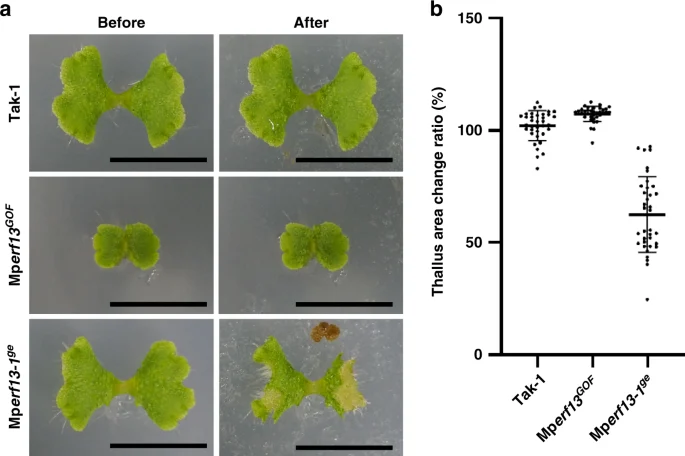
Marchantia polymorpha thalli before and after pill-bug feeding, with measured area changes in Kanazawa and coauthors’ figure 6
Young thalli from three indicated genotypes are photographed before and after a feeding experiment, with measured area changes plotted at right. The comparison concerns the oil body’s role in limiting herbivory; it is not a universal portrait of every form of Marchantia. Black scale bars represent one centimetre. The published experimental figure is reproduced unchanged.
Overview
Marchantia polymorpha is a liverwort whose flattened growing body, or thallus, contains specialized cells with oil bodies. Despite their name, these compartments are not the neutral-fat droplets that store energy in seeds and fruits. Liverwort oil bodies contain other compounds, including sesquiterpenoids and bisbibenzyls. Their biological role and cellular origin have been investigated using Marchantia as an experimental model, combining microscopy with precisely altered genes and comparisons between mutant and unmodified plants.
Kanazawa and colleagues identify a membrane-fusion protein, MpSYP12B, on the oil-body membrane. A related protein, MpSYP12A, instead localizes to the forming cell plate during cell division. Experiments with fluorescent markers show that ordinary secreted cargo can be redirected into the oil body when its production is controlled by particular regulatory sequences. The authors propose that the cell alternates between phases sending material outward and phases sending it into the internal compartment. They call this the oil-body cycle hypothesis; it is an interpretation supported by the targeting experiments, rather than a completely filmed historical origin of the organelle.
The study also identifies MpERF13, a transcription factor important for oil-body formation. Two independently generated loss-of-function mutants lack oil bodies, while a different mutant produces many more than the unmodified plants under the experimental conditions. The oil-body-deficient lines do not show detectable abnormalities in the reported thallus development and reproductive growth. This helps distinguish loss of a specialized compartment from wholesale failure of the plant to grow, although it does not establish that every aspect of mutant physiology is unchanged.
To test a defensive role, the researchers expose ten-day-old thalli to pill bugs, Armadillidium vulgare, previously kept without food for 48 hours. Six animals are placed on each experimental plate for 24 hours. Thallus area decreases much more in the oil-body-deficient plants than in the unmodified and oil-body-rich lines. The result supports protection against feeding in that assay; it does not prove immunity to every herbivore, or establish the activity of each stored compound independently.
The material includes male Takaragaike-1 and female Takaragaike-2 accessions, maintained under controlled conditions. The experimental system can produce new plants from gemmae and spores after crossing male and female lines. Its utility comes from linking cell architecture, genetic regulation and a measurable ecological interaction. Proposed applications of oil-body compounds remain separate from this demonstrated plant-defense experiment, and the study does not establish treatment efficacy in humans.
Origins & earliest records
Kanazawa and colleagues published the 2020 primary study in Nature Communications 11,6152. Takaragaike-1 and Takaragaike-2 are experimental accessions, not newly designated species types. The profile follows the specified laboratory system rather than assuming that every wild Marchantia population was tested.
Evidence & interpretation
Fluorescent protein localization, immunoelectron microscopy, gene alteration, RNA measurements and a 24-hour pill-bug feeding assay provide complementary evidence. The oil-body cycle is a proposed model; reduced feeding damage is measured under the reported experimental conditions.
Selected bibliography
Documented works and useful reading. This is not a list of every appearance.
- 01
The liverwort oil body is formed by redirection of the secretory pathway
Nature Communications 11,6152; main Results and Discussion, plant-material, microscopy and complete feeding-assay Methods. Original adaptation of CC BY 4.0 article. https://creativecommons.org/licenses/by/4.0/.
- 02
Insights into Land Plant Evolution Garnered from the Marchantia polymorpha Genome
Published Cell171:287–304.e15,5October2017; DOI10.1016/j.cell.2017.09.030.
Family, evolution & connections
Hornwort placement in Li et al.’s 2020 genome analysis
Eight retained species from the 21-genome Figure 2 amino-acid topology. Bonn and Oxford Anthoceros agrestis strain tips are collapsed into one species label; the sampled vascular plants are reduced to Selaginella moellendorffii. Other tips are pruned.
Scroll sideways to see all branches. With a keyboard, focus the tree and use the arrow keys.
- Selected Figure 2 topology
- Klebsormidium nitens
- Remaining selected streptophytes
- Chara braunii
- Remaining selected samples
- Mesotaenium endlicherianum
- Land plants (bootstrap 100; SH-aLRT 100; local posterior 1.0)
- Selaginella moellendorffii
- Bryophytes (bootstrap 100; SH-aLRT 100; local posterior 1.0)
- Moss / liverwort lineage (bootstrap 100; SH-aLRT 100; local posterior 1.0)
- Sampled hornworts
- Anthoceros punctatus
742 mostly single-copy orthogroups; MAFFT alignments, IQ-TREE concatenation and ASTRAL gene-tree summary. Thick original branches indicate maximal support in both nucleotide and amino-acid analyses: 1,000-replicate ultrafast bootstrap and SH-aLRT, and local posterior probability. The inset supports the bryophyte hypothesis in over half of gene-tree quartets, leaving substantial discordance. Displayed support belongs to original nodes and is not recalculated after pruning. Thin branches receive no invented value. The 0.2 scale is substitutions per site, not time; no living species is shown as a direct ancestor. Historical source names are retained.
Taxonomic classification
A hierarchy of classified groups, not a chain of direct ancestors.
- GenusMarchantia
- SpeciesMarchantia polymorpha
Armadillidium vulgare
In Kanazawa and colleagues’ 24-hour feeding assay, starved pill bugs damaged oil-body-deficient liverwort mutants more than the tested wild type and oil-body-rich mutant. This supports protection under the reported laboratory conditions, not an exhaustive natural diet or proof that every oil-body compound has the same effect.
Located primary passages
Specific passages supporting details in this entry, grouped by their published witness.
Primary source witness
Published Cell171:287–304.e15,5October2017; DOI10.1016/j.cell.2017.09.030.
- The sampled liverwort genome has comparatively little duplication among regulatory genes. The authors interpret this as useful evidence for ancestral land-plant regulation, rather than identifying Marchantia as an actual ancestor. A suggested connection between ancient sex chromosomes and limited whole-genome duplication remains a hypothesis. Genome annotations and evolutionary reconstructions are not experimentally demonstrated functions for every predicted gene.
Other results, STAR Methods, supplementary files and cited works uninspected.2017 phylogenetic framing not asserted as current consensus.
References
Sources supporting this profile. Linked pages have their own scope and editorial standards.
- ResearchKanazawa et al. 2020 primary experimental studyResearch access: 2026-10-05
Image credits
Scientific plant experiment photograph and chartMarchantia polymorpha thalli before and after pill-bug feeding, with measured area changes in Kanazawa and coauthors’ figure 6
Young thalli from three indicated genotypes are photographed before and after a feeding experiment, with measured area changes plotted at right. The comparison concerns the oil body’s role in limiting herbivory; it is not a universal portrait of every form of Marchantia. Black scale bars represent one centimetre. The published experimental figure is reproduced unchanged.