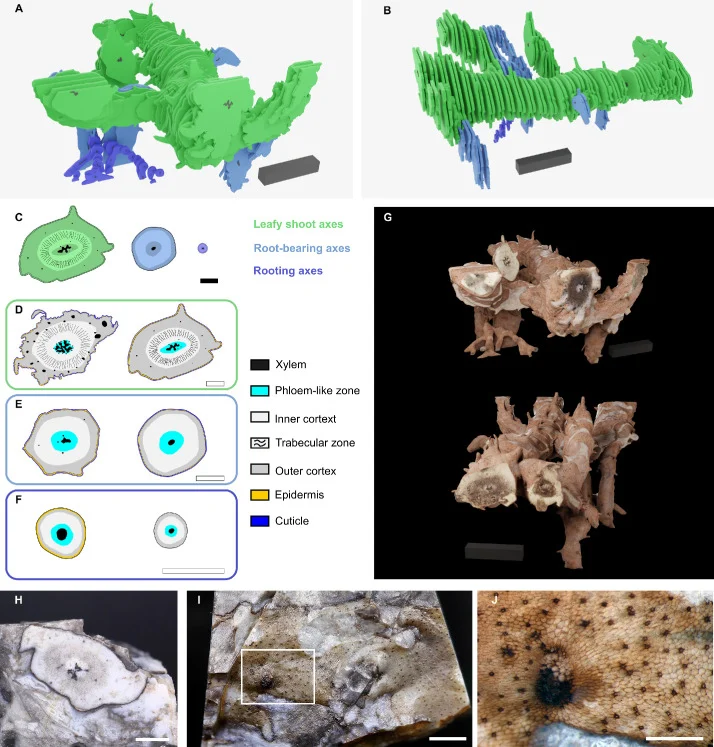
Fossil-based reconstruction, anatomical sections and specimen photographs of Asteroxylon mackiei in Hetherington and coauthors’ figure 1
The figure combines a reconstruction from 31 fossil sections, anatomical drawings and photographs of preserved axes in chert. Green, blue and purple distinguish three axis types; they do not establish the living plant’s colours. Matt Humpage’s panel G is an artist’s impression of the reconstructed system. The studied specimens are not designated types. Scale bars differ between panels; the published figure is reproduced unchanged.
Overview
Asteroxylon mackiei belonged to an early lycophyte lineage preserved in the silica-rich Rhynie chert. Its body combined leafy shoots, specialized root-bearing axes and finer rooting axes. These were anatomically different structures, rather than identical branches given different names. The larger shoots had abundant stomata, traces supplying their leaf-like outgrowths and a star-shaped central conducting strand. Root-bearing axes had fewer outgrowths and a more elliptical vascular strand. The slender rooting axes lacked stomata, leaf traces and a cuticle, and their conducting strand was approximately circular.
Hetherington and colleagues reconstructed connected parts of one individual from 31 consecutive rock sections. The studied volume measured 4.8 by 3.5 by 2.8 centimetres; it was not an entire plant. The reconstructions show larger axes spreading horizontally and others turning upwards, while root-bearing axes descend more strongly. Rooting axes, commonly less than one millimetre across, branch repeatedly over short distances. The historical picture of a roughly 30-centimetre plant is a broader reconstruction, rather than the height measured in this particular block.
The crucial transition occurs at an unequal fork. A root-bearing axis divides into another root-bearing axis and a thinner rooting axis. A second reconstruction from serial peels follows the continuous tissues through such a junction, while a separate museum section preserves an apex dividing into two meristems. Together these observations support origin by division of an existing growing tip. Modern lycopsid roots instead normally originate within another organ before emerging through its tissues, even though established roots themselves can subsequently fork.
These rooting organs were transitional in another important respect: they lacked the root cap and root hairs characteristic of living lycopsid roots. They should therefore not be presented as anatomically interchangeable with a modern clubmoss root. The paper interprets their combination of characters as evidence for stepwise assembly of the lycophyte rooting system. Comparisons with other early plants suggest that changes in organ type at branch points were more widespread, but the authors acknowledge that compression fossils often preserve too few anatomical characters to test the hypothesis decisively.
The preserved sections document structure and development exceptionally well, but the reconstruction does not connect every organ of the whole plant. Fertile axes were not attached to the reconstructed individual. Asteroxylon is consequently valuable evidence for an extinct body plan, without being identified as the direct ancestor of any living species. A separate 2023 study also documents the fungus Potteromyces asteroxylicola in its outer tissues, with localized tissue changes interpreted as a reaction to infection.
Origins & earliest records
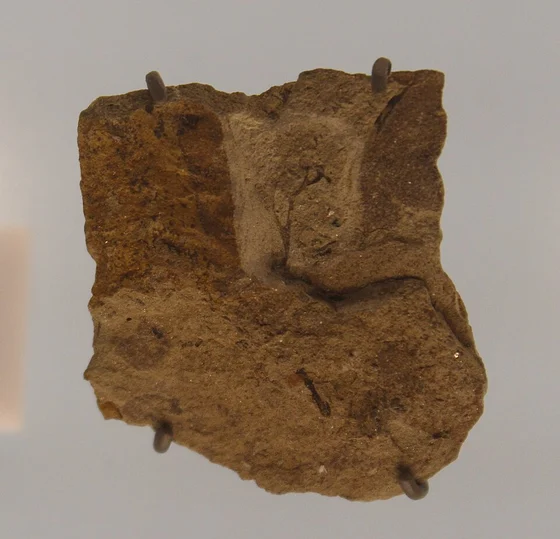
The 2021 reconstruction examines Early Devonian Rhynie chert material, including Münster preparations Pb 4161–4191 from a block collected in 1964, the Bhutta serial-peel collection at Cardiff, and NHMUK 16433. These are studied preparations, not a newly designated holotype.
Evidence & interpretation
Serial sections preserve connected axes and their vascular anatomy. The additional peel series contains four missing preparations, explicitly represented as gaps in the reconstruction. Preserved apical meristems support unequal branching; the broader evolutionary comparison is an interpretation of these observations. The 2023 pathogen study supplies a separate plant–fungus association.
Selected bibliography
Documented works and useful reading. This is not a list of every appearance.
- 01
An evidence-based 3D reconstruction of Asteroxylon mackiei, the most complex plant preserved from the Rhynie chert
eLife 10:e69447; complete main Results, Discussion, Conclusions and Methods. Original adaptation of the CC BY 4.0 article, with attribution to its authors. https://creativecommons.org/licenses/by/4.0/.
- 02
A fungal plant pathogen discovered in the Devonian Rhynie Chert
Nature Communications 14,7932; the separately documented Potteromyces–Asteroxylon association. CC BY 4.0.
Family, evolution & connections
Taxonomic classification
A hierarchy of classified groups, not a chain of direct ancestors.
- GenusAsteroxylon
- SpeciesAsteroxylon mackiei
References
Sources supporting this profile. Linked pages have their own scope and editorial standards.
- ResearchHetherington et al. 2021 primary reconstructionResearch access: 2026-10-05
- ResearchStrullu-Derrien et al. 2023 primary pathogen descriptionResearch access: 2026-10-05
Image credits
Scientific fossil reconstruction and specimen figureFossil-based reconstruction, anatomical sections and specimen photographs of Asteroxylon mackiei in Hetherington and coauthors’ figure 1
The figure combines a reconstruction from 31 fossil sections, anatomical drawings and photographs of preserved axes in chert. Green, blue and purple distinguish three axis types; they do not establish the living plant’s colours. Matt Humpage’s panel G is an artist’s impression of the reconstructed system. The studied specimens are not designated types. Scale bars differ between panels; the published figure is reproduced unchanged.