Cooksonia
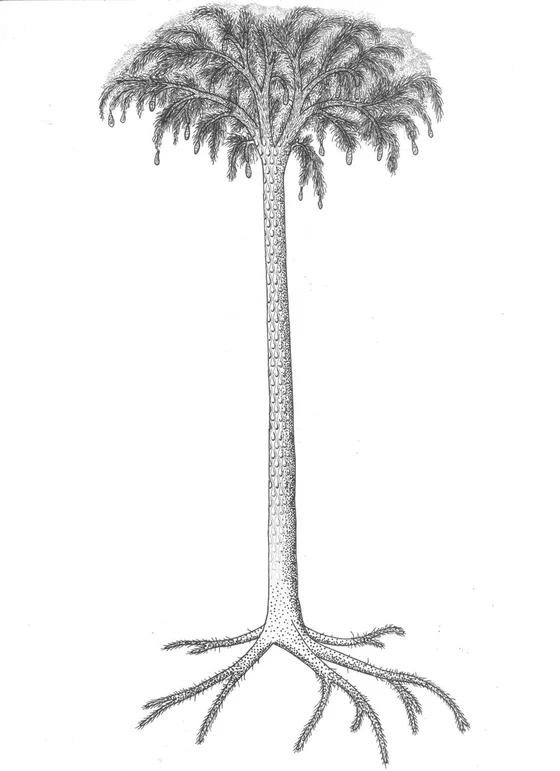
Image associated with the exact linked encyclopedia article; consult credited file description for its interpretation.
Overview
Cooksonia fossils show small, branching axes without the broad leaves familiar on many modern plants. Spore-bearing structures occur at the tips. This relatively spare form makes the genus important in studying the early establishment of plants on land, when upright support, transport and reproduction were developing in combinations different from those of later forests.
Silurian specimens from the British Isles feature prominently in museum collections. Some anatomical characters require exceptionally preserved material, and different assigned species are not necessarily identical in their organisation. Cooksonia is often described as an early vascular plant, but the detailed evidence and scope of that designation should be considered specimen by specimen. Its small size does not imply that the surrounding terrestrial ecosystem was biologically simple or devoid of other organisms.
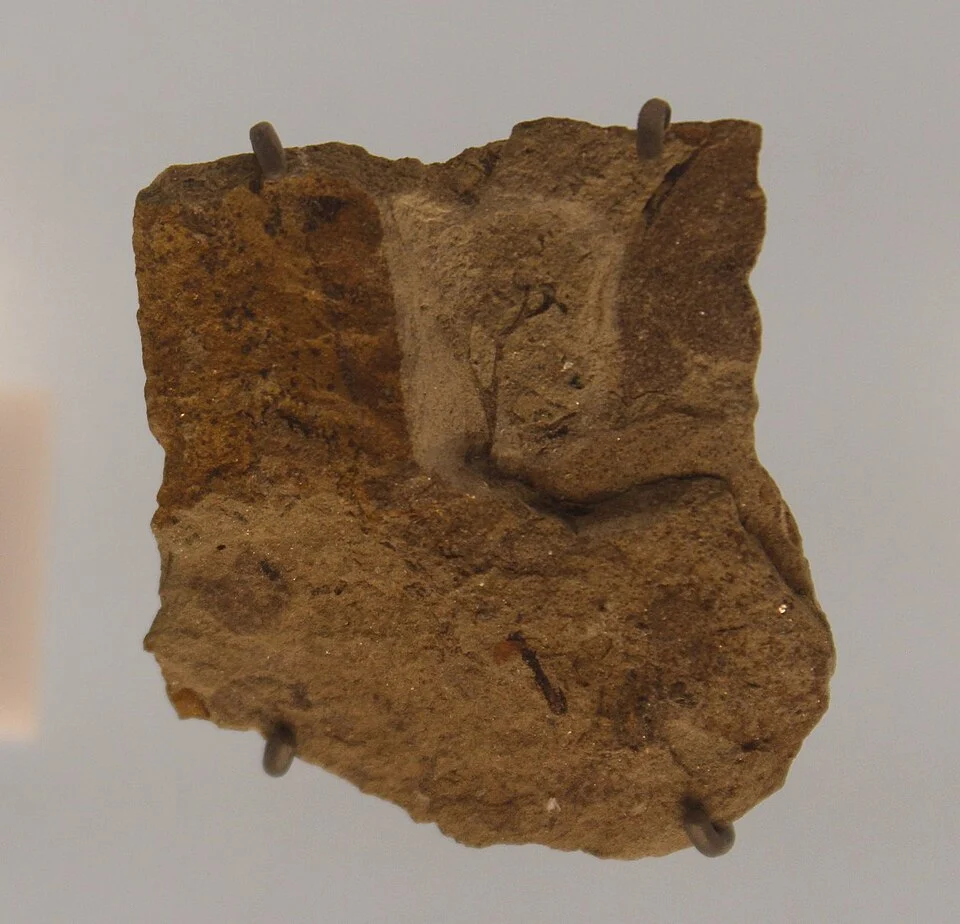
Libertín and colleagues' 2018 Czech study locates Cooksonia barrandei holotype NM-D 552a,b at Loděnice, in the Motol Formation. Associated graptolites support a middle Sheinwoodian age around 432 million years; this is stratigraphic correlation, not direct specimen dating. The material is held in Prague's National Museum. Three additional fertile-looking specimens remain Cooksonia sp., not automatically C. barrandei: attachment of some presumed sporangia is obscured. Compression preservation prevented detailed comparisons with charcoal-preserved taxa. Neither cuticle preparation nor scanning electron microscopy revealed informative conducting-cell anatomy in this material. Marine burial records transported land vegetation near a volcanic island, rather than proving marine growth.
Origins & earliest records
Cooksonia is represented in Silurian deposits, including specimens from Ireland and Shropshire, with an approximate marker near 430 million years ago. These occurrences are evidence of early land plants, not proof that Cooksonia was the first plant on land. Its scientific recognition is separate from the earlier evolutionary development of plant lineages.
Evidence & interpretation
Branching axes and terminal spore structures are preserved as compressions or other fossil remains. Internal transport tissues are harder to evaluate and depend on preservation. Fragmentary specimens can conceal whole-plant organisation, so the genus' appearance and assigned species should not automatically be turned into a complete ancestral blueprint for every vascular plant.
Selected bibliography
Documented works and useful reading. This is not a list of every appearance.
- 01
Plants – Cooksonia and Carboniferous swamps
Selected institutional scientific reading; not a complete bibliography.
- 02
Plant diversity of the mid Silurian (lower Wenlock, Sheinwoodian) terrestrial vegetation preserved in marine sediments from the Barrandian area, the Czech Republic
Fossil Imprint 74:327–333; complete main paper.
Family, evolution & connections
Taxonomic classification
A hierarchy of classified groups, not a chain of direct ancestors.
Encyclopedia background
An additional attributed reference, separate from the editorial profile above.
Read the open encyclopedia overview
Cooksonia is an extinct group of primitive land plants, treated as a genus, although probably not monophyletic. The earliest Cooksonia date from the middle of the Silurian (the Wenlock epoch); the group continued to be an important component of the flora until the end of the Early Devonian, a total time span of 433 to 393 million years ago. While Cooksonia fossils are distributed globally, most type specimens come from Britain, where they were first discovered in 1937. Cooksonia includes the oldest known plant to have a stem with vascular tissue and is thus a transitional form between the primitive non-vascular bryophytes and the vascular plants.
Text from Wikipedia contributors, “Cooksonia”. CC BY-SA 4.0. Extracted introduction; formatting changed. Retrieved 5 October 2026. The source article may have changed since retrieval.
References
Sources supporting this profile. Linked pages have their own scope and editorial standards.
- MuseumPlants – Cooksonia and Carboniferous swampsResearch access: 2026-10-05
- ResearchLibertín et al. 2018 — Barrandian fossil plantsResearch access: 2026-10-05
Image credits
Reference illustrationCooksonia
Image associated with the exact linked encyclopedia article; consult credited file description for its interpretation.