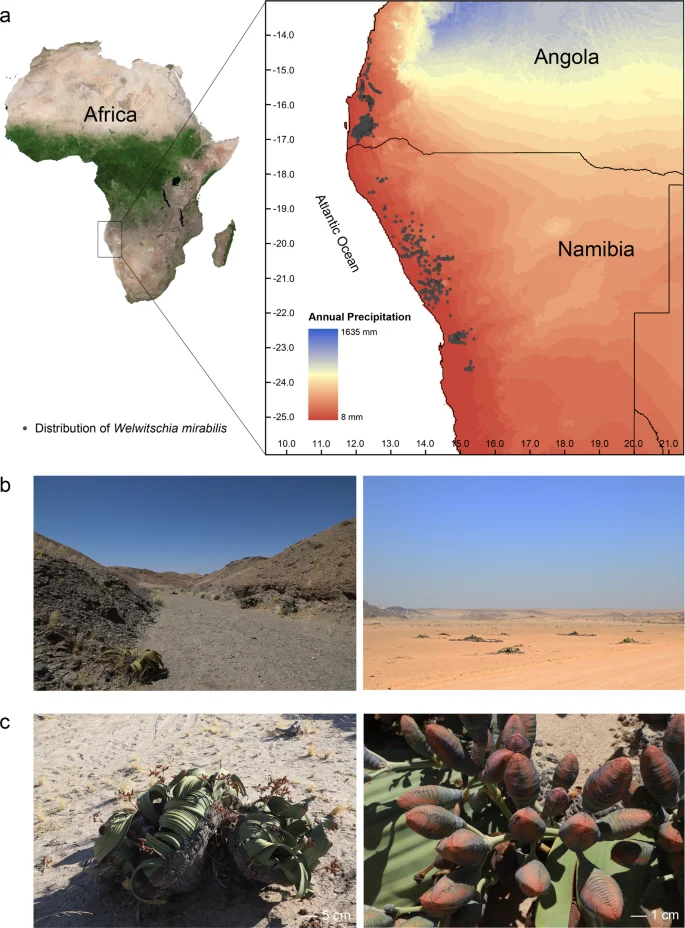
Welwitschia mirabilis distribution, habitat and male and female plants in Wan and coauthors’ figure 1
This figure places the species’ recorded distribution alongside desert habitats and photographs of male and female plants in cone. It combines geographic context with actual plant images. The map’s colour scale represents annual precipitation, while the lower photographs have separate scale bars. These examples do not establish the ages of the individual plants. The published figure is reproduced unchanged.
Overview
Welwitschia mirabilis grows in the arid coastal region of northern Namibia and southern Angola. It produces just two persistent leaves, which continue extending throughout the plant’s life. Their fibrous, strap-like tissue emerges from grooves near the top of the stem. The growth pattern differs from plants that repeatedly replace their leaves: the young plant’s shoot apex dies, while growth continues at the leaf bases. Damage to old leaf tissue need not destroy the plant, but damage to the basal growing tissue can be fatal.
Wan and colleagues investigate this organization by comparing RNA activity in growing tissues and leaf sections. Genes associated with meristem activity are expressed together at the leaf base, including regulatory genes whose relationships differ from those in many plants with determinate leaf growth. The researchers also measure higher concentrations of the growth-related hormone castasterone in basal meristems than in leaves. These observations support sustained cell production, without demonstrating that any single gene or hormone makes a leaf immortal.
The genomic study uses a male plant conserved at Fairy Lake Botanical Garden, complemented by tissue samples from plants growing in Namibia and another cultivated individual. Its chromosome-level assembly spans about 6.86 billion DNA bases, with 21 reconstructed chromosome-scale sequences and 26,990 predicted protein-coding genes. Repetitive DNA occupies most of the genome. Comparisons with Gnetum identify duplicated and rearranged genomic regions, supporting an ancient whole-genome duplication in the Welwitschia lineage rather than treating its unusual shape as evidence of genetic simplicity.
DNA methylation provides another layer of regulation. The researchers find substantial chemical marking of repetitive elements, with differences between leaves and their basal growing tissues, and between cultivated and wild material. They interpret these patterns as potentially helping silence mobile genetic elements and protect long-lived growing regions. Environmental responses and the evolutionary consequences of this marking remain interpretations of comparative observations; the study does not experimentally recreate centuries of desert survival.
Young leaf regions show elevated activity in pathways involved in building cellulose, lignin and other structural materials. Basal meristems also express genes connected with protein protection, DNA repair and stress responses. The paper places these findings alongside previous radiocarbon estimates indicating that some large plants exceed 1,500 years. That does not give every individual the same age, or mean every cell in a leaf survives that long. Welwitschia’s enduring leaves are continually renewed by basal growth, making longevity a property of an organized living system rather than an absence of tissue turnover.
Origins & earliest records
Wan and colleagues published the 2021 primary genome and tissue study in Nature Communications 12,4247. The sequenced male plant has botanical-garden accession SZBG 00052740; a separate cultivated plant SZBG 00052750 and wild Namibian material supplied additional tissue comparisons. These accessions are not nomenclatural types.
Evidence & interpretation
Genome assembly and annotation, comparative sequence organization, RNA expression, DNA methylation and measured hormone concentrations provide distinct evidence. Explanations linking them to longevity and desert adaptation are qualified; individual ages cited from earlier studies are not newly measured by the genome project.
Selected bibliography
Documented works and useful reading. This is not a list of every appearance.
- 01
The Welwitschia genome reveals a unique biology underpinning extreme longevity in deserts
Nature Communications 12,4247; main Introduction, Results and longevity Discussion, complete plant-material, assembly, annotation and gene-prediction Methods. Original adaptation of CC BY 4.0 article. https://creativecommons.org/licenses/by/4.0/.
Family, evolution & connections
Taxonomic classification
A hierarchy of classified groups, not a chain of direct ancestors.
- FamilyWelwitschiaceae
- GenusWelwitschia
- SpeciesWelwitschia mirabilis
Gnetum montanum genome
Wan and colleagues found sampled Gnetum genome segments corresponding to paired Welwitschia segments, alongside duplicated-gene patterns. These comparisons support an ancient duplication in the Welwitschia lineage. They concern reconstructed chromosome history, not a claim that the living Gnetum species was Welwitschia’s ancestor or that duplication alone explains longevity.
References
Sources supporting this profile. Linked pages have their own scope and editorial standards.
- ResearchWan et al. 2021 primary genome and tissue studyResearch access: 2026-10-05
Image credits
Scientific plant photographs and distribution mapWelwitschia mirabilis distribution, habitat and male and female plants in Wan and coauthors’ figure 1
This figure places the species’ recorded distribution alongside desert habitats and photographs of male and female plants in cone. It combines geographic context with actual plant images. The map’s colour scale represents annual precipitation, while the lower photographs have separate scale bars. These examples do not establish the ages of the individual plants. The published figure is reproduced unchanged.