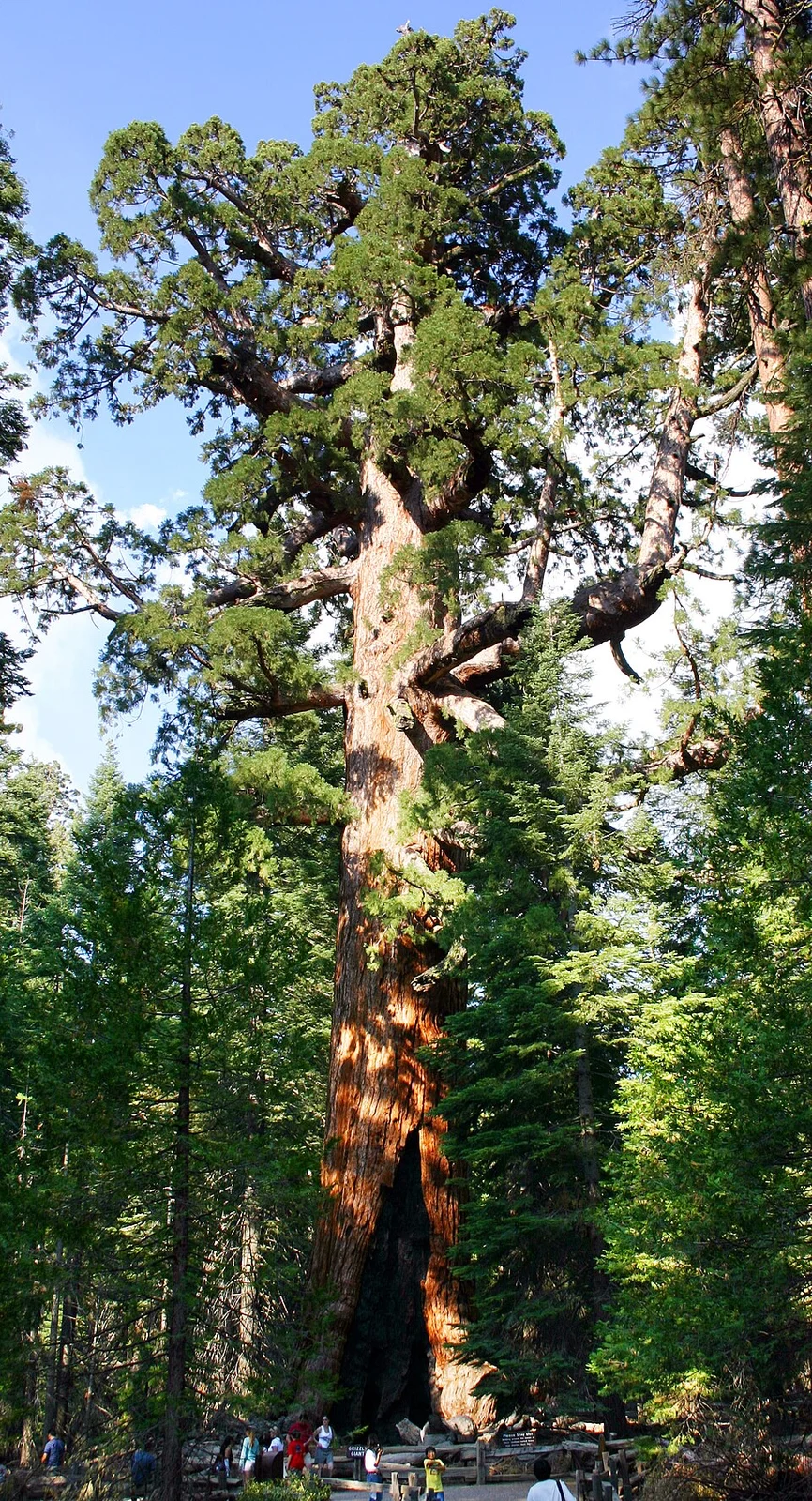
Giant sequoia
Image associated with the exact linked encyclopedia article; consult credited file description for its interpretation.
Overview
Giant sequoias are native to groves in California's Sierra Nevada. Thick bark and immense trunks make old trees prominent in forest landscapes, but the living population also depends on younger stages that require appropriate conditions for establishment. Their ecological history is inseparable from the surrounding forest and its disturbance processes.
Tree rings record frequent surface fires before major changes associated with grazing, loss of Indigenous burning and government fire suppression. Fire can create openings and conditions useful for sequoia recruitment, while severe modern fires can kill even large trees. These are different fire regimes, not a contradiction. Conservation therefore considers fuel conditions, changing climate and the history of land management rather than assuming that every fire benefits the species.
Genomic research adds another scale to that ecological account. Scott and colleagues assembled a reference genome in 2020 using material from SEGI21, a large tree in Sequoia/Kings Canyon National Park. Cones collected in 2012 supplied a haploid seed megagametophyte for short-read sequencing; foliage collected in 2017 supplied diploid DNA for long reads and chromosome-conformation libraries. Additional root, foliage and cambium transcript evidence came from cultivated material. The reference therefore combines complementary biological samples rather than sequencing every grove or deriving all gene-expression evidence from one ancient tree.
The resulting assembly contains about 8.125 billion bases. Its eleven largest scaffolds correspond to the known chromosome number, with seven carrying telomeric sequence at both ends and four at one end. Repeated centromeric and telomeric sequences helped detect and correct a mistaken join. Chromosome-scale continuity is useful, but does not mean every base or chromosome end is finished: gaps and smaller unplaced scaffolds remain. This distinction matters particularly in a repeat-rich conifer genome, where roughly four fifths of the sequence was masked as repetitive material during annotation.
After filtering initial predictions and integrating transcript evidence, the authors reported 41,632 high-quality gene models. Gene prediction is especially difficult when introns are very long. Their completeness assessments differed among raw assembly, transcript data and annotation, illustrating why long scaffolds alone do not certify that every gene has been recovered. Comparative analyses with other gymnosperms identified changing gene-family sizes, but these are model-dependent evolutionary reconstructions, not a direct observation of ancestral trees.
The study also investigated NLR proteins, a plant immune-receptor class. A motif-search pipeline identified 984 complete or partial candidate regions; comparison with the annotation supported a narrower set of 375 consensus candidates. Some may still be fragments or pseudogenes, and their locations are uneven across the chromosomes. These numbers do not establish resistance to particular pathogens, beetles or drought. The reference is a basis for testing genetic variation and responses across living populations; it does not by itself identify which trees should be planted or prove that a large immune-gene repertoire guarantees survival under severe fire.
Origins & earliest records
Giant sequoias belong to an older conifer lineage, but the age of that lineage does not establish the first occurrence of the living species. The present Sierra Nevada groves have their own environmental and cultural histories. Tree-ring ages measure individual trees and past events rather than the evolutionary origin of Sequoiadendron giganteum.
Evidence & interpretation
Tree-ring records, field observations and post-fire surveys establish fire history, recruitment and mortality. The cited National Park Service account connects these records with changing management. Results vary among groves and fire severities, so evidence for beneficial surface fire cannot justify claiming that all burning is favourable or that ancient trees are invulnerable. Complementary sequencing libraries, chromosome scaffolding and transcript-supported annotation provide reference-genome evidence; NLR predictions do not demonstrate resistance.
Selected bibliography
Documented works and useful reading. This is not a list of every appearance.
- 01
Giant Sequoias and Fire
Selected institutional scientific reading; not a complete bibliography.
- 02
A Reference Genome Sequence for Giant Sequoia
G3 10, 3907-3919. Full main Introduction, Methods, Results/Discussion and conclusions read, including NLR classification and assembly limitations. CC BY4.0 factual adaptation; supplements and computational analyses not reproduced.
Family, evolution & connections
Six sampled gymnosperms in the 2022 nuclear-gene analysis
The six gymnosperm tips pruned from the 15-taxon Figure 1b; angiosperms, ferns and lycophyte outgroup omitted.
Scroll sideways to see all branches. With a keyboard, focus the tree and use the arrow keys.
- Sampled gymnosperms (nuclear Figure 1b)
- Ginkgo / Cycas pair (organelle conflict noted)
- Cycas panzhihuaensis
- Remaining sampled gymnosperms
- Gnetum and sampled Pinaceae
- Gnetum montanum
- Picea / Pinus pair
- Picea abies
- Pinus taeda
Selected branching topology from nuclear single-copy gene first and second codon positions (SSCG-NT12); Figure 1 caption reports maximum ML bootstrap and ASTRAL support. Nuclear/plastid and mitochondrial datasets disagree on the position of cycads. High summarized branch support coexists with substantial gene-tree conflict; incomplete lineage sorting is discussed as an explanation, not shown here as a dated event. Selected tips are sampled representatives, not all species or direct ancestors. Dates and whole-genome duplications are omitted.
Redwoods and selected plants — Fu 2023
All nine species depicted in Figure 1D; branch lengths, dates and gene-family counts omitted.
Scroll sideways to see all branches. With a keyboard, focus the tree and use the arrow keys.
- Nine-species Figure 1D topology
- Azolla filiculoides
- Remaining sampled seed plants
- Sampled angiosperms
- Amborella trichopoda
- Oryza / Vitis pair
- Oryza sativa
- Vitis vinifera
- Sampled gymnosperms
- Taxus and redwoods
- Taxus yunnanensis
- Three sampled redwoods
- Metasequoia glyptostroboides
- Sequoiadendron / Sequoia pair
- Sequoia sempervirens
195 single-copy ortholog groups aligned with MAFFT; RAxML gene trees combined in ASTRAL with 100 bootstrap replicates. A study-specific species-tree summary, not direct ancestry. Figure 1D’s green values are estimated times; other numbers count gene-family changes, not support. Figure 3 shows 48.25% discordance among 2,033 qualifying single-copy gene trees. Separate QuIBL, MSCquartets and PhyloNet tests favour incomplete lineage sorting rather than hybridisation in the tested datasets; this does not prove absence of every historical gene-flow event. No numerical node confidence is inferred from the illustration.
Taxonomic classification
A hierarchy of classified groups, not a chain of direct ancestors.
- kingdomPlantae
- phylumTracheophyta
- classPinopsida
- orderPinales
- familyCupressaceae
- genusSequoiadendron
- speciesSequoiadendron giganteum
Gnetum montanum and sampled Pinaceae (Liu et al. 2022)
Figure 1b places giant sequoia beside the sampled Gnetum-plus-Pinaceae clade. The study explicitly compares conflicting genomic histories; this selected nuclear topology is not a claim that a living pine or gnetophyte descended from giant sequoia.
Sequoia sempervirens
Figure 1D pairs giant sequoia with coast redwood, with dawn redwood outside that pair. Almost half the qualifying single-copy gene trees disagree; the study’s tests favour incomplete lineage sorting in these data. Neither living species is depicted as the other’s ancestor.
Located primary passages
Specific passages supporting details in this entry, grouped by their published witness.
Primary source witness
G3 Genes|Genomes|Genetics10(11),3907–3919; DOI10.1534/g3.120.401612; actualPDF firstpage states early online18September2020, November2020 issue
- The study builds a chromosome-scale reference from seed and foliage material of one giant sequoia, SEGI21, combining short reads, long reads and proximity information. Annotation yields41,632 high-confidence gene models. Candidate disease-resistance sequences require qualification:984 motif-based predictions include pseudogene or false-positive possibilities, while375 are supported by annotation. The authors offer a basis for further conservation-genomic work, rather than experimentally demonstrated resistance to particular threats.
Selected sections only, not complete sequencing/annotation methods, entire Results, supplementary analyses or reproduced genomic computation. No current protection percentage/status, record-longest scaffold claim, causal resistance demonstration or directly measured NLR drought response in giant sequoia asserted. Cited comparative studies not independently read.
Encyclopedia background
An additional attributed reference, separate from the editorial profile above.
Read the open encyclopedia overview
Sequoiadendron giganteum (also known as the giant sequoia, giant redwood, Sierra redwood or Wellingtonia) is a species of coniferous tree, classified in the family Cupressaceae in the subfamily Sequoioideae. Giant sequoia specimens are the largest trees on Earth. They are native to the groves on the western slopes of the Sierra Nevada mountain range of California but have been introduced, planted, and grown around the world.
The giant sequoia is listed as an endangered species by the IUCN with fewer than 80,000 remaining in its native California.
The giant sequoia grow to an average height of 50–85 m (164–279 ft) with trunk diameters ranging from 6–8 m (20–26 ft). Record trees have been measured at 94.8 m (311 ft) tall. The specimen known to have the greatest diameter at breast height is the General Grant tree at 8.8 m (29 ft). Giant sequoias are among the oldest living organisms on Earth. The oldest known giant sequoia is 3,200–3,266 years old.
Wood from mature giant sequoias is fibrous and brittle; trees would often shatter after they were felled. The wood is unsuitable for construction and instead is used for fence posts or match sticks. The giant sequoia is a very popular ornamental tree in many parts of the world.
Text from Wikipedia contributors, “Sequoiadendron giganteum”. CC BY-SA 4.0. Extracted introduction; formatting changed. Retrieved 5 October 2026. The source article may have changed since retrieval.
References
Sources supporting this profile. Linked pages have their own scope and editorial standards.
- ResearchGiant Sequoias and FireResearch access: 2026-10-05
- ResearchScott et al. 2020 primary reference-genome study (CC BY4.0)Research access: 2026-10-05
Image credits
Reference illustrationGiant sequoia
Image associated with the exact linked encyclopedia article; consult credited file description for its interpretation.