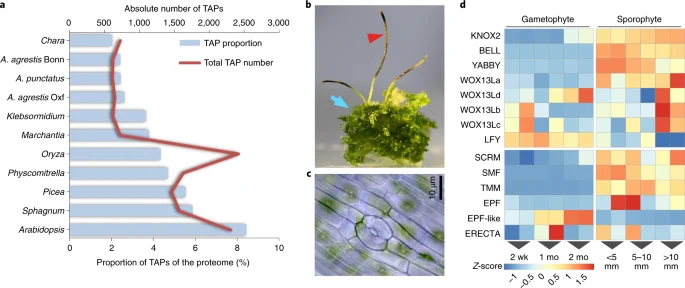
Anthoceros agrestis Bonn plant and stomatal micrograph alongside developmental gene-expression and transcription-factor plots, Li and coauthors 2020 figure 3
Panel b shows Anthoceros agrestis Bonn, with a red arrowhead marking a sporophyte and a blue arrow its gametophyte. Panel c is a stomatal micrograph; the surrounding panels compare transcription factors and developmental gene expression. The colored heatmap encodes measurements and does not describe the plant’s natural coloration.
Overview
Anthoceros agrestis is a hornwort, belonging to a bryophyte lineage distinct from mosses and liverworts. Its life cycle is dominated by the gametophyte, while fertilization produces an elongated sporophyte that releases spores. The sporophyte keeps producing tissue from a basal meristem, with maturation proceeding toward its tip. This arrangement differs from a flowering plant shoot’s growing tip. A 2020 genome study compares the Bonn and Oxford research strains with the related hornwort Anthoceros punctatus to investigate development, photosynthesis and microbial partnership.
The Bonn assembly places most of its sequence in six large scaffolds, consistent with six chromosome pairs. Across all three assemblies, total sequence lengths range from 117 to 133 million bases. The study combines sequencing, chromosome-conformation information, gene prediction and RNA evidence rather than treating a single draft as an exact universal genome. Its comparisons find little internal conserved gene-order duplication and no clear whole-genome duplication signal in the sampled Anthoceros genomes. This differs from the duplicated genome history of the moss used for comparison.
Developing sporophytes express several genes related to flowering-plant meristem and stomatal regulation. Some are present while others are absent, and their timing differs between developmental stages. These results support hypotheses about shared genetic components, rather than proving that hornwort and flowering-plant growth mechanisms are identical. Likewise, the lack of familiar repeat-rich centromere regions is intriguing but inconclusive: the authors explicitly acknowledge that difficult regions may have escaped correct sequencing or assembly.
The Oxford strain can form a laboratory association with the nitrogen-fixing cyanobacterium Nostoc punctiforme. The investigators compare nitrogen-fed, nitrogen-starved and reconstituted symbiotic cultures in both hornwort species. Forty genes are strongly induced in the presence of the cyanobiont in both hosts, including transporters and regulatory proteins. A SWEET-family sugar transporter is particularly strongly expressed, making it a candidate for supplying carbon to the partner. Expression implicates a possible role; transport through that particular protein is not directly established by this experiment.
Hornwort chloroplasts can contain pyrenoids, compartments associated with concentrating carbon dioxide around the photosynthetic enzyme RuBisCO. The study identifies a candidate LCIB gene related to a carbon-concentrating component studied in green algae. However, its expression does not change clearly across the tested carbon-dioxide environments, and its location and function still require experimental confirmation. A phylogeny based on 742 mostly single-copy genes supports hornworts as sister to mosses plus liverworts within a monophyletic bryophyte group. That reconstruction places living lineages in relation to one another; it does not make this modern species the ancestor of vascular plants.
Origins & earliest records
Li and colleagues’ 2020 study sequences single-spore-derived Bonn and Oxford strains alongside Anthoceros punctatus. These cultured research strains are not presented as nomenclatural types.
Evidence & interpretation
Genome assemblies, chromosome counts, conserved gene-order comparisons and developmental or symbiosis RNA experiments support the account. Proposed centromere structure, transporter function and carbon-concentrating roles retain the study’s stated uncertainties.
Selected bibliography
Documented works and useful reading. This is not a list of every appearance.
- 01
Anthoceros genomes illuminate the origin of land plants and the unique biology of hornworts
Nature Plants 6,259–272; main genomic, developmental, symbiotic and carbon-concentrating sections, and corresponding sampling, expression, assembly and phylogenetic Methods. Original adaptation of CC BY 4.0 article, https://creativecommons.org/licenses/by/4.0/.
Family, evolution & connections
Hornwort placement in Li et al.’s 2020 genome analysis
Eight retained species from the 21-genome Figure 2 amino-acid topology. Bonn and Oxford Anthoceros agrestis strain tips are collapsed into one species label; the sampled vascular plants are reduced to Selaginella moellendorffii. Other tips are pruned.
Scroll sideways to see all branches. With a keyboard, focus the tree and use the arrow keys.
- Selected Figure 2 topology
- Klebsormidium nitens
- Remaining selected streptophytes
- Chara braunii
- Remaining selected samples
- Mesotaenium endlicherianum
- Land plants (bootstrap 100; SH-aLRT 100; local posterior 1.0)
- Selaginella moellendorffii
- Bryophytes (bootstrap 100; SH-aLRT 100; local posterior 1.0)
- Moss / liverwort lineage (bootstrap 100; SH-aLRT 100; local posterior 1.0)
- Sampled hornworts
- Anthoceros punctatus
742 mostly single-copy orthogroups; MAFFT alignments, IQ-TREE concatenation and ASTRAL gene-tree summary. Thick original branches indicate maximal support in both nucleotide and amino-acid analyses: 1,000-replicate ultrafast bootstrap and SH-aLRT, and local posterior probability. The inset supports the bryophyte hypothesis in over half of gene-tree quartets, leaving substantial discordance. Displayed support belongs to original nodes and is not recalculated after pruning. Thin branches receive no invented value. The 0.2 scale is substitutions per site, not time; no living species is shown as a direct ancestor. Historical source names are retained.
Taxonomic classification
A hierarchy of classified groups, not a chain of direct ancestors.
- GenusAnthoceros
- SpeciesAnthoceros agrestis
Sampled mosses and liverworts
Li and colleagues’ 742-gene analysis places sampled hornworts sister to mosses plus liverworts within bryophytes. Over half of the gene-tree quartets support that grouping, rather than all genes agreeing. This is a sampled phylogenetic hypothesis, not a claim that a living moss or hornwort was another species’ ancestor.
Nostoc punctiforme
The study reconstituted symbiosis between the Oxford hornwort strain and Nostoc punctiforme ATCC 29133, comparing gene expression with cyanobacterium-free cultures. A strongly induced sugar-transporter gene suggests a carbon-supply role; the expression evidence alone does not demonstrate transport function or every natural partner.
References
Sources supporting this profile. Linked pages have their own scope and editorial standards.
- ResearchLi et al. 2020 hornwort genome studyResearch access: 2026-10-05
Image credits
Scientific plant photograph and microscopy figureAnthoceros agrestis Bonn plant and stomatal micrograph alongside developmental gene-expression and transcription-factor plots, Li and coauthors 2020 figure 3
Panel b shows Anthoceros agrestis Bonn, with a red arrowhead marking a sporophyte and a blue arrow its gametophyte. Panel c is a stomatal micrograph; the surrounding panels compare transcription factors and developmental gene expression. The colored heatmap encodes measurements and does not describe the plant’s natural coloration.