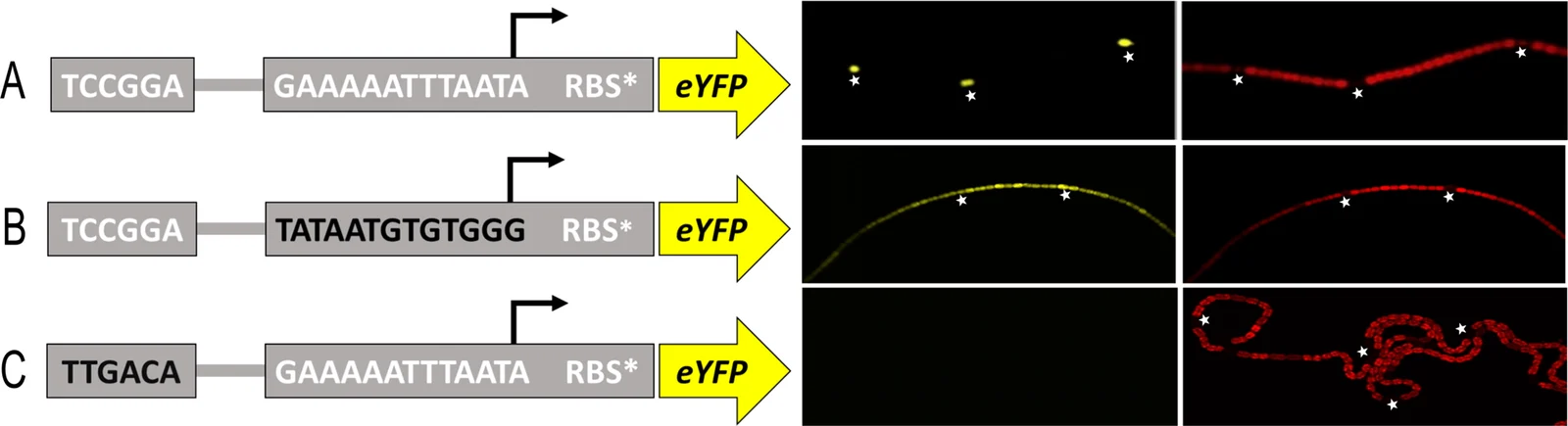
Experimental Nostoc punctiforme filaments in yellow reporter and red autofluorescence channels beside three promoter diagrams, Wegelius and colleagues’ 2018 figure 3
Nostoc punctiforme ATCC 29133 filaments were imaged twelve hours after combined nitrogen was removed. Yellow records expression from three experimental promoter–YFP constructs; red records autofluorescence. Stars identify heterocysts, and the left-hand panels diagram the constructs. These fluorescent channels are not an ordinary daylight portrait of the cyanobacterium. The complete published figure is shown.
Overview
Nostoc punctiforme is a filamentous cyanobacterium with differentiated cell forms and a capacity for plant association. Cyanobacteria are bacteria, despite older descriptions of them as blue-green algae. The 2025 study summarized here examined the axenic culture PCC 73102 from the Pasteur Culture Collection alongside two other Nostoc field isolates. Its detailed growth tests show that photosynthesis does not necessarily make a cultured organism independent of the surrounding microbial community under every environmental condition.
The investigators compared growth on nitrogen-free medium across three carbonate levels. PCC 73102 grew poorly without added carbonate and performed much better at the highest level. The two comparison strains, KVJ2 and KVJ3, carried associated microbiomes and grew well even when carbonate was limited. They are identified as Nostoc sp., rather than automatically assigned to N. punctiforme. Different strains and community compositions therefore form part of the experiment; the comparison does not by itself separate every possible effect of laboratory history from environmental association.
The researchers isolated several accompanying bacteria and tested their effects on PCC 73102. Some promoted cyanobacterial growth, while closely related isolates did not necessarily do so. One strongly effective isolate, Agrobacterium tumefaciens Het4, was selected for further study because it could maintain close physical interaction with the cyanobacterium. Adding Het4 improved growth under limited or intermediate carbonate conditions, but had a negative effect at high carbonate. The relationship consequently includes context-dependent benefits and costs, rather than demonstrating an unconditional mutualism.
The authors interpret the carbonate responses as evidence that inorganic-carbon supply constrains this culture and that associated heterotrophic bacteria can help relieve the constraint. They discuss respiratory carbon supply as a likely component of the partnership. Their comparison of carbon-acquisition genes also identifies possible contributors to weak carbon concentration, but a gene inventory alone does not prove the contribution of each transporter. The study’s broader proteomic and microscopy observations support additional hypotheses about the partnership; those analyses are not independently reproduced here.
An important qualification concerns domestication. The authors contrast PCC 73102 with the synonymous collection culture ATCC 29133, for which different growth and motility experiences have been reported. They therefore restrict the near-obligate dependence found in their experiments primarily to PCC 73102 and the selected conditions. This is evidence for physiological and ecological flexibility within studied cultures, not a claim that all free-living Nostoc require Agrobacterium or that every plant association works through the same metabolic exchange.
Origins & earliest records
Account based on selected complete growth Results, full Discussion and corresponding culture/plate-assay Methods in Teikari and colleagues’ 2025 primary study.
Evidence & interpretation
Replicated carbonate plate assays and reconstituted co-cultures support conditional growth promotion; proposed carbon-supply mechanisms are distinguished from the direct growth comparison.
Selected bibliography
Documented works and useful reading. This is not a list of every appearance.
- 01
Competition and interdependence define interactions of Nostoc sp. and Agrobacterium sp. under inorganic carbon limitation
npj Biofilms and Microbiomes 11, 42. Complete first growth Results section, Discussion, strains/plate-assay and relevant sequencing Methods read; later proteomic/microscopy Results not wholly read. PCC 73102 study culture; CC BY 4.0 adaptation credited.
Family, evolution & connections
Taxonomic classification
A hierarchy of classified groups, not a chain of direct ancestors.
- GenusNostoc
- SpeciesNostoc punctiforme
Agrobacterium tumefaciens Het4 (experimental isolate)
Teikari and colleagues reconstituted co-cultures of Nostoc punctiforme PCC 73102 with isolate Het4. The bacterial partner promoted cyanobacterial growth at limited or intermediate carbonate supply, but reduced growth at high carbonate. These replicated culture experiments establish a condition-dependent interaction, not an unconditional mutualism or a requirement of every Nostoc strain. Other closely related isolates did not all provide the same benefit.
References
Sources supporting this profile. Linked pages have their own scope and editorial standards.
- ResearchTeikari et al. 2025, primary microbial-interaction study (CC BY 4.0)Research access: 2026-10-05
Image credits
Scientific organism fluorescence microscopy and experiment figureExperimental Nostoc punctiforme filaments in yellow reporter and red autofluorescence channels beside three promoter diagrams, Wegelius and colleagues’ 2018 figure 3
Nostoc punctiforme ATCC 29133 filaments were imaged twelve hours after combined nitrogen was removed. Yellow records expression from three experimental promoter–YFP constructs; red records autofluorescence. Stars identify heterocysts, and the left-hand panels diagram the constructs. These fluorescent channels are not an ordinary daylight portrait of the cyanobacterium. The complete published figure is shown.