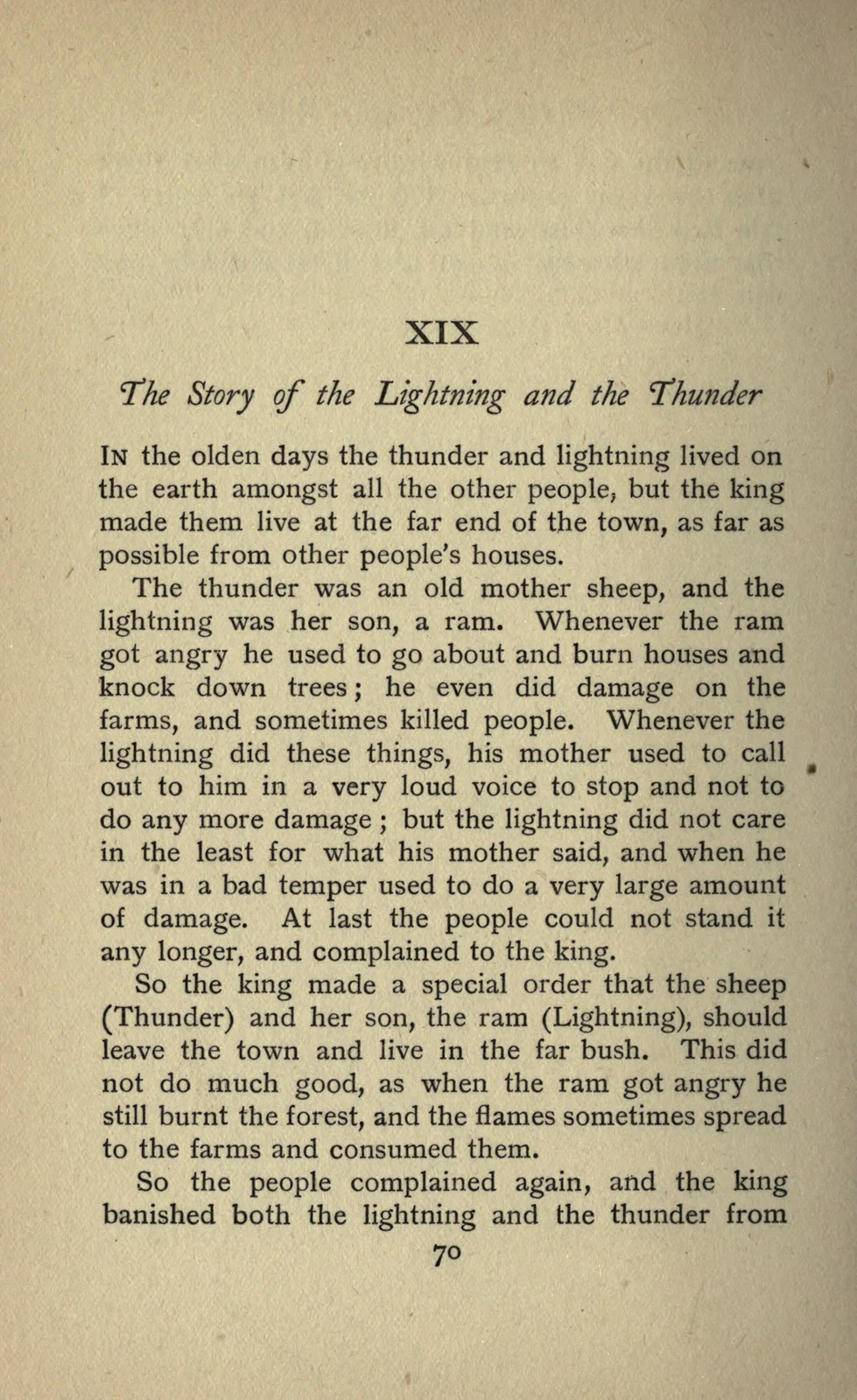
Thunder Sheep and Lightning Ram,1910 historical printed text witness, page70; documentary source-page facsimile
Documentary text facsimile of the exact named tale/being, not creature artwork. Printed page70 of the1910 collection. Original historical terminology remains in the source.
Overview
Thunder is an old mother sheep and Lightning her son, a ram. They initially live among people, but are placed at the far end of town because the ram’s anger burns houses, fells trees and damages farms. His mother loudly calls for restraint, yet he ignores her and sometimes kills people. The king responds to complaints by moving both beings into the distant bush, an attempted separation that leaves their storm-like destructive powers intact.
Fire still spreads from the forest to cultivated land, so the king banishes the pair from earth into the sky. The mother continues to rebuke her son whenever he grows angry, producing the sound heard after his destructive flashes. At times she has travelled too far away for her voice to be heard although the ram remains visibly active. The tale therefore links a family conflict, repeated relocation and animal forms to both noisy and silent lightning events.
Origins & earliest records
Dayrell 1910, tale XIX, a historical collector-mediated Southern Nigerian narrative. The selected chapter names neither a specific locality nor an individual contributor. The animal mother–son relation and successive removals are the chapter’s own explanation of storm events.
Records & interpretation
Complete tale XIX, The Story of the Lightning and the Thunder, pp. 70–71; relocation from town edge to bush and finally sky, including final distant-mother explanation, reread in full.
In the literature
“The thunder was an old mother sheep, and the lightning was her son, a ram.”
XIX: The Story of the Lightning and the Thunder; paragraph beginning “The thunder was an old mother sheep, and the lightning was her son, a ram. Whenever the ra…”
Mother Thunder’s cries rebuke her destructive ram son Lightning; complaints bring their banishment from town and bush to sky.
Selected bibliography
Documented works and useful reading. This is not a list of every appearance.
- 01
Folk Stories from Southern Nigeria, West Africa
Complete tale XIX, The Story of the Lightning and the Thunder, pp. 70–71; relocation from town edge to bush and finally sky, including final distant-mother explanation, reread in full.
Family, evolution & connections
Textual genealogy: Thunder and Lightning in Dayrell’s tale XIX
Explicit mother and son in the selected1910 collected tale.
Scroll sideways to see all branches. With a keyboard, focus the tree and use the arrow keys.
- Lightning (ram son)
Retain Thunder as the old mother sheep and Lightning as her ram son; the collective entry represents both figures. Narrative kinship rather than biological phylogeny or atmospheric science. No father or additional descendants are named. Colonial collection and editorial mediation do not establish a first oral date or consensus across contemporary communities. The root entry link points to the collective storm-family profile.
Lightning (ram son in Dayrell XIX)
In Dayrell’s nineteenth tale, Thunder is a mother sheep and Lightning is her ram son. Her shouting follows his destructive anger, and the king eventually removes both to the sky after earlier relocations fail. The relationship belongs to this collected explanation of storm behavior; it is not an identification of atmospheric electricity with real animal reproduction or evidence of a universal Southern Nigerian genealogy.
Located primary passages
Specific passages supporting details in this entry, grouped by their published witness.
Folk Stories from Southern Nigeria, West Africa
London: Longmans, Green and Co.,1910. Project Gutenberg34655 produced from Internet Archive/American Libraries images; title-page edition checked.
- Mother Thunder’s cries rebuke her destructive ram son Lightning; complaints bring their banishment from town and bush to sky.
Selected historical collected English tale, not individually credited original-language transcript or universal belief. Colonial commentary and depicted punishments are historical text, not endorsements. Narrative bodies distinguished from Lang introduction.
References
Sources supporting this profile. Linked pages have their own scope and editorial standards.
- Historical collected taleXIX. The Story of the Lightning and the ThunderResearch access: 2026-10-05
Image credits
Historical text facsimileThunder Sheep and Lightning Ram,1910 historical printed text witness, page70; documentary source-page facsimile
Documentary text facsimile of the exact named tale/being, not creature artwork. Printed page70 of the1910 collection. Original historical terminology remains in the source.