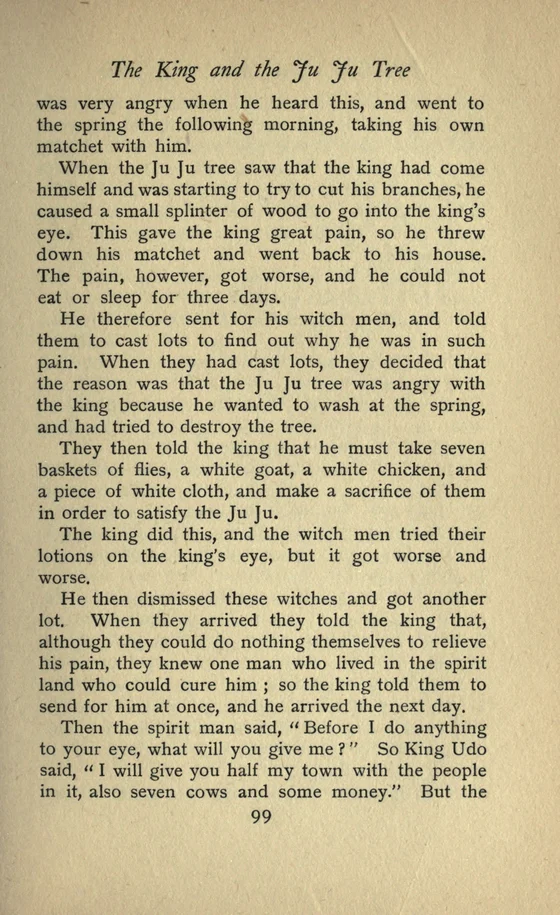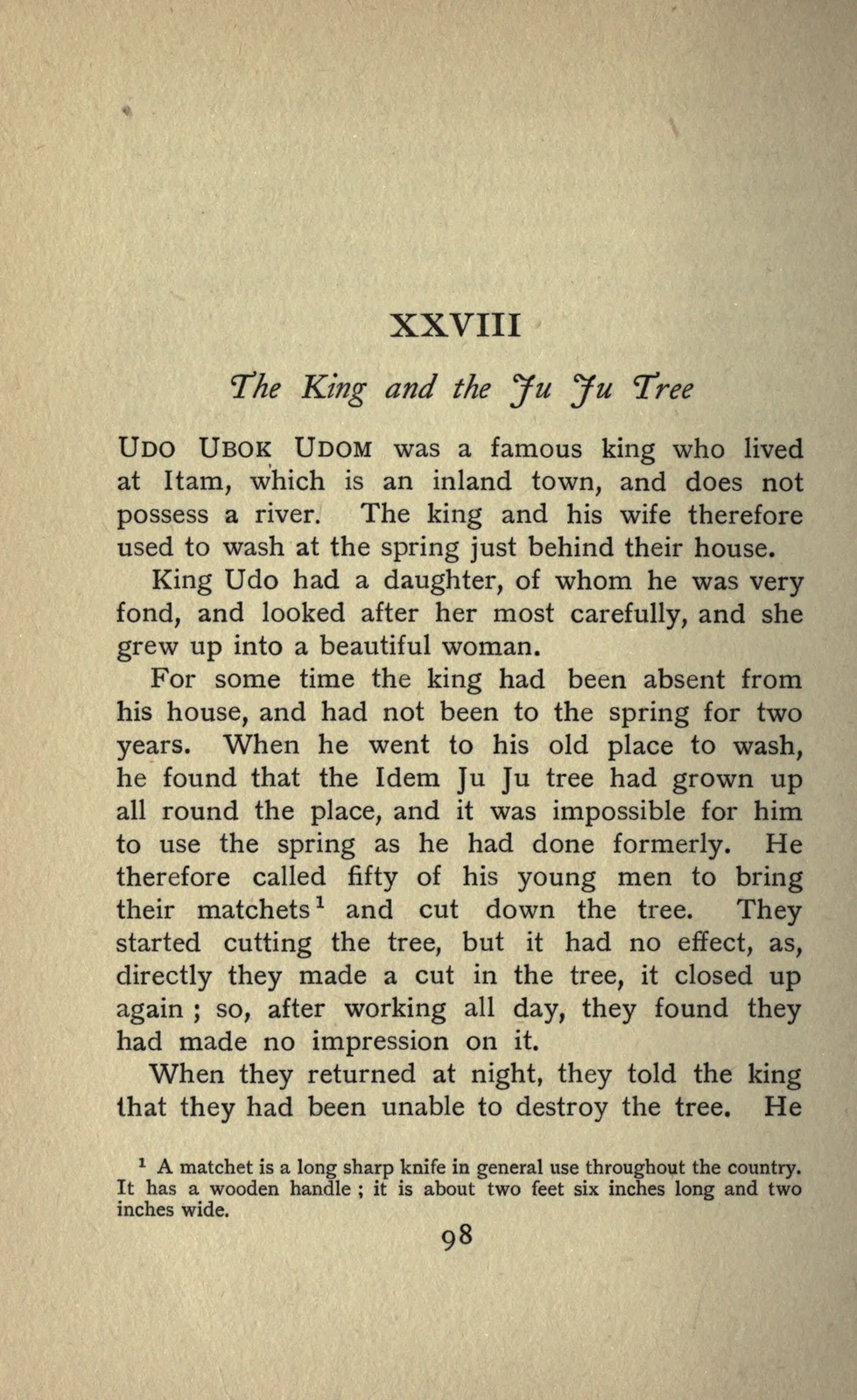
Idem Ju Ju Tree (Itam tale),1910 historical printed text witness, page98; documentary source-page facsimile
Documentary text facsimile of the exact named tale/being, not creature artwork. Printed page98 of the1910 collection. Original historical terminology remains in the source.
Overview
The Idem Ju Ju tree occupies the washing spring behind Udo Ubok Udom’s house at Itam, a town described in the tale as lacking a river. After two years away from the spring, the king finds the tree has grown around it so completely that he cannot wash there. Fifty young men attack it with matchets. Every cut immediately closes; a full day’s work leaves no effect. Their failure angers the king, who goes himself the following morning. When he begins cutting its branches, the tree sends a small splinter into his eye.
The injury worsens until he cannot eat or sleep for three days. His diviners cast lots and interpret the pain as the tree’s anger at the attempted destruction. Their prescribed offerings and lotions fail. A second group admits it cannot help but summons a physician from the spirit land. The king offers half his town and its people, seven cows and money; the physician rejects those terms and demands the king’s daughter. The king initially refuses, then yields after another painful night and pressure from his subjects. The physician’s leaf preparation brings out the splinter the following morning.
The tree initiates the longer tale but is not the cannibal physician who carries the daughter away. She later escapes that spirit’s intended feast with a helpful skull’s advice and medicine, returns home and diverts the pursuer with food. The king then prohibits spirits from returning to cure the living. No second attack by the tree, successful felling or reconciliation with it is printed. The witnessed tree powers are immediate closing of cuts and the deliberate splinter injury; the separate physician and skull retain their own actions.
Origins & earliest records
Published in Dayrell’s Folk Stories from Southern Nigeria (1910), in his historical colonial collection with an introduction by Andrew Lang. This selected chapter supplies no individual narrator name or dated oral performance. The located narrative is distinguished from Lang’s comparative introduction.
Records & interpretation
Complete tale XXVIII, The King and the Ju Ju Tree, pp. 98–103; spring, failed cutting and injury in opening, followed through the daughter’s return and final royal prohibition.
In the literature
“directly they made a cut in the tree, it closed up again”
XXVIII: The King and the Ju Ju Tree; paragraph beginning “For some time the king had been absent from his house, and had not been to the spring for …”
The tree obstructsKing Udo’s spring; cuts heal instantly, defeating fifty woodcutters.
Selected bibliography
Documented works and useful reading. This is not a list of every appearance.
- 01
Folk Stories from Southern Nigeria, West Africa
Complete tale XXVIII, The King and the Ju Ju Tree, pp. 98–103; spring, failed cutting and injury in opening, followed through the daughter’s return and final royal prohibition.
Family, evolution & connections
Spirit Physician (Itam tale)
The King and the Ju Ju Tree connects these two powers through a specific injury: the tree sends a splinter into the king’s eye, and the spirit physician’s treatment eventually removes it. The relationship is an interaction in Dayrell’s recorded Itam tale. It neither makes the physician a relative of the tree nor establishes that the treatment is medical evidence.
Located primary passages
Specific passages supporting details in this entry, grouped by their published witness.
Folk Stories from Southern Nigeria, West Africa
London: Longmans, Green and Co.,1910. Project Gutenberg34655 produced from Internet Archive/American Libraries images; title-page edition checked.
- The tree obstructsKing Udo’s spring; cuts heal instantly, defeating fifty woodcutters.
- King Udo tries cutting it; the tree sends a painful splinter into his eye, and subsequent sacrifices and witchmen’s lotions fail.
Selected historical collected English tale, not individually credited original-language transcript or universal belief. Colonial commentary and depicted punishments are historical text, not endorsements. Narrative bodies distinguished from Lang introduction.
References
Sources supporting this profile. Linked pages have their own scope and editorial standards.
- Historical collected taleXXVIII. The King and the Ju Ju TreeResearch access: 2026-10-05
Image credits
Historical text facsimileIdem Ju Ju Tree (Itam tale),1910 historical printed text witness, page98; documentary source-page facsimile
Documentary text facsimile of the exact named tale/being, not creature artwork. Printed page98 of the1910 collection. Original historical terminology remains in the source.