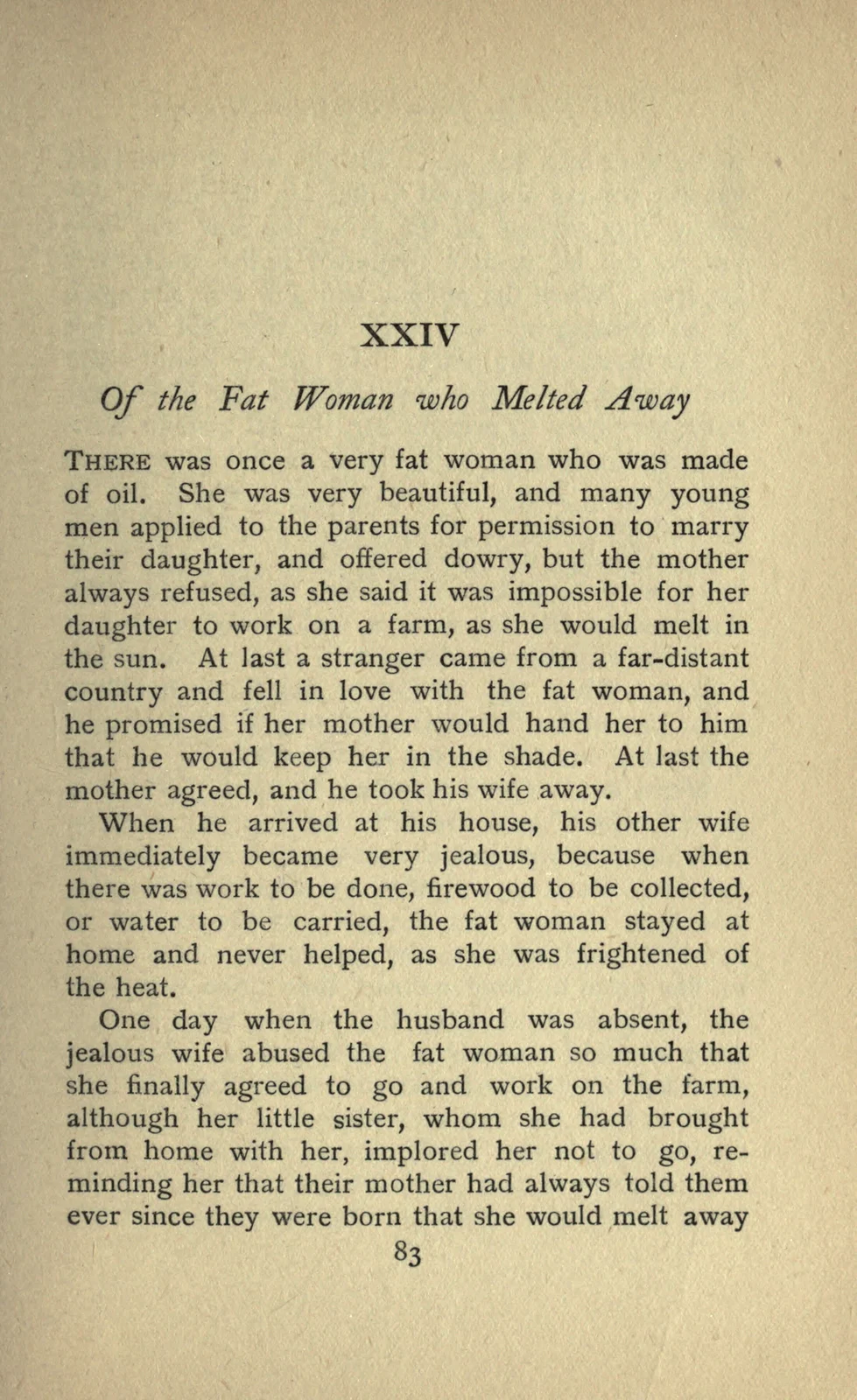
Oil Woman (Southern Nigerian tale),1910 historical printed text witness, page83; documentary source-page facsimile
Documentary text facsimile of the exact named tale/being, not creature artwork. Printed page83 of the1910 collection. Original historical terminology remains in the source.
Overview
The woman is described as beautiful, fat and made of oil. Many suitors offer dowry, but her mother refuses because ordinary farm labor in the sun would make her melt. A stranger from a distant country eventually wins permission by promising to keep her in shade. The marriage therefore begins with a clearly stated bodily condition and an undertaking of protection. The new bride brings her little sister from home, giving her a companion who knows the warning from childhood. At the husband’s house, his other wife resents the newcomer’s exemption from gathering firewood, carrying water and other work.
When the husband is away, the jealous wife abuses her until she agrees to go to the farm despite her sister’s pleas. The journey itself remains survivable because she follows shade. At the farm she stays beneath a large tree, but renewed demands that she do her share finally force her into the hot sun. She melts almost entirely. One big toe survives because a leaf covered it; the sister notices, gathers it with tears, wraps it carefully in leaves and carries it at the bottom of her basket. At home she puts the remnant into an earthen pot with water and seals the top with clay. Protection of the tiny surviving part makes recovery possible.
The sister tells the returning husband what happened and predicts complete restoration after three months. She also demands removal of the jealous wife, threatening to take the pot home to their mother if he refuses. He returns that wife to her parents; the narrative records her sale into slavery and repayment of the marriage dowry. Once the full interval has passed, the sister opens the pot and the oil woman emerges as fat and beautiful as before. Her husband celebrates with neighbors and recounts the coercion that caused the disaster. The closing marriage-payment explanation belongs to the storyteller’s ending, linking the extraordinary woman’s recovery with a punitive account of household relations.
Origins & earliest records
Selected narrative in Elphinstone Dayrell’s Folk Stories from Southern Nigeria (1910), collected through a colonial district commissioner.
Records & interpretation
Tale XXIV attests these forms and actions. Lang’s comparative introduction is not used as evidence of original belief or narrative age.
In the literature
“nothing left of her but one big toe, which had been covered by a leaf.”
XXIV: Of the Fat Woman who Melted Away; paragraph beginning “One day when the husband was absent, the jealous wife abused the fat woman so much that sh…”
A jealous wife forces the oil woman into sunlit work; she melts except a leaf-covered toe, which her sister preserves in a pot.
“the fat woman emerged, quite as fat and beautiful as she had been before.”
XXIV: Of the Fat Woman who Melted Away; paragraph beginning “The husband then took the jealous wife back to her parents, who sold her as a slave and pa…”
After three months and removal of the jealous wife, the oil woman emerges restored from the pot.
Selected bibliography
Documented works and useful reading. This is not a list of every appearance.
- 01
Folk Stories from Southern Nigeria, West Africa
XXIV. Of the Fat Woman who Melted Away
Family, evolution & connections
Textual family: the oil woman and her younger sister
Mother and two daughters explicitly linked in tale XXIV.
Scroll sideways to see all branches. With a keyboard, focus the tree and use the arrow keys.
- The sisters’ unnamed mother
- Unnamed younger sister
Explicit parentage in the named collected tale. The father is not named. The husband and his other wife are not inserted as descendants. These are narrative relationships in Dayrell’s mediated collection, not natural species ancestry or verified historical households.
Lion in a Woman’s Skin (Southern African tale)
Dayrell’s oil woman is restored from a protected toe kept in a pot; in Honey’s lion tale the murdered woman grows again from her heart in a calabash supplied with milk. The surviving fragment and container support a precise regeneration comparison. Different narrative circumstances and ingredients remain visible, and the parallel is not evidence of historical transmission or real human regeneration.
The sisters’ unnamed mother (Dayrell XXIV)
The younger sister recalls what their mother told them from birth. The passage thus supplies a shared mother, not merely a loosely used sibling term.
The unnamed younger sister (Dayrell XXIV)
The little sister accompanies the woman from home, preserves her surviving toe and oversees her restoration. Both are connected to the same mother by the text.
The stranger husband (Dayrell XXIV)
The stranger obtains the mother’s permission and marries the oil woman. His existing wife is a separate spouse, not identified as a relative of the new bride.
Located primary passages
Specific passages supporting details in this entry, grouped by their published witness.
Folk Stories from Southern Nigeria, West Africa
London: Longmans, Green and Co.,1910. Project Gutenberg34655 produced from Internet Archive/American Libraries images; title-page edition checked.
- A jealous wife forces the oil woman into sunlit work; she melts except a leaf-covered toe, which her sister preserves in a pot.
- After three months and removal of the jealous wife, the oil woman emerges restored from the pot.
Selected historical collected English tale, not individually credited original-language transcript or universal belief. Colonial commentary and depicted punishments are historical text, not endorsements. Narrative bodies distinguished from Lang introduction.
References
Sources supporting this profile. Linked pages have their own scope and editorial standards.
- Historical collected taleXXIV. Of the Fat Woman who Melted AwayResearch access: 2026-10-05
Image credits
Historical text facsimileOil Woman (Southern Nigerian tale),1910 historical printed text witness, page83; documentary source-page facsimile
Documentary text facsimile of the exact named tale/being, not creature artwork. Printed page83 of the1910 collection. Original historical terminology remains in the source.