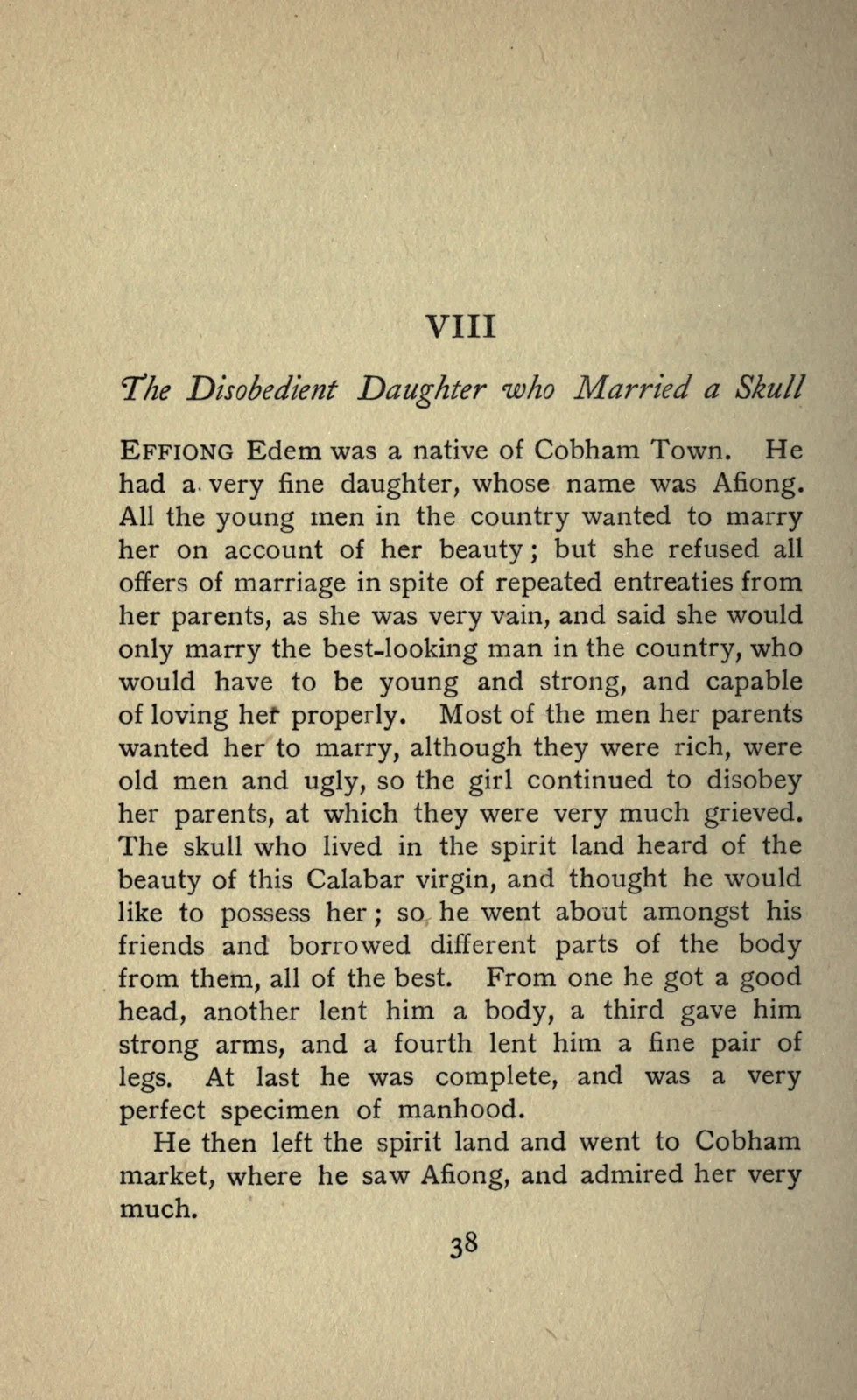
Skull Bridegroom (Calabar tale),1910 historical printed text witness, page38; documentary source-page facsimile
Documentary text facsimile of the exact named tale/being, not creature artwork. Printed page38 of the1910 collection. Original historical terminology remains in the source.
Overview
The bridegroom is a skull living in the spirit country, whose attractive human appearance is assembled from borrowed parts. Hearing of Afiong, the beautiful daughter of Effiong Edem of Cobham Town, he obtains a fine head, body, arms and legs from different acquaintances. He appears at Cobham market as an exceptionally handsome stranger. Afiong invites him home and her parents eventually permit the marriage, although they distrust his unfamiliar origin. He stays two days, then persuades her to accompany him to his distant country. The disguise therefore depends on borrowed bodily possessions, rather than an attested ability to change shape at will.
Once the couple crosses the boundary into spirit land, the owners successively reclaim their limbs and other parts. The handsome man is reduced to the skull; Afiong wants to return, but he orders her onward. At his house she finds his aged mother, who can only creep about, and undertakes cooking, gathering firewood and carrying water for her. These domestic actions alter the danger surrounding the captive. The mother explains that the inhabitants will kill and eat a human stranger, hides Afiong, and undertakes to return her home. The witness attributes cannibal danger to this story’s spirit population; it is not evidence about the conduct of living Calabar communities.
The rescue is elaborate: the mother summons a spider who dresses Afiong’s hair, supplies ornaments, and calls the winds. She rejects a violent tornado with thunder, lightning and rain, selecting a gentle breeze to transport the girl safely. Afiong’s father lays animal skins between her arrival place and the house, and her company celebrates for eight days and nights. The conclusion gives a chief’s prohibition on marrying distant strangers and a subsequent marriage arranged by her father. That closing rule belongs to Dayrell’s narrated moral resolution. The edition does not identify an individual narrator or independently document this law as a historical enactment.
Origins & earliest records
Selected narrative in Elphinstone Dayrell’s Folk Stories from Southern Nigeria (1910), collected through a colonial district commissioner.
Records & interpretation
Tale VIII attests these forms and actions. Lang’s comparative introduction is not used as evidence of original belief or narrative age.
In the literature
“borrowed different parts of the body from them, all of the best.”
VIII: The Disobedient Daughter who Married a Skull; paragraph beginning “Effiong Edem was a native of Cobham Town. He had a very fine daughter, whose name was Afio…”
A skull borrows handsome body parts to court and marry Afiong.
“the skull was left by itself in all its natural ugliness.”
VIII: The Disobedient Daughter who Married a Skull; paragraph beginning “After walking for several days, Afiong and the Skull crossed the border between the spirit…”
Crossing into spirit land, owners reclaim borrowed limbs, head and body, revealing the skull to Afiong.
Selected bibliography
Documented works and useful reading. This is not a list of every appearance.
- 01
Folk Stories from Southern Nigeria, West Africa
VIII. The Disobedient Daughter who Married a Skull
Family, evolution & connections
Textual family: the Skull and his mother
The explicit mother-child relationship in tale VIII.
Scroll sideways to see all branches. With a keyboard, focus the tree and use the arrow keys.
- Unnamed elderly mother
Explicit parentage in the named collected tale. Neither the Skull’s father nor further children are supplied. Afiong remains his wife, not his mother’s biological daughter. These are narrative relationships in Dayrell’s mediated collection, not natural species ancestry or verified historical households.
The Skull’s unnamed elderly mother (Dayrell VIII)
The Skull’s mother is identified at his house. Her protective actions toward Afiong do not make her Afiong’s biological mother.
Afiong (Dayrell VIII)
Afiong marries the disguised Skull and becomes his mother’s daughter-in-law in the tale. Afiong’s own father is separately named Effiong Edem.
Located primary passages
Specific passages supporting details in this entry, grouped by their published witness.
Folk Stories from Southern Nigeria, West Africa
London: Longmans, Green and Co.,1910. Project Gutenberg34655 produced from Internet Archive/American Libraries images; title-page edition checked.
- A skull borrows handsome body parts to court and marry Afiong.
- Crossing into spirit land, owners reclaim borrowed limbs, head and body, revealing the skull to Afiong.
- The mother rewards Afiong’s care, hides her from cannibals and sends her home on a gentle breeze after rejecting a tornado.
Selected historical collected English tale, not individually credited original-language transcript or universal belief. Colonial commentary and depicted punishments are historical text, not endorsements. Narrative bodies distinguished from Lang introduction.
References
Sources supporting this profile. Linked pages have their own scope and editorial standards.
- Historical collected taleVIII. The Disobedient Daughter who Married a SkullResearch access: 2026-10-05
Image credits
Historical text facsimileSkull Bridegroom (Calabar tale),1910 historical printed text witness, page38; documentary source-page facsimile
Documentary text facsimile of the exact named tale/being, not creature artwork. Printed page38 of the1910 collection. Original historical terminology remains in the source.