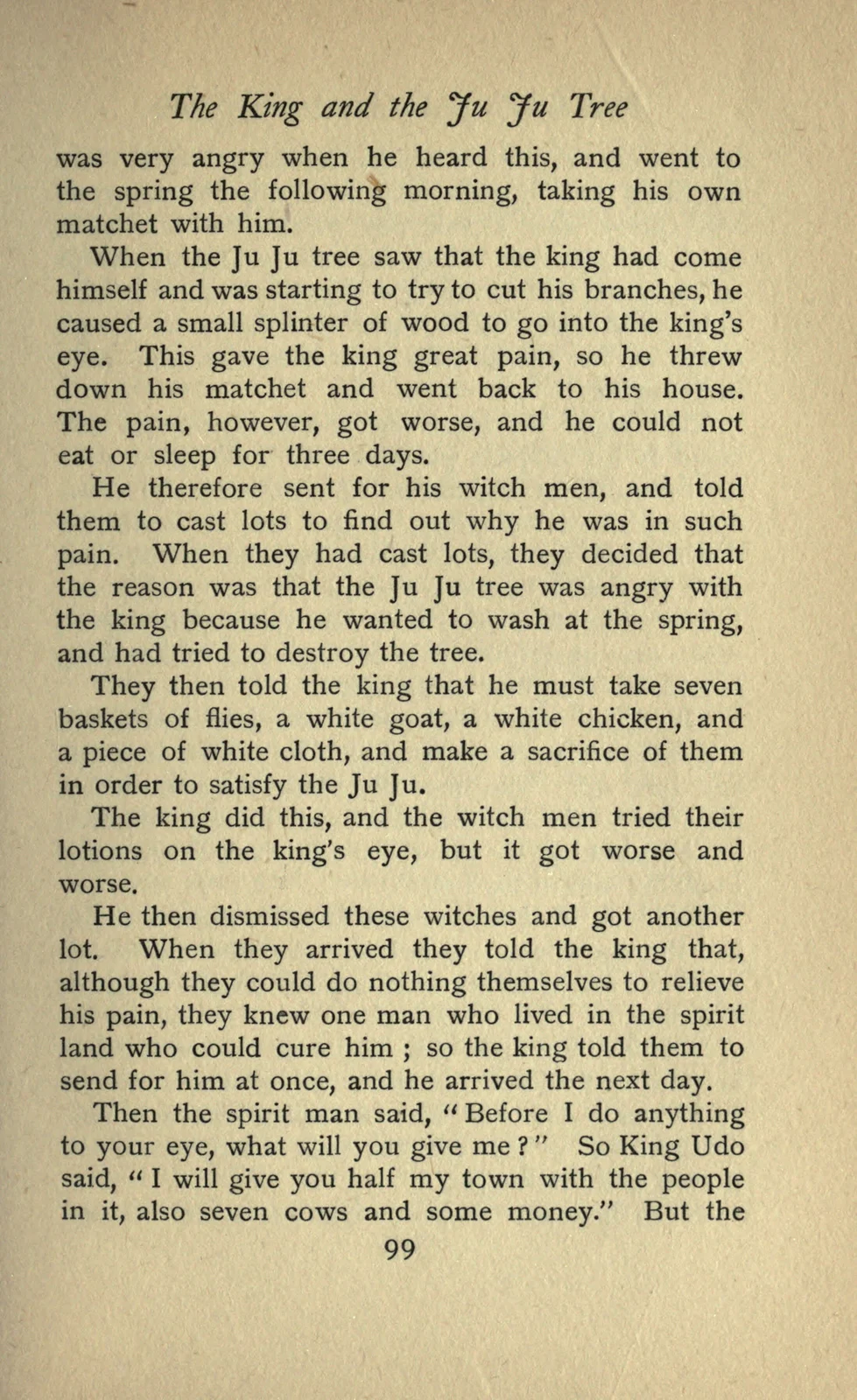
Spirit Physician (Itam tale),1910 historical printed text witness, page99; documentary source-page facsimile
Documentary text facsimile of the exact named tale/being, not creature artwork. Printed page99 of the1910 collection. Original historical terminology remains in the source.
Overview
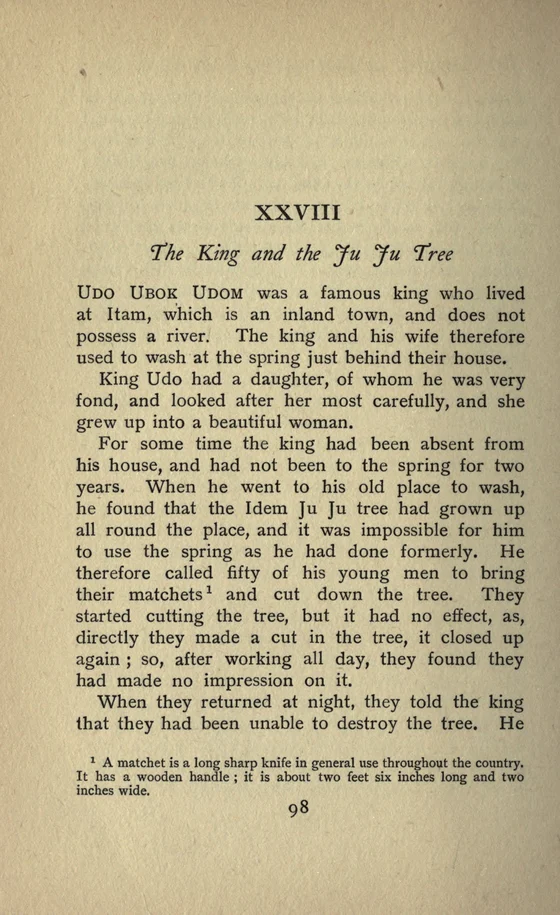
The spirit physician enters the story after King Udo Ubok Udom’s assault on the self-repairing Idem Ju Ju tree leaves a splinter in his eye. Ordinary ritual specialists fail to relieve the pain and summon a man they know in the spirit land. The newcomer rejects an offer comprising half the town, its people, cattle and money. He will accept only the king’s daughter. The king initially refuses, then yields after another night of suffering and pressure from his subjects. Only after receiving the girl does the physician prepare leaf juice and apply it to the injured eye. Next morning the splinter falls out and the king recovers.
The healer departs with the daughter that same night rather than staying as the king’s guest. His household becomes a place of concealed predation. For two years she is kept in a fattening house and given food. A resident skull warns that the purpose is to eat her rather than arrange a marriage, and secretly takes the food from her. Towards the end of the third year the physician brings friends to inspect her and promises them a feast on the following day. The skull overhears the plan, provides strengthening medicine and gives the girl precise directions for a flight while the party is away preparing in the wood.
When the physician returns, he questions the skull. The skull acknowledges that she left through the back door but says he does not know where she went. The spirit nevertheless quickly guesses that she has returned home and follows, shouting. The fleeing daughter reaches her father and asks him to leave a substitute offering on the road. The pursuer stops to eat, takes away the remainder and abandons the chase. The king then declares that dead people returning from the spirit land must no longer come to cure the living. This ending links the episode with dangerous spirit medicine without turning the tree, helpful skull and cannibal physician into one being. The physician’s successful cure is real within the narrative even though his demanded payment conceals the later feeding plan.
Origins & earliest records
Selected narrative in Elphinstone Dayrell’s Folk Stories from Southern Nigeria (1910), collected through a colonial district commissioner.
Records & interpretation
Complete tale XXVIII, pp. 98–103, independently reread; appearance, separate agents and full conclusion checked against the digitized edition.
In the literature
“the only thing he was willing to accept as payment was the king's daughter.”
XXVIII: The King and the Ju Ju Tree; paragraph beginning “Then the spirit man said, "Before I do anything to your eye, what will you give me?" So Ki…”
The spirit refuses wealth and demands the king’s daughter, then treats the eye with leaf juice so the splinter falls out next morning.
Selected bibliography
Documented works and useful reading. This is not a list of every appearance.
- 01
Folk Stories from Southern Nigeria, West Africa
XXVIII. The King and the Ju Ju Tree, pp. 98–103.
Family & connections
A source-supported family tree or inspiration record has not yet been compiled for this profile. Related reading below indicates a connection in subject matter, not a proven lineage or creative influence.
Located primary passages
Specific passages supporting details in this entry, grouped by their published witness.
Folk Stories from Southern Nigeria, West Africa
London: Longmans, Green and Co.,1910. Project Gutenberg34655 produced from Internet Archive/American Libraries images; title-page edition checked.
- The spirit refuses wealth and demands the king’s daughter, then treats the eye with leaf juice so the splinter falls out next morning.
- The physician intends to fatten and eat the daughter; a skull assists her escape with medicine and instructions, and road sacrifices stop her pursuer.
Selected historical collected English tale, not individually credited original-language transcript or universal belief. Colonial commentary and depicted punishments are historical text, not endorsements. Narrative bodies distinguished from Lang introduction.
References
Sources supporting this profile. Linked pages have their own scope and editorial standards.
- Historical collected taleXXVIII. The King and the Ju Ju TreeResearch access: 2026-10-05
Image credits
Historical text facsimileSpirit Physician (Itam tale),1910 historical printed text witness, page99; documentary source-page facsimile
Documentary text facsimile of the exact named tale/being, not creature artwork. Printed page99 of the1910 collection. Original historical terminology remains in the source.