Kagara and Haunu, page113, historical printed text witness; documentary source-page facsimile
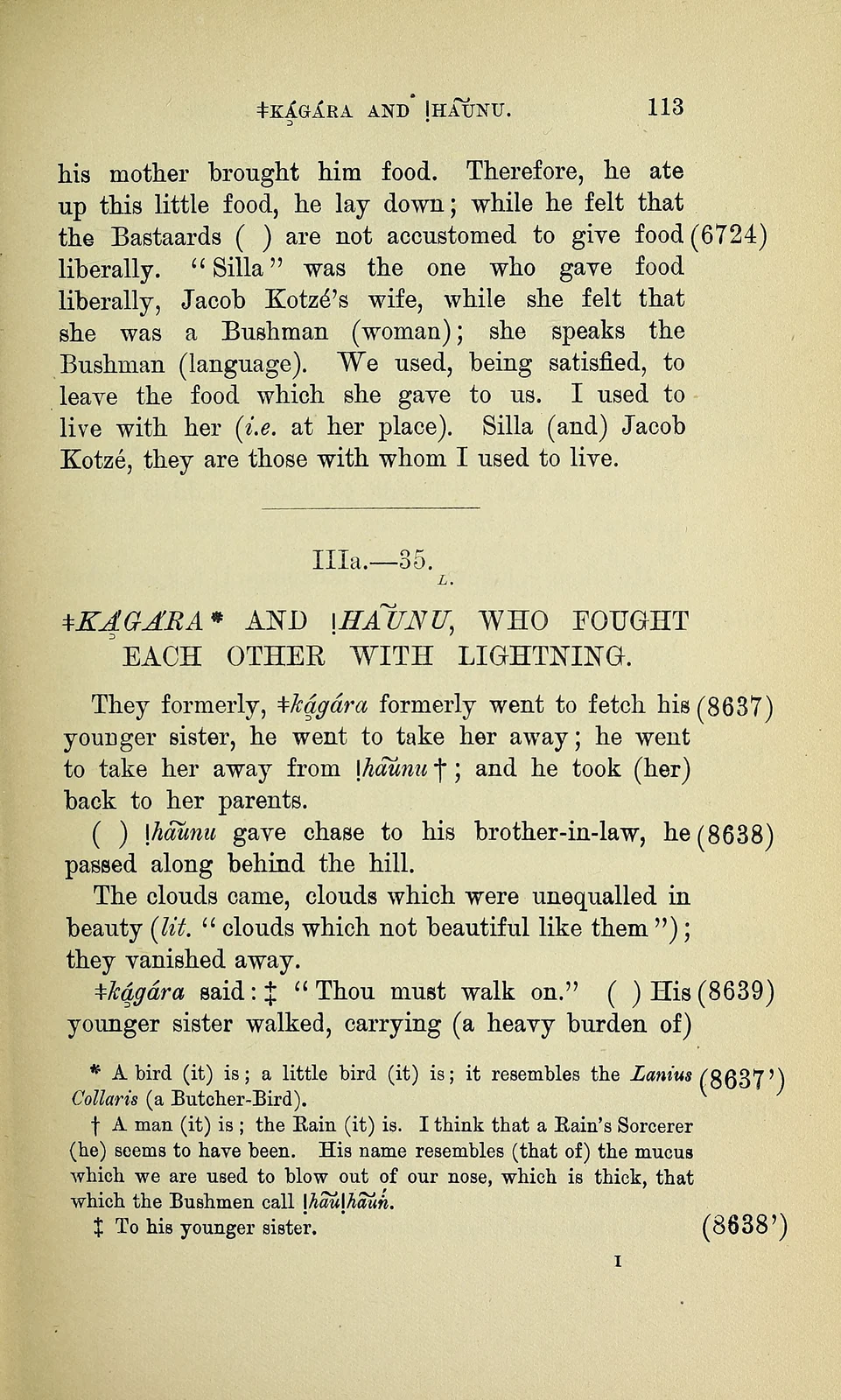
Primary text witness to Kagara and Haunu, page113 in the 1911 edition. Documentary text facsimile, not creature artwork; historical terminology and collector interpretations belong to the original publication.
Overview
#Kaga’ra and !Haunu are opponents connected by marriage: !Haunu is the husband of #Kaga’ra’s younger sister. #Kaga’ra goes to fetch her and take her back to their parents. Her husband follows behind a hill, while beautiful clouds gather and disappear. She carries a heavy load of her husband’s possessions. The notes make that burden unusually mobile, comparing the things to water that sways and pushes behind her back. #Kaga’ra repeatedly urges his sister onward, because their home is still far away, then waits for her and questions the things she carries.
His rough handling of those possessions provokes !Haunu. The husband sneezes, blood pours from his nostrils and he stealthily sends lightning at his brother-in-law. #Kaga’ra quickly wards it off and answers with lightning of his own; !Haunu also fends off the return attack. The teller explains this defence through a familiar bodily motion: moving an arm aside as people do when blocking a fist. During the repeated exchange #Kaga’ra tells his sister to stay close, since her husband is giving them no respite and is not striking only once.
!Haunu intends to whisk #Kaga’ra away with lightning, but the brother withstands him. #Kaga’ra eventually sends black lightning that lifts !Haunu and carries him a short distance. The husband lies dying and thundering. #Kaga’ra returns home, binds his aching head with a net and rubs himself and his sister with buchu before lying down in the hut. The end thus retains the victor’s pain and his sister’s presence, rather than ending at the spectacular stroke. An accompanying explanation describes black lightning as lethal and unseen in its approach, compared to being startled by a gun.
The narrator’s separate note places the fight in an inherited reading of weather. He recalls his grandmothers identifying the pair as fighting in the east when thick, mountain-like clouds brought lightning. The edition’s other notes associate #Kaga’ra with a small bird resembling a butcher-bird, and call !Haunu a man and Rain; the suggestion that the latter was a rain sorcerer is expressly tentative. The original heading names |han#kass’o’s 1879 dictation and says he learned the account from his maternal grandmother #kammi and, after her death, his mother |xabbi-an.
Origins & earliest records
Selected tale in Bleek and Lloyd’s bilingual collection, edited from recorded narratives and explanatory notes. London: George Allen & Co., 1911. Dictated in 1879 by |han#kass’o, learned from maternal grandmother #kammi and subsequently mother |xabbi-an; printed heading p. 112.
Records & interpretation
Complete narrative and explanatory notes, pp. 112–119, inspected in the original bilingual edition. Actual p. 112 pixels confirm the 1879 narrator/transmission heading, and p. 119 confirms the separate grandmothers’ weather note. Bird comparison and tentative rain-sorcerer interpretation remain attributed to the notes.
In the literature
“he stealthily lightened at his younger sister's husband with black lightning”
IIIa.35, #Kaga’ra and !Haunu, who fought each other with Lightning, pp. 112–121; Black lightning and the narrator’s storm explanation · W. H. I. Bleek and Lucy C. Lloyd
#Kaga’ra carries !Haunu away with black lightning, returns with his sister and treats his aching head with a net and buchu; the narrator connects the pair to eastern storms through his grandmothers’ explanation.
Selected bibliography
Documented works and useful reading. This is not a list of every appearance.
- 01
Specimens of Bushman Folklore
Complete #Kaga’ra and !Haunu narrative, pp. 112–117, including burden, deflecting lightning, black stroke and homecoming notes; separate Note by the Narrator, pp. 118–119.
- 02
Specimens of Bushman Folklore — IIIa.35, #Kaga’ra and !Haunu, who fought each other with Lightning, pp. 112–121
London: George Allen & Co., 1911. Dictated in 1879 by |han#kass’o, learned from maternal grandmother #kammi and subsequently mother |xabbi-an; printed heading p. 112.
Family, evolution & connections
#Kaga’ra’s unnamed younger sister
The tale identifies the woman as #Kaga’ra’s younger sister and !Haunu’s wife. The two combatants are brothers-in-law, not stated biological brothers. Her parents are mentioned but not named, so no shared parental couple is reconstructed.
Located primary passages
Specific passages supporting details in this entry, grouped by their published witness.
Specimens of Bushman Folklore — IIIa.35, #Kaga’ra and !Haunu, who fought each other with Lightning, pp. 112–121
George Allen & Co., London, 1911. Dictated in 1879 by |han#kass’o, learned from maternal grandmother #kammi and subsequently mother |xabbi-an; printed heading p. 112.
- !Haunu pursues his wife and her brother #Kaga’ra through thunderclouds; the brothers-in-law defend themselves against lightning directed at one another.
- #Kaga’ra carries !Haunu away with black lightning, returns with his sister and treats his aching head with a net and buchu; the narrator connects the pair to eastern storms through his grandmothers’ explanation.
The evidence excerpt supports one clause; the complete chapter was read for the full episode. This historical translation is a mediated witness, not an exhaustive account of present community beliefs.
References
Sources supporting this profile. Linked pages have their own scope and editorial standards.
- Collected oral narrative in translation#Kaga’ra and !Haunu, Who Fought Each Other with LightningResearch access: 2026-10-05
- Primary collected narrative and original page scansSpecimens of Bushman Folklore, original bilingual editionResearch access: 2026-10-05
Image credits
Historical text facsimileKagara and Haunu, page113, historical printed text witness; documentary source-page facsimile
Primary text witness to Kagara and Haunu, page113 in the 1911 edition. Documentary text facsimile, not creature artwork; historical terminology and collector interpretations belong to the original publication.