The Son of the Mantis and the Baboons, page17, historical printed text witness; documentary source-page facsimile
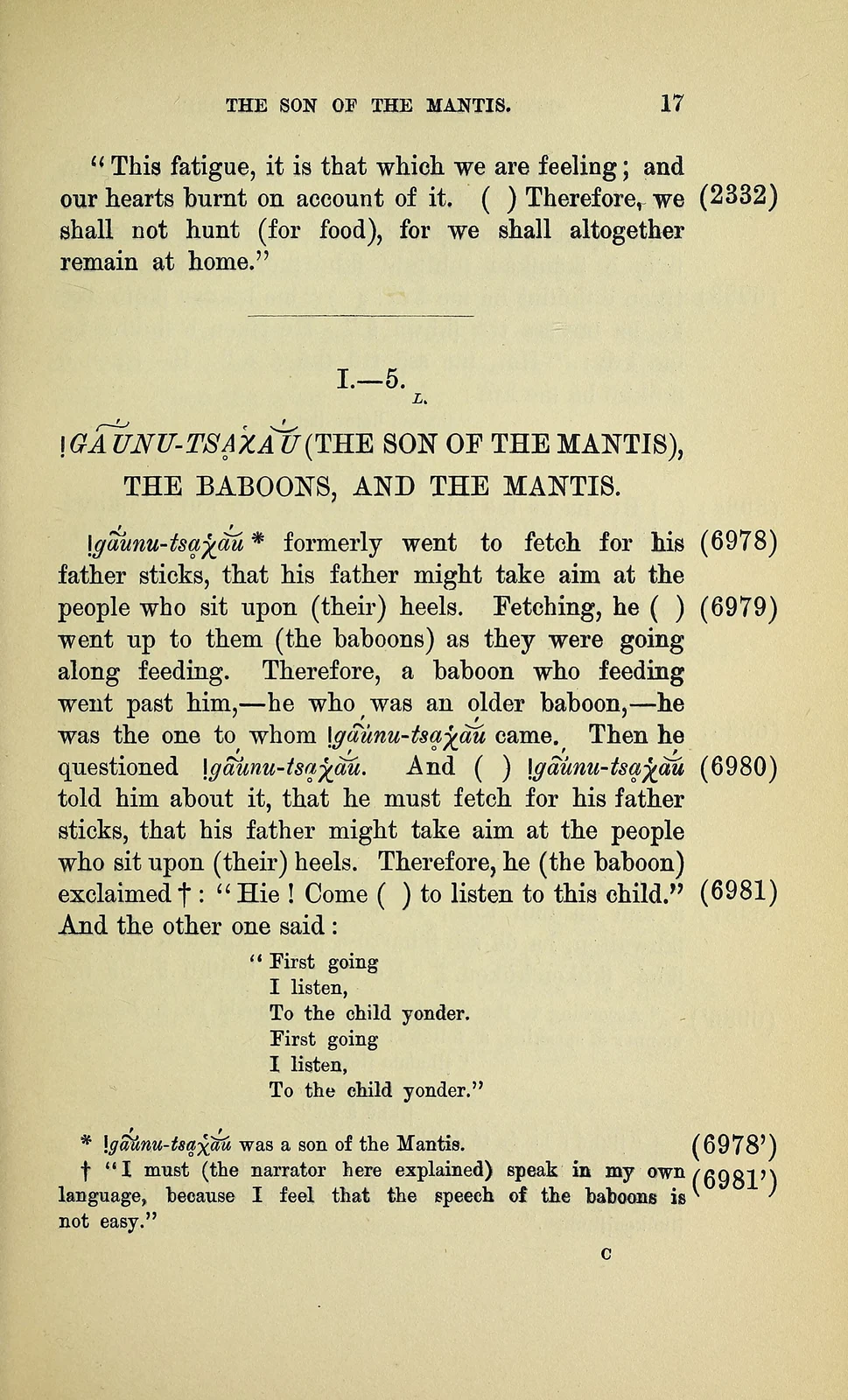
Primary text witness to The Son of the Mantis and the Baboons, page17 in the 1911 edition. Documentary text facsimile, not creature artwork; historical terminology and collector interpretations belong to the original publication.
Overview
!Gaunu-tsaxau is the Mantis’s son, sent to fetch sticks for his father. When baboons question him, he explains that the sticks will enable his father to take aim at the people who sit on their heels. Successive older baboons gather to hear him and finally recognize themselves as the intended targets. They beat the child, break his head and knock out an eye, which they use as a ball while he lies dead. The repeated question-and-answer sequence makes his innocent disclosure, rather than an unprovoked unexplained attack, the immediate narrative trigger.
The Mantis learns of the killing in a midday dream and goes toward the dust raised by the ball game. He hides his tears before joining the baboons, then catches the eye, anoints it with his armpit perspiration and sends it skyward. It comes down into a small bag beside his quiver. He denies possessing the ball while secretly holding it as he turns the bag out. A fight follows; he is beaten and escapes by flying toward water. Once there he places the eye in the water and calls for it to grow into what it formerly was. Some accompanying exclamations remain untranslated because the collectors could not obtain a clear explanation; they are not given invented magical meanings here.
Restoration takes time. The child appears near the water but repeatedly flees beneath the surface when the approaching father makes a sound. The Mantis prepares a front skin garment and another item of clothing, approaches quietly, catches him and anoints him with his own scent. He identifies himself as the boy’s father, dresses him and brings him home. The young Ichneumon questions how a child reported dead can now return; the Mantis explains what he did with the eye and says the recovered boy remains weak and must be cared for until strong. This ending distinguishes re-creation and convalescence from an instantly invulnerable resurrection. The chapter’s comparison with Orpen’s 1874 collection is editorial bibliography; that other version has not been folded into the selected sequence.
Origins & earliest records
Selected tale in Bleek and Lloyd’s bilingual collection, edited from recorded narratives and explanatory notes. London: George Allen & Co., 1911. Related in 1878 by |han#kass’o, learned from his mother |xabbi-an; printed heading p. 16.
Records & interpretation
The cited chapter attests the represented form and actions. Individual speaker attribution remains unresolved in this web extract; no first oral date or universal community belief is claimed.
In the literature
“Thou must grow out, that thou mayest become like that which thou hast been.”
I.5, !Gaunu-tsaxau, the Baboons, and the Mantis, pp. 16–37; Mantis retrieves and restores the eye · W. H. I. Bleek and Lucy C. Lloyd
Mantis joins the ball game, retrieves the eye, anoints it with perspiration and puts it in water with a command to grow the child again.
Selected bibliography
Documented works and useful reading. This is not a list of every appearance.
- 01
Specimens of Bushman Folklore
Selected witness: !Gaunu-tsaxau, the Son of the Mantis, the Baboons, and the Mantis
- 02
Specimens of Bushman Folklore — I.5, !Gaunu-tsaxau, the Baboons, and the Mantis, pp. 16–37
London: George Allen & Co., 1911. Related in 1878 by |han#kass’o, learned from his mother |xabbi-an; printed heading p. 16.
Family, evolution & connections
Textual genealogy: Mantis and !Gaunu-tsaxau
The explicitly stated father–son relationship in the selected |Xam narrative.
Scroll sideways to see all branches. With a keyboard, focus the tree and use the arrow keys.
Opening father references and the translator’s note 1 identify the parent and child. One transcribed and translated narrative witness; no mother or further descendants are supplied. The narrator’s characters are not a biological mantis lineage. Historical transcription symbols are retained.
The Mantis and !Gaunu-tsaxau — this |Xam telling
The expressly identified father and son in the baboons episode.
Scroll sideways to see all branches. With a keyboard, focus the tree and use the arrow keys.
Repeated father/son wording in the narrative, its opening note and the reunion scene. Bleek and Lloyd’s historical English translation mediates this witness. The household also uses grandfather and grandson addresses; those addresses alone do not establish additional biological generations here. Other Mantis traditions and the distinct Great Star narrative are not combined.
Mantis (|Xam narratives)
The opening explains that !Gaunu-tsaxau fetches sticks for his father; note 1 explicitly identifies him as a son of Mantis. This is a relationship in the recorded narrative, not the ancestry of natural insects.
Located primary passages
Specific passages supporting details in this entry, grouped by their published witness.
Specimens of Bushman Folklore — I.5, !Gaunu-tsaxau, the Baboons, and the Mantis, pp. 16–37
George Allen & Co., London, 1911. Related in 1878 by |han#kass’o, learned from his mother |xabbi-an; printed heading p. 16.
- While fetching sticks, the child is repeatedly struck by the baboons; they kill him and use his eye as their ball.
I.5, !Gaunu-tsaxau, the Baboons, and the Mantis, pp. 16–37; The baboons kill the child and play ball
- Mantis joins the ball game, retrieves the eye, anoints it with perspiration and puts it in water with a command to grow the child again.
I.5, !Gaunu-tsaxau, the Baboons, and the Mantis, pp. 16–37; Mantis retrieves and restores the eye
- The regrowing child initially fears Mantis; his father finally anoints him with his scent, dresses him and takes him home while he remains weak.
I.5, !Gaunu-tsaxau, the Baboons, and the Mantis, pp. 16–37; Reconciliation with the restored child
The evidence excerpt supports one clause; the complete chapter was read for the full episode. This historical translation is a mediated witness, not an exhaustive account of present community beliefs.
References
Sources supporting this profile. Linked pages have their own scope and editorial standards.
- Collected oral narrative in translation!Gaunu-tsaxau, the Son of the Mantis, the Baboons, and the MantisResearch access: 2026-10-05
- Primary collected text translationAccessible current publisher route — !Gaunu-tsaxauResearch access: 2026-10-05
Image credits
Historical text facsimileThe Son of the Mantis and the Baboons, page17, historical printed text witness; documentary source-page facsimile
Primary text witness to The Son of the Mantis and the Baboons, page17 in the 1911 edition. Documentary text facsimile, not creature artwork; historical terminology and collector interpretations belong to the original publication.