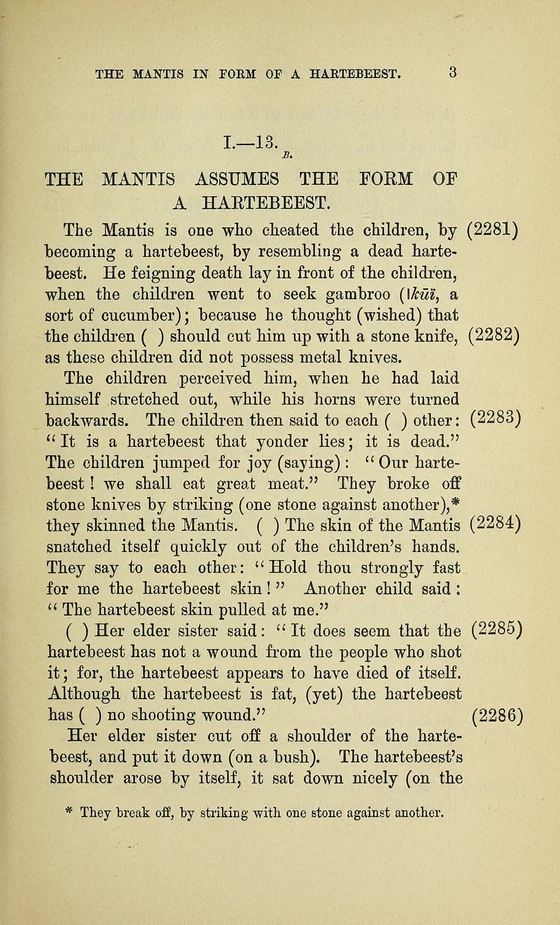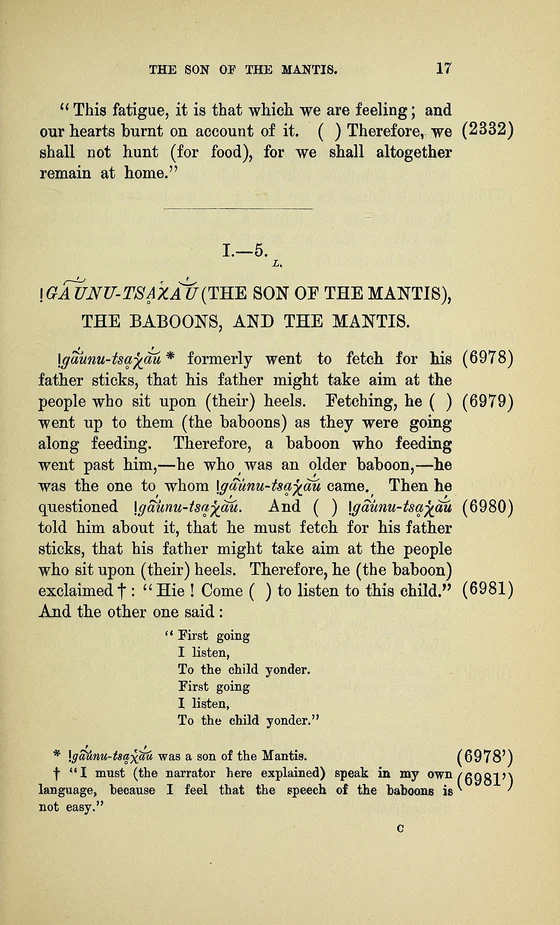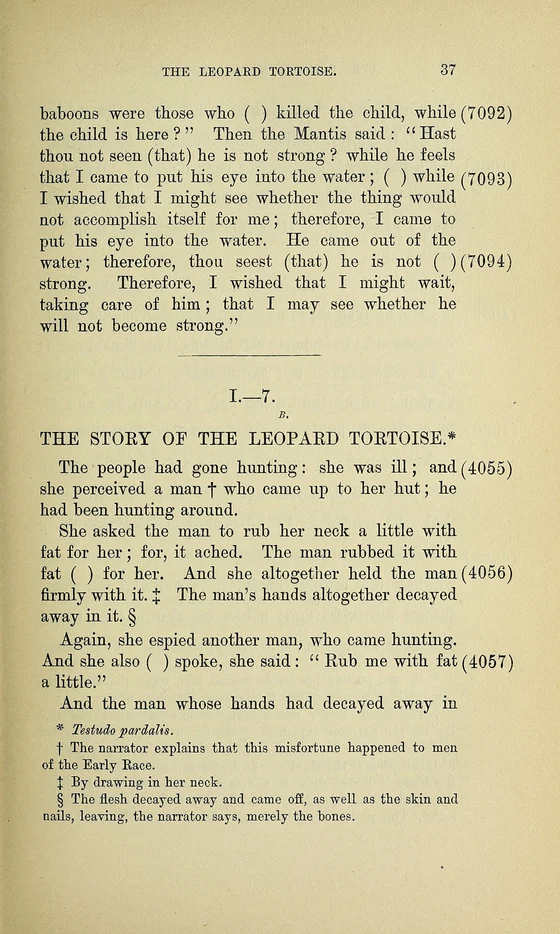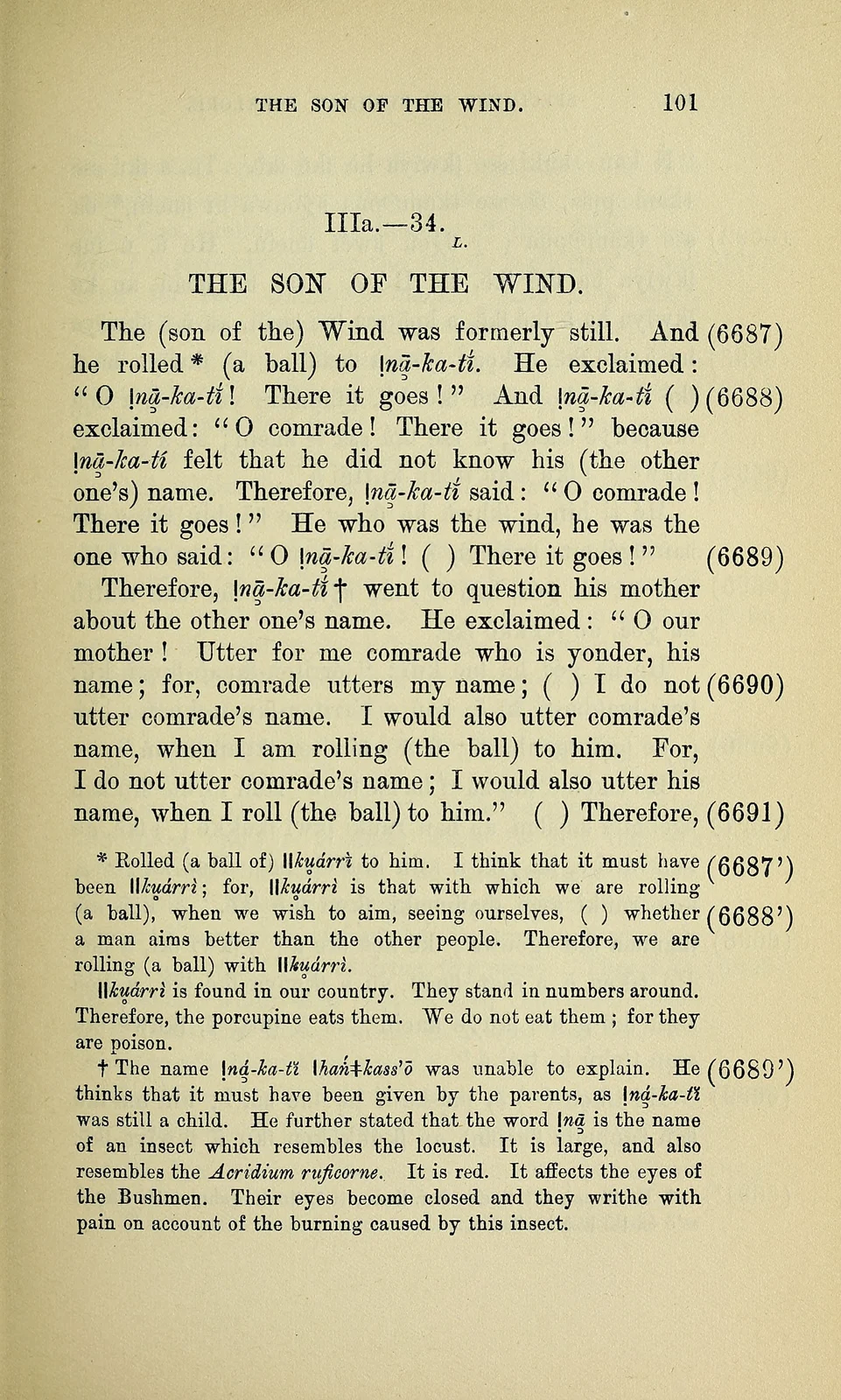
The Son of the Wind, page101, historical printed text witness; documentary source-page facsimile
Primary text witness to The Son of the Wind, page101 in the 1911 edition. Documentary text facsimile, not creature artwork; historical terminology and collector interpretations belong to the original publication.
Overview
The Wind is represented as a former person who has become a bird. Earlier he rolled a ball and shot; in bird form he flies instead of walking and makes his home in a mountain hole. His movements include an ordinary daily rhythm: he leaves early, seeks food, eats and returns to sleep. An explanatory note calls his skin the covering he wears. The narrator speaks specifically about the young Wind and acknowledges that the people who told him about it had not supplied an account of its parents.
A separately titled narrative, The Son of the Wind, describes the danger of calling a young playmate by his name. The other boy asks his mother what his companion is called. She tells him to wait until his father has strengthened the shelter around their hut, and to run home immediately after using the name. When he finally does so, the Wind falls and kicks violently on the ground. Dust obscures the people’s sight; wind breaks the sheltering bushes and their huts. The Wind’s own mother raises him to his feet, although he wants to remain lying down, and the wind becomes still. The teller connects this contrast between lying and standing with ways of describing strong and gentle wind.
The collection then preserves a local encounter supplied by |han#kass’o, rather than presenting only the preceding tale. Smoke’s Man, also identified as Witbooi Tooren, told him that he had seen the Wind at Haarfontein’s mountain. Mistaking it for a certain bird called !kuerre!kuerre, he threw a stone. The Wind burst into violent movement, raised dust and flew into a mountain hole. Smoke’s Man was afraid and returned to the sheltering bushes of his hut. Cold and unable to see the flock through the dust, he waited while the sheep came back by themselves.
The encounter continues beyond the sudden storm. At sunset the young shepherd gathered the sheep into their kraal and returned to his hut’s shelter to wait for food. His mother, who worked at Jacob Kotzé’s place, eventually brought him a small meal; he ate and lay down. These household circumstances belong to the reported encounter, rather than supplying another transformation or an ending in which the bird is killed. The recorded chain also distinguishes the speakers: the heading credits |han#kass’o’s April 1878 telling of The Son of the Wind to his mother |xabbi-an, while the added encounter credits Smoke’s Man as the person who spoke to him about seeing the Wind.
Origins & earliest records
Bleek and Lloyd’s bilingual 1911 edition prints The Son of the Wind and The Wind on pp. 100–113. The original p. 100 heading names |han#kass’o, April 1878, and his mother |xabbi-an; p. 108 separately labels the encounter as added by |han#kass’o, reporting Smoke’s Man’s account.
Records & interpretation
Complete pp. 100–113 and their explanatory notes inspected. Original facing-page scans verify the narrator heading on p. 100 and the separate addition heading on p. 108. Mother-to-son transmission of the first tale is not automatically assigned to Smoke’s Man’s local encounter.
In the literature
“The wind raised the dust, while the wind flew away.”
IIIa.34, The Wind, subsection following The Son of the Wind; English pp. 107, 109, 111, 113; Added report beginning Smoke’s Man was the one · W. H. I. Bleek and Lucy C. Lloyd
Smoke’s Man reports throwing a stone at the wind-bird at Haarfontein, provoking a violent gust and dust; he flees home while the sheep return alone.
Selected bibliography
Documented works and useful reading. This is not a list of every appearance.
- 01
Specimens of Bushman Folklore
The Son of the Wind, pp. 100–107; The Wind and Smoke’s Man’s added encounter, pp. 107–113, including notes and the evening conclusion.
- 02
Specimens of Bushman Folklore — IIIa.34, The Wind, subsection following The Son of the Wind; English pp. 107, 109, 111, 113
London: George Allen & Co., 1911. The added report is expressly credited to |han#kass’o on printed p. 108, reporting ||goo-ka-!kui (Smoke’s Man).
Family & connections
A source-supported family tree or inspiration record has not yet been compiled for this profile. Related reading below indicates a connection in subject matter, not a proven lineage or creative influence.
Located primary passages
Specific passages supporting details in this entry, grouped by their published witness.
Specimens of Bushman Folklore — IIIa.34, The Wind, subsection following The Son of the Wind; English pp. 107, 109, 111, 113
George Allen & Co., London, 1911. The added report is expressly credited to |han#kass’o on printed p. 108, reporting ||goo-ka-!kui (Smoke’s Man).
- Wind, identified as Wind’s son, changes from a man into a bird and lives in a mountain hole, flying out for food and returning to sleep.
- Smoke’s Man reports throwing a stone at the wind-bird at Haarfontein, provoking a violent gust and dust; he flees home while the sheep return alone.
The evidence excerpt supports one clause; the complete chapter was read for the full episode. This historical translation is a mediated witness, not an exhaustive account of present community beliefs.
References
Sources supporting this profile. Linked pages have their own scope and editorial standards.
- Collected oral narrative in translationThe WindResearch access: 2026-10-05
- Primary collected narrative and original page scansSpecimens of Bushman Folklore, original bilingual editionResearch access: 2026-10-05
Image credits
Historical text facsimileThe Son of the Wind, page101, historical printed text witness; documentary source-page facsimile
Primary text witness to The Son of the Wind, page101 in the 1911 edition. Documentary text facsimile, not creature artwork; historical terminology and collector interpretations belong to the original publication.