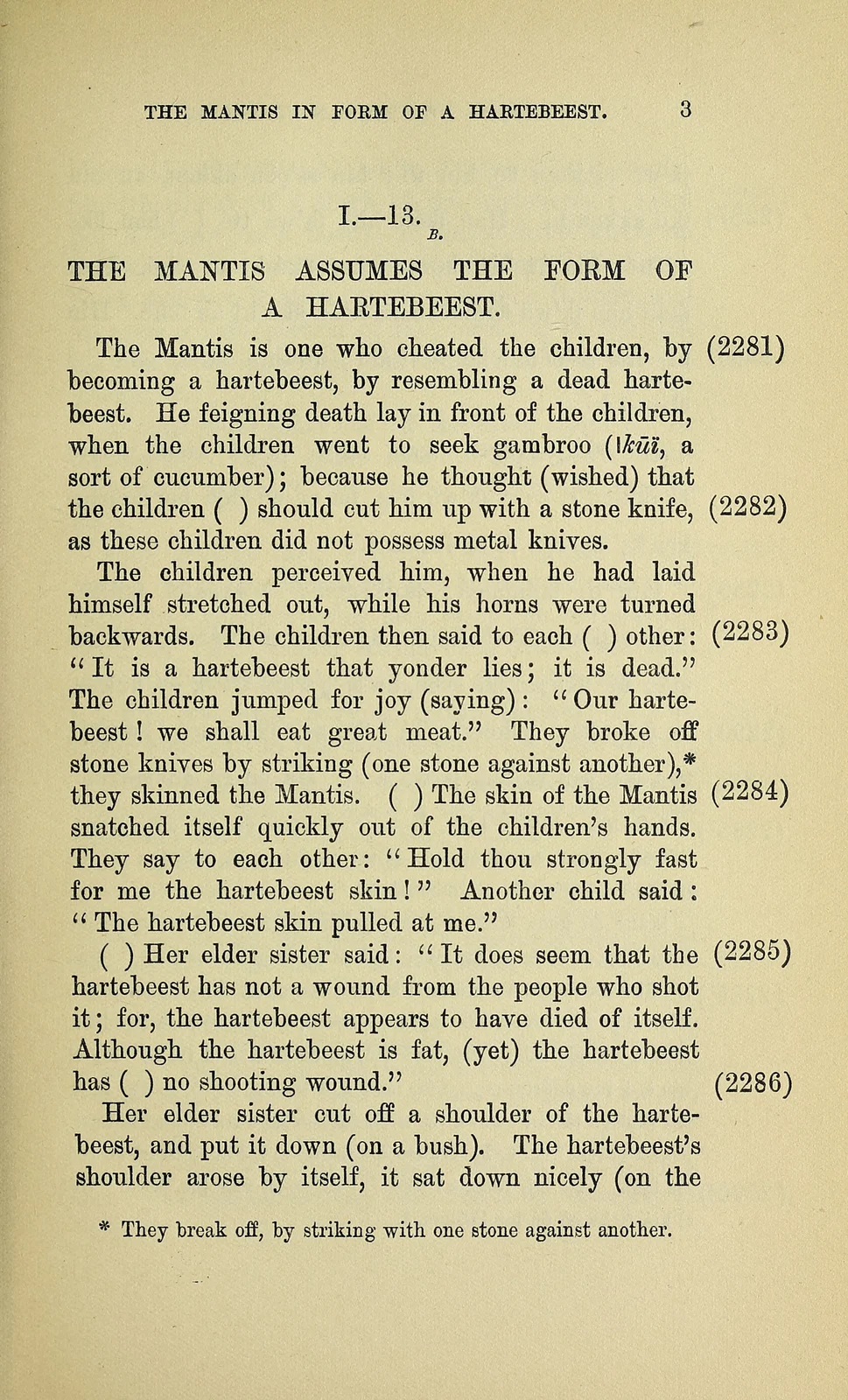
The Mantis assumes the form of a Hartebeest, page3, historical printed text witness; documentary source-page facsimile
Primary text witness to The Mantis assumes the form of a Hartebeest, page3 in the 1911 edition. Documentary text facsimile, not creature artwork; historical terminology and collector interpretations belong to the original publication.
Overview
The Mantis turns himself into what appears to be a dead hartebeest, with its horns pointing backwards. Children gathering gambroo, described by the edition as a kind of cucumber, discover it and rejoice at the prospect of meat. They strike stones to produce sharp cutting pieces because they lack metal knives, then skin and divide the apparent carcass. Its living parts resist their handling: the skin pulls away, a shoulder moves to a more comfortable bush and another avoids prickly support. The children notice that the fat animal has no arrow wound, but continue treating the moving flesh as food to carry home.
The smallest child receives the head as her burden. It slips toward the ground, turns against the carrying thong and whispers that the strap obstructs its eye. The Mantis winks, and the child tells her sisters that the head can speak; they initially accuse her of deception. When she loosens the thong and drops the head, he complains of injury. The other children drop their portions, which race together: head, neck, back, thighs, chest and shoulder blades join in a restored body. He resumes a human-like shape, with a rounded head, shoes on his feet and a moving left shoulder. The explanatory note identifies that shoulder movement with his left-handedness; it does not place footwear on his arm.
The restored Mantis chases the children until they reach home, then turns through the riverbed and circles back toward his own house. The children describe the talking head, quivering flesh and suddenly reunited body to their parents. The elders recognize the deceiver as the old Mantis, also called Tinderbox Owner in this episode. The children end by declaring themselves too exhausted to go gathering again. These acts support animal disguise, independently active severed parts and reassembly into a person-like form.
Origins & earliest records
Selected tale in Bleek and Lloyd’s bilingual collection, edited from recorded narratives and explanatory notes.
Records & interpretation
The cited chapter attests the represented form and actions. Individual speaker attribution remains unresolved in this web extract; no first oral date or universal community belief is claimed.
In the literature
“The Mantis is one who cheated the children, by becoming a hartebeest”
I.13, The Mantis Assumes the Form of a Hartebeest, pp. 2–15; Opening encounter · W. H. I. Bleek and Lucy C. Lloyd
Mantis resembles a dead hartebeest to deceive children gathering gambroo; the carcass moves while they skin and divide it.
Selected bibliography
Documented works and useful reading. This is not a list of every appearance.
- 01
Specimens of Bushman Folklore
Selected witness: The Mantis Assumes the Form of a Hartebeest
- 02
Specimens of Bushman Folklore — I.13, The Mantis Assumes the Form of a Hartebeest, pp. 2–15
London: George Allen & Co., 1911. Unnamed heading; ||kabbo attribution follows the book preface convention.
Family, evolution & connections
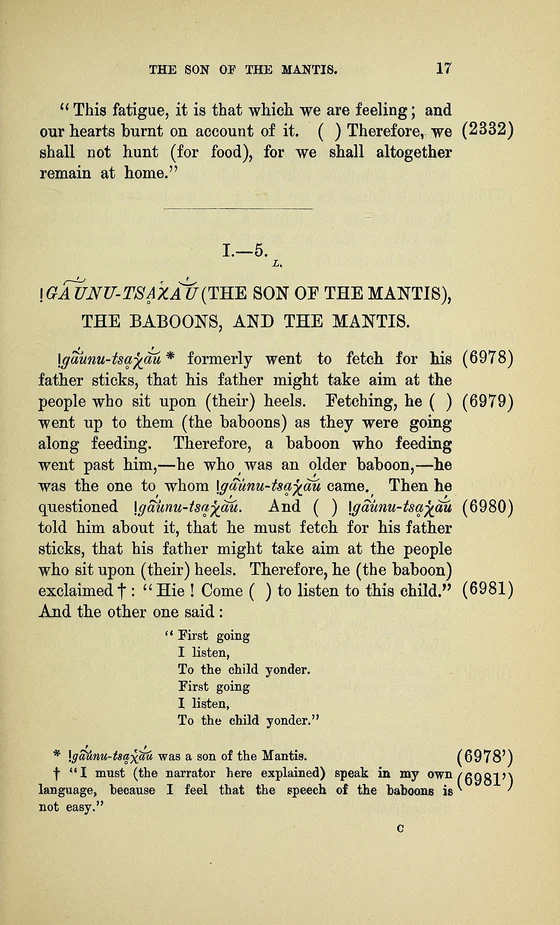
Textual genealogy: Mantis and !Gaunu-tsaxau
The explicitly stated father–son relationship in the selected |Xam narrative.
Scroll sideways to see all branches. With a keyboard, focus the tree and use the arrow keys.
Opening father references and the translator’s note 1 identify the parent and child. One transcribed and translated narrative witness; no mother or further descendants are supplied. The narrator’s characters are not a biological mantis lineage. Historical transcription symbols are retained.
The Mantis and !Gaunu-tsaxau — this |Xam telling
The expressly identified father and son in the baboons episode.
Scroll sideways to see all branches. With a keyboard, focus the tree and use the arrow keys.
Repeated father/son wording in the narrative, its opening note and the reunion scene. Bleek and Lloyd’s historical English translation mediates this witness. The household also uses grandfather and grandson addresses; those addresses alone do not establish additional biological generations here. Other Mantis traditions and the distinct Great Star narrative are not combined.
!Gaunu-tsaxau
The story and its opening note identify !Gaunu-tsaxau as the Mantis’s son. At their reunion the Mantis again identifies himself as the child’s father. This relationship belongs to this translated |Xam narrative, not to every southern African Mantis tradition.
Located primary passages
Specific passages supporting details in this entry, grouped by their published witness.
Specimens of Bushman Folklore — I.13, The Mantis Assumes the Form of a Hartebeest, pp. 2–15
George Allen & Co., London, 1911. Unnamed heading; ||kabbo attribution follows the book preface convention.
- Mantis resembles a dead hartebeest to deceive children gathering gambroo; the carcass moves while they skin and divide it.
I.13, The Mantis Assumes the Form of a Hartebeest, pp. 2–15; Opening encounter
- After the youngest child drops the speaking head, the separated body parts rejoin, Mantis takes human form and chases the children before appearing harmless near home.
I.13, The Mantis Assumes the Form of a Hartebeest, pp. 2–15; Reassembly and pursuit
The evidence excerpt supports one clause; the complete chapter was read for the full episode. This historical translation is a mediated witness, not an exhaustive account of present community beliefs.
References
Sources supporting this profile. Linked pages have their own scope and editorial standards.
- Collected oral narrative in translationThe Mantis Assumes the Form of a HartebeestResearch access: 2026-10-05
- Primary collected text translationAccessible current publisher route — Mantis as HartebeestResearch access: 2026-10-05
Image credits
Historical text facsimileThe Mantis assumes the form of a Hartebeest, page3, historical printed text witness; documentary source-page facsimile
Primary text witness to The Mantis assumes the form of a Hartebeest, page3 in the 1911 edition. Documentary text facsimile, not creature artwork; historical terminology and collector interpretations belong to the original publication.