Water-bull drawn by Dia!kwain, May 1875, a related |Xam rainmaking witness
Plate 31 explicitly labels a water-bull living in water and led around the country by rainmakers to make rain. This related rainmaking witness is not an illustration of the precise abduction episode on printed page 193. Original scan is preserved; display rotation makes the sideways published drawing readable.
Overview
The Rain approaches a young woman who is still ill and lies inside her hut with her child beside her on a kaross. He is drawn by her scent. His approach makes the surroundings misty: the notes identify the enclosing vapor as his breath and describe his own scent as exceptionally sweet. He trots to the hut in the body of a bull, with the narrator specifically distinguishing a bull from the more general word for an ox. An explanatory note interprets his lowered posture through his ears. The woman initially addresses the approaching figure as a man, then takes buchu in her hand, throws it on his forehead and presses it down.
She puts on her skin covering and carefully leaves the child covered at home before mounting the Rain. The notes explain the danger she anticipates: his destination is the water pit from which he emerged, and she expects death and a frog form if carried there. The pit itself dries when the Rain Bull leaves it. While riding, she looks for a tree and complains of pain so that he will set her down beneath its branches. He carries her to the large ravine-growing tree named |kuerriten|kuerriten. She rubs his neck with buchu, and he falls asleep. Climbing along the tree and descending farther away, she slips back toward her home.
The Rain wakes as the place grows cool and returns to his spring, still believing that she rides on his back. At the settlement, she burns buchu and rubs away the strong scent identified as belonging to the Rain. Other women return from food gathering and burn horns, intending the ascending smell to prevent his anger. The notes credit the woman’s intelligence with preserving the people, who otherwise would have died and become frogs. Scent thus draws the visitor, induces sleep and helps manage the danger after escape; the watery destination and imagined frog transformation bind his animal body to the threatened change in his human companions.
Origins & earliest records
Selected tale in Bleek and Lloyd’s bilingual collection, edited from recorded narratives and explanatory notes. London: George Allen & Co., 1911. Dictated in 1878 by |han#kass’o, learned from his mother |xabbi-an; printed heading p. 192.
Records & interpretation
Complete selected chapter and explanatory notes reread. Bull identification explicitly attributed to the narrator; local tree clarification credits |hang#kass’o, without treating that note as a secure narrator identity for the entire story. Death/frog outcome is anticipated, not a completed transformation of the escaping woman.
Additional images
 View larger
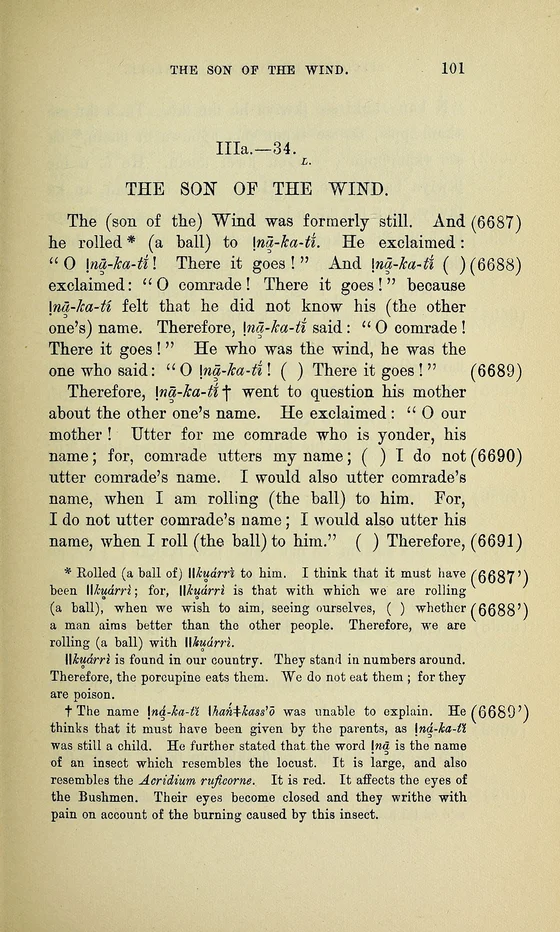
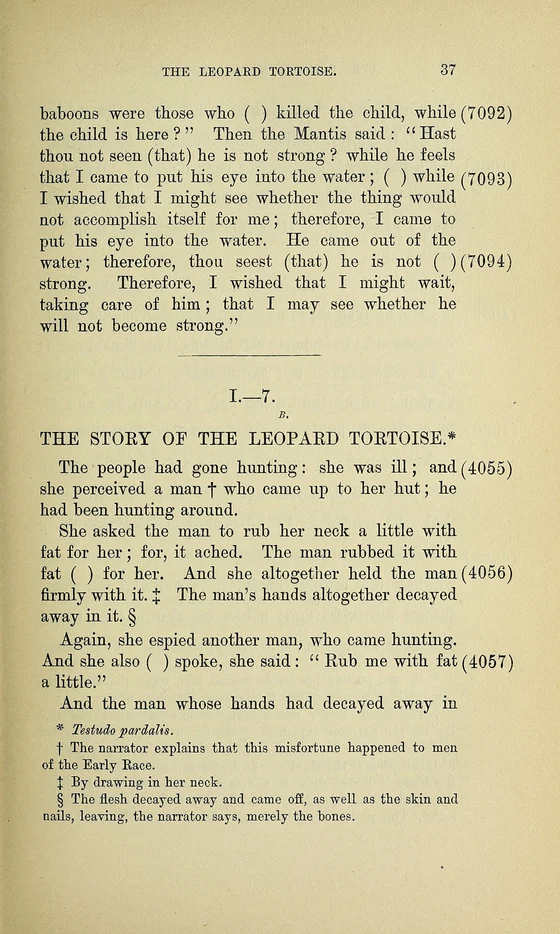
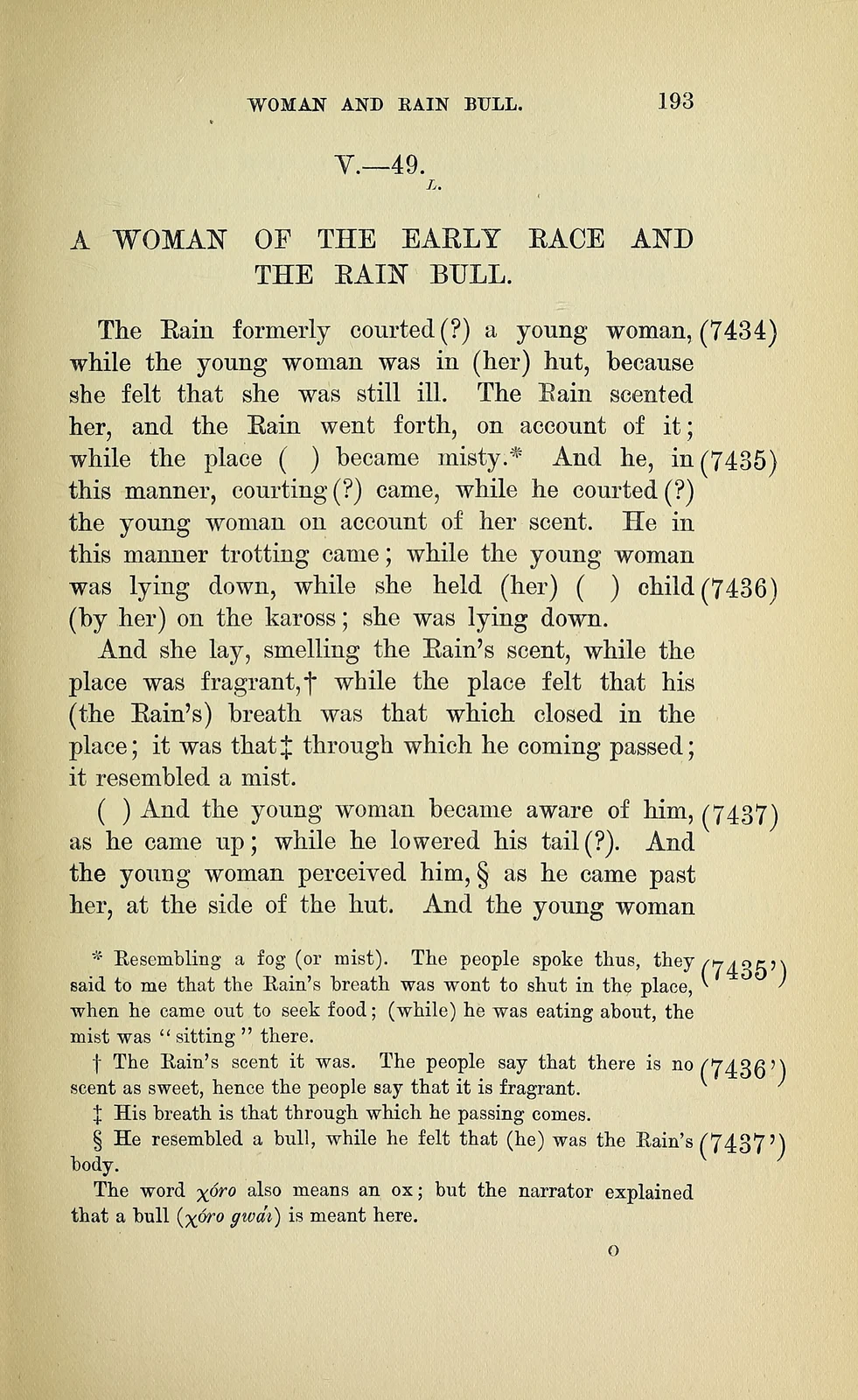
 A Woman of the Early Race and the Rain Bull, page193, historical printed text witness; documentary source-page facsimile
Primary text witness to A Woman of the Early Race and the Rain Bull, page193 in the 1911 edition. Documentary text facsimile, not creature artwork; historical terminology and collector interpretations belong to the original publication.
In the literature
“She mounted the Rain; and the Rain took her away.”
V.49, A Woman of the Early Race and the Rain Bull, pp. 192–199; Courtship and journey · W. H. I. Bleek and Lucy C. Lloyd
Rain courts a sick young woman, who applies buchu and leaves her child in the hut before mounting him and travelling toward the water.
Selected bibliography
Documented works and useful reading. This is not a list of every appearance.
- 01
Specimens of Bushman Folklore
Selected witness: A Woman of the Early Race and the Rain Bull
- 02
Specimens of Bushman Folklore — V.49, A Woman of the Early Race and the Rain Bull, pp. 192–199
London: George Allen & Co., 1911. Dictated in 1878 by |han#kass’o, learned from his mother |xabbi-an; printed heading p. 192.
Family & connections
A source-supported family tree or inspiration record has not yet been compiled for this profile. Related reading below indicates a connection in subject matter, not a proven lineage or creative influence.
Located primary passages
Specific passages supporting details in this entry, grouped by their published witness.
Specimens of Bushman Folklore
George Allen & Co., London, 1911. Dictated in 1878 by |han#kass’o, learned from his mother |xabbi-an; printed heading p. 192.
- Rain courts a sick young woman, who applies buchu and leaves her child in the hut before mounting him and travelling toward the water.
V.49, A Woman of the Early Race and the Rain Bull, pp. 192–199; Courtship and journey
- The woman rubs Rain with buchu until he sleeps and escapes through a tree; she burns her scented buchu at home, and older women burn horns in the concluding precautions.
The evidence excerpt supports one clause; the complete chapter was read for the full episode. This historical translation is a mediated witness, not an exhaustive account of present community beliefs.
References
Sources supporting this profile. Linked pages have their own scope and editorial standards.
- Collected oral narrative in translationA Woman of the Early Race and the Rain BullResearch access: 2026-10-05
Image credits
Historical illustrationWater-bull drawn by Dia!kwain, May 1875, a related |Xam rainmaking witness
Plate 31 explicitly labels a water-bull living in water and led around the country by rainmakers to make rain. This related rainmaking witness is not an illustration of the precise abduction episode on printed page 193. Original scan is preserved; display rotation makes the sideways published drawing readable.
Further credits appear with each additional image.