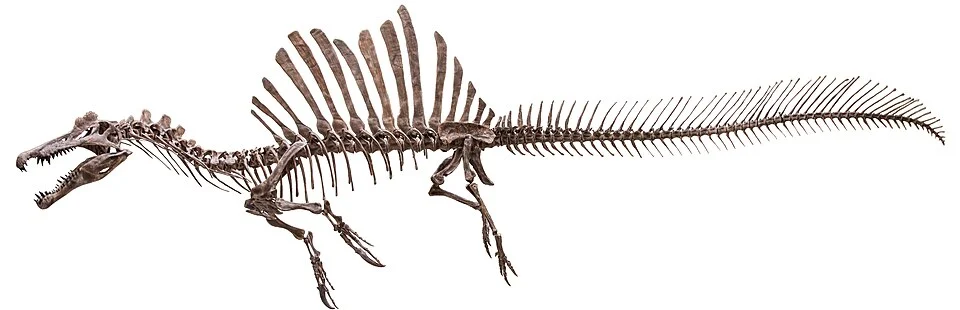
Spinosaurus
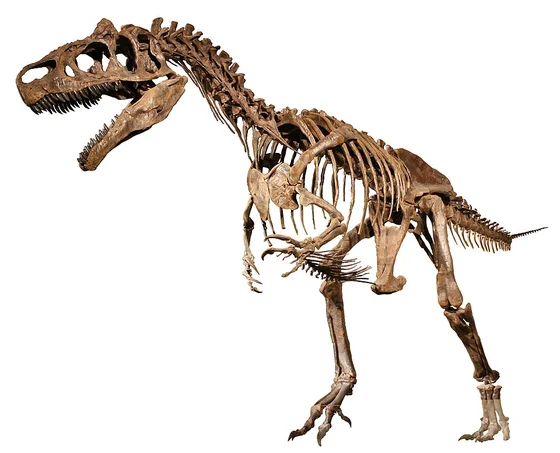
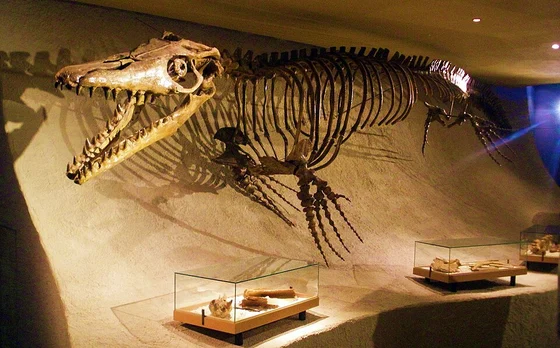
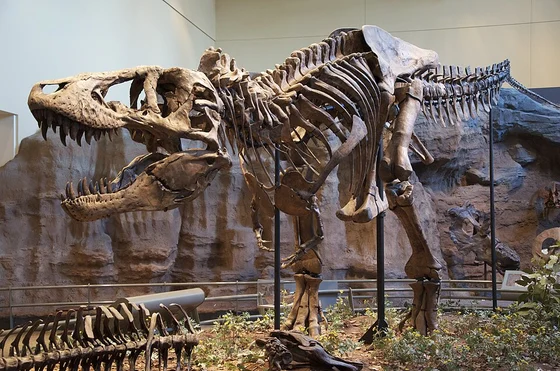
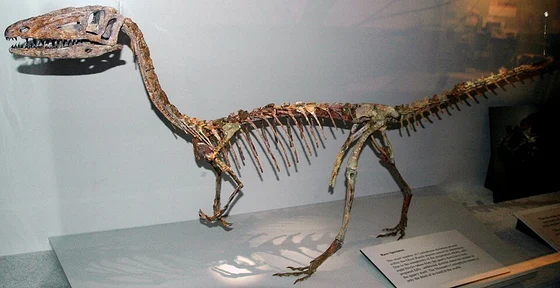
Image associated with the exact linked encyclopedia article; consult credited file description for its interpretation.
Overview
Spinosaurus had an elongate skull with conical teeth and tall vertebral spines supporting a conspicuous back profile. Fossils and comparisons suggest important feeding connections with aquatic prey. Its anatomy differs substantially from the broad-skulled terrestrial predator stereotype, making it valuable for examining diversity among large carnivorous dinosaurs.
Reconstruction is difficult because specimens are incomplete and the historically important original material was destroyed during the Second World War. New discoveries have changed proposals about proportions, posture and the tail. Researchers disagree over how effectively Spinosaurus swam or pursued prey underwater. An association with rivers and aquatic food therefore should not be converted into an unqualified claim that every detail of a fully aquatic hunting lifestyle has been demonstrated.
Matteo Fabbri and colleagues’ 2022 study linked bone density to aquatic habits through comparisons across living and extinct amniotes. Its public abstract interprets Spinosaurus and Baryonyx as feeding below the water surface, while assigning non-diving habits to Suchomimus. The distinction matters: the paper does not propose identical behaviour for every spinosaurid. This account uses the publicly accessible abstract; the full subscription paper has not been independently read here.
Nathan Myhrvold and colleagues re-examined that approach in a 2024 study. They argued that the comparative groups overlapped too strongly, that choices about species and lifestyle categories affected the result, and that some statistical assumptions were not met. They also investigated how measurements of bone compactness could vary with the specimen, the position of a cross-section, fossil damage and image processing. Their measurements included newly scanned material and attempts to reproduce published cross-sections. Because some original processing choices were not reported, they expected differences between measurements; a single compactness value should not be mistaken for an error-free property shared by all members of a species.
The 2024 authors concluded that the tested bone-density classification did not establish underwater foraging in the proposed way. They explicitly stated that their reanalysis alone did not settle the broader lifestyle debate. Dense limb bones can be relevant to ballast, yet they do not account for the buoyancy of air spaces elsewhere in the body, and large body size offers another possible influence on compactness. The authors favoured a semiaquatic fish-eater over an underwater pursuit predator when considering other work, but those broader comparisons are separate from their statistical test. A useful reconstruction must therefore distinguish feeding on aquatic animals, entering water, swimming at the surface, submerging and chasing prey underwater. Evidence supporting one of those activities does not automatically demonstrate all the others.
Origins & earliest records
Spinosaurus was named from Egyptian fossils in the early twentieth century and is known from Cretaceous North African material. The representative timeline age is about 100 million years. Discovery history, loss of original specimens and later finds concern the evidence available to researchers rather than the biological beginning of the genus.
Evidence & interpretation
Skulls, teeth, vertebral spines and other skeletal parts support its distinctive anatomy. New fossils and mechanical studies have produced competing reconstructions of movement and aquatic habits. Missing material and choices about mass distribution, tissue volume and posture matter, so strong claims of underwater pursuit should remain linked to particular interpretations.
Selected bibliography
Documented works and useful reading. This is not a list of every appearance.
- 01
Spinosaurus
Selected institutional scientific reading; not a complete bibliography.
- 02
Subaqueous foraging among carnivorous dinosaurs
Complete public abstract and bibliographic record read. Full subscription main text and supplementary analyses not independently assessed here.
- 03
Diving dinosaurs? Caveats on the use of bone compactness and pFDA for inferring lifestyle
Complete Study goals, bone-measurement Methods, focal lifestyle-interpretation Results and all Conclusions independently read; other Methods/Results partly read. Summary adapted under CC BY4. Code and supplements not rerun.
Family, evolution & connections
Sampled spinosaurids: Sereno et al. 2022
Eight visibly depicted spinosaurid terminals pruned from Appendix 5, Figure 1; outgroups and megalosaurids omitted.
Scroll sideways to see all branches. With a keyboard, focus the tree and use the arrow keys.
- Sampled Spinosauridae (Bremer 2)
- Camarillasaurus
- Remaining sampled spinosaurids (Bremer 2)
- Baryonychinae (Bremer 2)
- Baryonyx
- Ceratosuchops / Suchomimus pair (Bremer 2)
- Ceratosuchops
- Suchomimus
- Spinosaurinae (Bremer 3)
- Ichthyovenator
- Remaining sampled spinosaurines (Bremer 3)
- Vallibonavenatrix
- Spinosaurus / Irritator pair (Bremer 1)
- Irritator
Parsimony of 120 anatomical characters, including 25 new characters; one shortest tree of 129 steps. Labels retain source Bremer decay values. This study combines Wessex material under Ceratosuchops rather than a separate Riparovenator terminal. Camarillasaurus placement is tentative. Alternative analyses differ; the tree does not settle swimming behaviour or imply direct ancestors. Text and caption claim nine spinosaurids, but the figure visibly depicts eight (14 total tips versus text’s 15). No missing ninth tip is invented.
Selected spinosaurids: Barker et al. 2021
Ten tips pruned from Figure 7’s Bayesian maximum-clade-credibility tree; fragmentary terminals and outgroups omitted.
Scroll sideways to see all branches. With a keyboard, focus the tree and use the arrow keys.
- Sampled Spinosauridae (posterior 94%)
- Vallibonavenatrix
- Remaining selected spinosaurids
- Selected Spinosaurinae
- Camarillasaurus
- Remaining selected spinosaurines (posterior 81%)
- Ichthyovenator
- Irritator and selected North African tips (posterior 75%)
- Irritator
- Selected North African tips (weak support)
- Sigilmassasaurus
- Selected Baryonychinae (posterior 71%)
- Baryonyx
- Ceratosuchopsini (posterior 64%)
- Suchomimus
- Ceratosuchops / Riparovenator pair
- Ceratosuchops
- Riparovenator
Published Bayesian topology, Figure 7 in the article PDF. Selected displayed posterior probabilities are percentages; divergence dates and ancestral-area reconstructions omitted. Moderate-to-poor support and fragmentary/composite specimens limit resolution. Parsimony places Vallibonavenatrix differently. Constrained alternative baryonychine arrangements are statistically indistinguishable. This source separates Riparovenator and Ceratosuchops, unlike Sereno 2022. North African specimen synonymy remains equivocal; omitted tips do not prove synonymy or direct ancestry.
Taxonomic classification
A hierarchy of classified groups, not a chain of direct ancestors.
- kingdomAnimalia
- phylumChordata
- familySpinosauridae
- genusSpinosaurus
Located primary passages
Specific passages supporting details in this entry, grouped by their published witness.
Primary source witness
PLOS ONE19(3):e0298957,6March2024.
- The authors remeasured selected fossil cross-sections and criticised lifestyle labels, sampling, measurement variation and statistical assumptions in a previous bone-compactness classification. They argue that those analyses do not support identifying Spinosaurus aegyptiacus as a submerged pursuit predator. Crucially, they also state that this reanalysis does not itself settle spinosaurid ecology. Dense bones alone do not establish one swimming or foraging behaviour; the competing interpretations remain source-attributed, rather than a new unquestioned consensus.
Remaining introduction, most Results/Methods, code and supplementary datasets not independently read or rerun. Prior studies are contextual reported comparisons, not complete independent readings. Species-specific2024 claims are not extended automatically to later-named species.
Encyclopedia background
An additional attributed reference, separate from the editorial profile above.
Read the open encyclopedia overview
Spinosaurus (; lit. 'spine lizard') is a genus of large spinosaurid theropod dinosaurs that lived in what is now North Africa during the Cenomanian age of the Late Cretaceous period, about 100 to 94 million years ago. The genus was known first from Egyptian remains discovered in 1912 and described by German palaeontologist Ernst Stromer in 1915. The original remains were destroyed in World War II, but additional material came to light in the early 21st century. It is unclear whether one or two species are represented in the fossils reported in the scientific literature. The type species, S. aegyptiacus, is mainly known from the Bahariya Formation in Egypt and the Kem Kem beds in Morocco. The other species, S. mirabilis, is known from the Farak Formation in Niger. Possible junior synonyms include Sigilmassasaurus and the dubious S. maroccanus from the Kem Kem beds and Oxalaia from the Alcântara Formation in Brazil, though the distinction and validity of these taxa have been debated.
Spinosaurus is among the largest known terrestrial carnivores; other large carnivores comparable to Spinosaurus include theropods such as Tyrannosaurus, Giganotosaurus and the contemporary Carcharodontosaurus. A 2022 study suggests that S. aegyptiacus could have reached 14 m (46 ft) in length and 7.4 t (8.2 short tons) in body mass. The skull of Spinosaurus was long, low, and narrow, similar to that of a modern crocodilian, and bore straight conical teeth with few to no serrations. It would have had large, robust forelimbs bearing three-fingered hands, with an enlarged claw on the first digit. The distinctive neural spines of Spinosaurus, which were long extensions of the vertebrae, grew to at least 1.65 m (5.4 ft) long and were likely to have had skin connecting them, forming a sail-like structure. The hip bones of Spinosaurus were reduced, and the legs were very short in proportion to the body. Its long and narrow tail was deepened by tall, thin neural spines and elongated chevrons, forming a paddle-like structure.
Spinosaurus is known to have eaten both aquatic and terrestrial prey. Evidence suggests that it was semiaquatic, although the extent of its swimming capability has been strongly contested. Spinosaurus's leg bones had a high bone density, allowing for better buoyancy control. Multiple functions have been put forward for the dorsal sail, including thermoregulation and display; either to intimidate rivals or attract mates. It lived in a humid environment of tidal flats and mangrove forests alongside many other dinosaurs as well as fish, crocodylomorphs, squamates, turtles, pterosaurs, and plesiosaurs.
Text from Wikipedia contributors, “Spinosaurus”. CC BY-SA 4.0. Extracted introduction; formatting changed. Retrieved 5 October 2026. The source article may have changed since retrieval.
References
Sources supporting this profile. Linked pages have their own scope and editorial standards.
- MuseumSpinosaurusResearch access: 2026-10-05
- Primary researchSubaqueous foraging among carnivorous dinosaursResearch access: 2026-10-05
- Primary researchDiving dinosaurs? Caveats on the use of bone compactness and pFDA for inferring lifestyleResearch access: 2026-10-05
- LicenceCreative Commons Attribution 4.0Research access: 2026-10-05
Image credits
Reference illustrationSpinosaurus
Image associated with the exact linked encyclopedia article; consult credited file description for its interpretation.