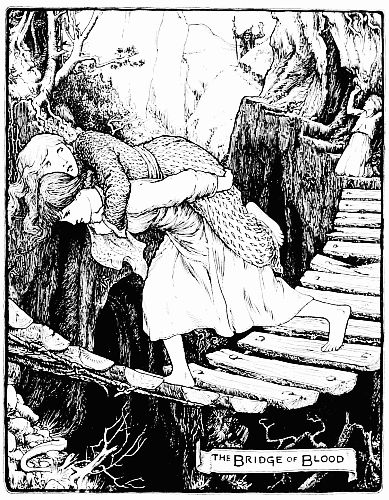
Batten: Smallhead carries her sisters across the Bridge of Blood
Printed Bridge of Blood caption and adjacent narrative identify Smallhead carrying her guilty sisters. No unlabelled background figure assigned to an individual hag. Selected title-page edition1895; John Dickson Batten1860–1932 credited illustrator; Joseph Jacobs compiler/editor.
Overview
Smallhead is introduced as a human girl nicknamed by hostile half-sisters, not as a separate fairy people. A returning mother in grey-cat form directs her to save those sisters despite their crimes. She exchanges identifying ribbons to frustrate a murderous host, carries the sisters over a guilt-sensitive bridge and obtains a Sword of Light and luminous Black Book to secure their marriages. When she later accepts employment with the defeated enchantress, she learns more magic than her employer suspects.
A blow from a stored rod reveals that the household pig is a stolen prince. Smallhead restores him, then uses the enchantress’s book to make them both doves. During pursuit she changes them into unattended heather brooms whose sweeping attracts a crowd and frustrates their hawk-shaped pursuer. A hound’s kiss later erases the prince’s memory of her. Living cock-and-hen figures produced from grains of wheat rehearse their shared history until he recognises her. The narrative also has a rival die while copying Smallhead’s magical thread-walking; that harmful outcome is retained as a plot event, not softened into a harmless exhibition.
Origins & earliest records
Jacobs’s source note points to Curtin’s Hero Tales of Ireland newspaper contributions and compares Campbell’s Maol a Chliobain. This selected 1895 adaptation is the inspected witness. The resemblance to other clever-youngest-child tales does not make their named heroines interchangeable.
Records & interpretation
The text explicitly supplies learned enchantment, animal and object transformations, and animated grains. These are narrative powers of a human character, not evidence of an ethnic category or a practical magical method. Family relationships remain those of this telling.
In the literature
“made two doves of herself and the King's son”
Smallhead and the King’s Sons, pp135–156; pp148–149; flight
Smallhead obeys the cat-mother’s request to save her murderous half-sisters. She reverses bed positions and ribbon markers, escaping while the hag’s son kills his own sisters. Smallhead carries her sisters over a bridge they cannot cross because they killed their mother.
Selected bibliography
Documented works and useful reading. This is not a list of every appearance.
- 01
More Celtic Fairy Tales: Smallhead and the King’s Sons, pp. 135–155; note XXXIX
Selected episode and relevant source note inspected. Earlier works named by Jacobs are attributed references, not falsely claimed as independently collated texts.
- 02
More Celtic Fairy Tales
Joseph Jacobs, More Celtic Fairy Tales, selected1895 London David Nutt / New York G. P. Putnam edition, PG34453. Complete named tale and relevant source-note paragraph independently read.
Family, evolution & connections
Smallhead and her maternal half-sisters
Three daughters of one mother, born across her two marriages.
Scroll sideways to see all branches. With a keyboard, focus the tree and use the arrow keys.
- Elder daughter of the second marriage
- Younger daughter of the second marriage
Explicit family statements in the named Jacobs retelling. The two husbands are unnamed and distinct; no joint father is invented. The cat identifies herself as the murdered mother. This transformation is textual identity, not biological evolution.
Two maternal half-sisters (second marriage)
The opening places Smallhead in the first marriage and the other two daughters in the second. Their maternal half-sibling relationship is explicit.
Located primary passages
Specific passages supporting details in this entry, grouped by their published witness.
More Celtic Fairy Tales
Joseph Jacobs, More Celtic Fairy Tales, selected1895 London David Nutt / New York G. P. Putnam edition, PG34453. Complete named tale and relevant source-note paragraph independently read.
- Smallhead obeys the cat-mother’s request to save her murderous half-sisters. She reverses bed positions and ribbon markers, escaping while the hag’s son kills his own sisters. Smallhead carries her sisters over a bridge they cannot cross because they killed their mother.
Smallhead and the King’s Sons, pp135–156; Sister rescue and the blood bridge
- After securing her sisters’ marriages with stolen objects, Smallhead serves the hag, learns magic and frees the pig-prince with a rod and book. They escape as doves and brooms. A dog’s kiss erases his memory; her conjured hen and cock recount events, restoring recognition and their marriage.
Smallhead and the King’s Sons, pp135–156; Acquired magic and eventual recognition
This selected1895 literary witness is independently read; unshown mechanisms and missing later fates are not invented. No song, prayer or ritual formula quoted.
Primary source witness
Joseph Jacobs, More Celtic Fairy Tales, selected1895 London David Nutt / New York G. P. Putnam edition, PG34453. Complete named tale and relevant source-note paragraph independently read.
- Jacobs credits Curtin’s Hero Tales of Ireland as contributed to the New York Sun, and compares Campbell and Molly Whuppie. These are reported source links, not independently collated source publications.
Only the relevant source/comparison paragraph read and adopted; speculative diffusion and antiquity claims not asserted as proven.
References
Sources supporting this profile. Linked pages have their own scope and editorial standards.
- Primary textMore Celtic Fairy Tales, selected 1895 edition: Smallhead and the King’s Sons, pp. 135–155; note XXXIXResearch access: 2026-10-05
Image credits
Historical illustrationBatten: Smallhead carries her sisters across the Bridge of Blood
Printed Bridge of Blood caption and adjacent narrative identify Smallhead carrying her guilty sisters. No unlabelled background figure assigned to an individual hag. Selected title-page edition1895; John Dickson Batten1860–1932 credited illustrator; Joseph Jacobs compiler/editor.