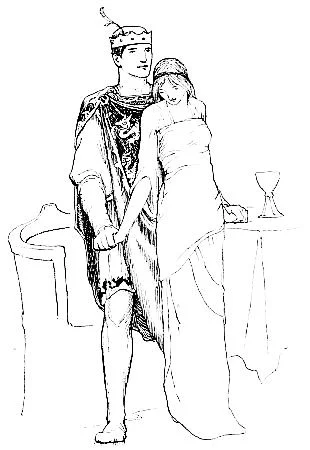
Batten: Smallhead beside the restored King of Munster’s son
Adjacent text explicitly reveals the household pig as the King of Munster’s son; this illustration depicts his restored human appearance, not pig anatomy. Selected title-page edition1895; John Dickson Batten1860–1932 credited illustrator; Joseph Jacobs compiler/editor.
Overview
The enchantress tells Smallhead that her household pig has been kept for seven years and will soon be slaughtered for a feast with her sister. The animal overturns hot food onto Smallhead’s bare feet, causing her to fetch a rod and strike him. That blow restores a handsome young man who identifies himself as the King of Munster’s son, kidnapped and enchanted by the hag. The apparent livestock therefore retains an intention to provoke rescue before his identity becomes known.
Smallhead briefly returns him to pig form to conceal the discovery, then restores him again and makes them both doves for their escape. They later become heather brooms while the pursuing hawk searches the market. Back at his father’s castle, the prince tries to honour a warning against kisses, but an old greyhound licks his face and he forgets his rescuer. Smallhead’s animated birds retell the pig captivity and flight until memory returns. The spell is story-specific and reversible; the passage does not supply tusked combat powers, an independent pig kingdom or kinship with unrelated swine-princes.
Origins & earliest records
The containing tale is Jacobs’s selected 1895 adaptation of Curtin’s Hero Tales of Ireland newspaper contributions. Its seven-year captivity is internal story time. The witness does not independently date the actual collection of this individual episode.
Records & interpretation
The narrative states both human identity and alternating pig form, followed by dove and broom transformations performed by Smallhead. This is evidence of literary enchantment rather than natural pig behaviour. The forgetting follows a narrated taboo, not a medical claim.
In the literature
“made a pig of me”
Smallhead and the King’s Sons, pp146–156; pp146–147; captive prince’s account
The captive identifies himself as the Munster king’s son, stolen seven years earlier and made a pig by the hag. A rod strike restores him; Smallhead briefly turns him back into a pig before rescuing him. He retains awareness while a pig.
Selected bibliography
Documented works and useful reading. This is not a list of every appearance.
- 01
More Celtic Fairy Tales: Smallhead and the King’s Sons, pp. 146–155; note XXXIX
Selected episode and relevant source note inspected. Earlier works named by Jacobs are attributed references, not falsely claimed as independently collated texts.
- 02
More Celtic Fairy Tales
Joseph Jacobs, More Celtic Fairy Tales, selected1895 London David Nutt / New York G. P. Putnam edition, PG34453. Complete named tale and relevant source-note paragraph independently read.
Family & connections
A source-supported family tree or inspiration record has not yet been compiled for this profile. Related reading below indicates a connection in subject matter, not a proven lineage or creative influence.
Located primary passages
Specific passages supporting details in this entry, grouped by their published witness.
More Celtic Fairy Tales
Joseph Jacobs, More Celtic Fairy Tales, selected1895 London David Nutt / New York G. P. Putnam edition, PG34453. Complete named tale and relevant source-note paragraph independently read.
- The captive identifies himself as the Munster king’s son, stolen seven years earlier and made a pig by the hag. A rod strike restores him; Smallhead briefly turns him back into a pig before rescuing him. He retains awareness while a pig.
Smallhead and the King’s Sons, pp146–156; Enchanted captive and two-way rod change
- Smallhead and the prince flee together as doves and brooms. Despite his promise, a greyhound’s kiss makes him forget her. Her conjured birds later narrate their shared past, and he recognises her and upholds the marriage promise; no independent antidote is specified.
Smallhead and the King’s Sons, pp146–156; Flight, forgotten promise and restoration of memory
This selected1895 literary witness is independently read; unshown mechanisms and missing later fates are not invented. No song, prayer or ritual formula quoted.
Primary source witness
Joseph Jacobs, More Celtic Fairy Tales, selected1895 London David Nutt / New York G. P. Putnam edition, PG34453. Complete named tale and relevant source-note paragraph independently read.
- Jacobs credits Curtin’s Hero Tales of Ireland as contributed to the New York Sun, and compares Campbell and Molly Whuppie. These are reported source links, not independently collated source publications.
Only the relevant source/comparison paragraph read and adopted; speculative diffusion and antiquity claims not asserted as proven.
References
Sources supporting this profile. Linked pages have their own scope and editorial standards.
- Primary textMore Celtic Fairy Tales, selected 1895 edition: Smallhead and the King’s Sons, pp. 146–155; note XXXIXResearch access: 2026-10-05
Image credits
Historical illustrationBatten: Smallhead beside the restored King of Munster’s son
Adjacent text explicitly reveals the household pig as the King of Munster’s son; this illustration depicts his restored human appearance, not pig anatomy. Selected title-page edition1895; John Dickson Batten1860–1932 credited illustrator; Joseph Jacobs compiler/editor.