A sourced illustration has not yet been added. This gap is included in the coverage record.
Overview
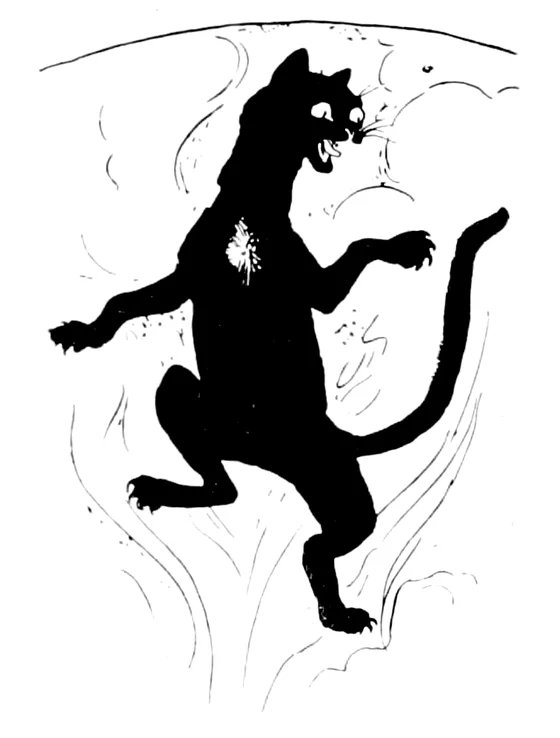
The two younger sisters kill their mother while Smallhead is away and conceal what happened. They later scatter twenty needles in straw and threaten to kill their older half-sister unless she retrieves them before evening. A short grey cat enters as Smallhead cries, asks about her trouble and gathers every needle. Its assistance replaces a task the frightened daughter cannot accomplish unaided with an exact, countable result that frustrates the sisters.
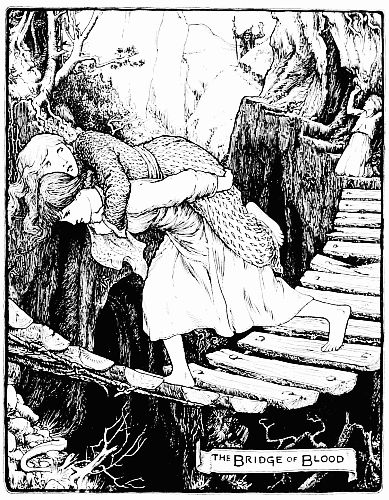
After helping, the cat says she is Smallhead’s mother and that the sisters destroyed her body. She asks her daughter not to retaliate but to save them and do good for them. Smallhead subsequently carries those same sisters over the Bridge of Blood, where their guilt prevents them crossing, and obtains marriages for both. The returning mother’s instruction thus continues to shape the plot after the cat leaves. The story supplies no later return to human form, explanation of how the animal body was obtained, or claim that grey cats generally contain human dead.
Origins & earliest records
Jacobs attributes the tale to Curtin’s Hero Tales of Ireland contributions to the New York Sun and notes Campbell’s Maol a Chliobain as a parallel. The selected print is dated 1895. These editorial references locate transmission without proving the date or exact wording of an earlier oral performance.
Records & interpretation
The cat’s speech, completed task and self-identification are textual evidence for a mother in animal form. They do not establish reincarnation as a fact or a universal Irish belief. The motive is protective kinship, distinct from a hostile fairy-cat encounter.
In the literature
“I am your mother”
Smallhead and the King’s Sons, pp135–137; p137; cat’s identification
Smallhead’s younger half-sisters kill their shared mother. A short grey cat later identifies herself as that mother, gathers the impossible twenty needles and urges Smallhead to protect her sisters. The narrative does not describe an intervening transformation or a new physical human restoration.
Selected bibliography
Documented works and useful reading. This is not a list of every appearance.
- 01
More Celtic Fairy Tales: Smallhead and the King’s Sons, pp. 135–137; note XXXIX
Selected episode and relevant source note inspected. Earlier works named by Jacobs are attributed references, not falsely claimed as independently collated texts.
- 02
More Celtic Fairy Tales
Joseph Jacobs, More Celtic Fairy Tales, selected1895 London David Nutt / New York G. P. Putnam edition, PG34453. Complete named tale and relevant source-note paragraph independently read.
Family, evolution & connections
Smallhead and her maternal half-sisters
Three daughters of one mother, born across her two marriages.
Scroll sideways to see all branches. With a keyboard, focus the tree and use the arrow keys.
- Elder daughter of the second marriage
- Younger daughter of the second marriage
Explicit family statements in the named Jacobs retelling. The two husbands are unnamed and distinct; no joint father is invented. The cat identifies herself as the murdered mother. This transformation is textual identity, not biological evolution.
Smallhead
The grey cat explicitly tells Smallhead that she is her mother. The opening gives Smallhead’s birth in the first marriage.
Two younger daughters of the second marriage
The woman bears two daughters in her second marriage. Their later murder of her does not change their stated family relationship.
Located primary passages
Specific passages supporting details in this entry, grouped by their published witness.
More Celtic Fairy Tales
Joseph Jacobs, More Celtic Fairy Tales, selected1895 London David Nutt / New York G. P. Putnam edition, PG34453. Complete named tale and relevant source-note paragraph independently read.
- Smallhead’s younger half-sisters kill their shared mother. A short grey cat later identifies herself as that mother, gathers the impossible twenty needles and urges Smallhead to protect her sisters. The narrative does not describe an intervening transformation or a new physical human restoration.
Smallhead and the King’s Sons, pp135–137; Mother’s killed body and speaking cat
This selected1895 literary witness is independently read; unshown mechanisms and missing later fates are not invented. No song, prayer or ritual formula quoted.
Primary source witness
Joseph Jacobs, More Celtic Fairy Tales, selected1895 London David Nutt / New York G. P. Putnam edition, PG34453. Complete named tale and relevant source-note paragraph independently read.
- Jacobs credits Curtin’s Hero Tales of Ireland as contributed to the New York Sun, and compares Campbell and Molly Whuppie. These are reported source links, not independently collated source publications.
Only the relevant source/comparison paragraph read and adopted; speculative diffusion and antiquity claims not asserted as proven.
References
Sources supporting this profile. Linked pages have their own scope and editorial standards.
- Primary textMore Celtic Fairy Tales, selected 1895 edition: Smallhead and the King’s Sons, pp. 135–137; note XXXIXResearch access: 2026-10-05
Image credits
A sourced illustration has not yet been added. This gap is included in the coverage record.