A sourced illustration has not yet been added. This gap is included in the coverage record.
Overview
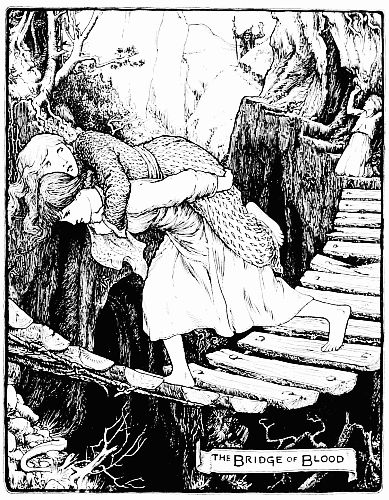
Smallhead finds her sisters lodging with an enchantress who has a son and three daughters. The woman marks her daughters with ribbons before directing her son to kill the guests. Smallhead exchanges beds and identifying ribbons, so the son instead kills his own sisters. The hag pursues the fugitives but cannot cross the Bridge of Blood, whose prohibition applies to those who have killed someone. Her threats establish her as dangerous, while the story makes her power subject to a boundary she cannot override.
She possesses the Sword of Light and Black Book stolen from a royal family, losing both through Smallhead’s deceptions. After killing her son in anger at the second loss, she promises not to harm Smallhead and hires her as a servant. Another magical book and rod remain in her house. The pig she plans to eat is a kidnapped prince held in that form for seven years. Once Smallhead restores and escapes with him, the hag sends her more powerful sister after them. The narrative does not give a personal name or make this woman the same individual as other tale hags.
Origins & earliest records
The selected 1895 Jacobs adaptation cites Curtin’s newspaper Hero Tales of Ireland and a Campbell parallel. It supplies this particular host’s household and sequence of defeats. Earlier source references remain attributed until independently inspected rather than claimed as identical wording.
Records & interpretation
The story documents a human enchantress with magical property, a transformed captive and limited pursuit. It is evidence of a narrated antagonist, not verification of historical accusations against women or a general description of Irish elders.
In the literature
“she thrust a knife into her son's heart”
Smallhead and the King’s Sons, pp137–150; p145; failed book recovery
The hag commands the robbery-murders that instead kill her three daughters. After Smallhead steals the Sword of Light and Black Book, the hag kills her son herself. Barred by the Bridge of Blood, she offers a non-harm bargain for Smallhead’s service rather than immediately being killed.
Selected bibliography
Documented works and useful reading. This is not a list of every appearance.
- 01
More Celtic Fairy Tales: Smallhead and the King’s Sons, pp. 137–148; note XXXIX
Selected episode and relevant source note inspected. Earlier works named by Jacobs are attributed references, not falsely claimed as independently collated texts.
- 02
More Celtic Fairy Tales
Joseph Jacobs, More Celtic Fairy Tales, selected1895 London David Nutt / New York G. P. Putnam edition, PG34453. Complete named tale and relevant source-note paragraph independently read.
Family & connections
A source-supported family tree or inspiration record has not yet been compiled for this profile. Related reading below indicates a connection in subject matter, not a proven lineage or creative influence.
Located primary passages
Specific passages supporting details in this entry, grouped by their published witness.
More Celtic Fairy Tales
Joseph Jacobs, More Celtic Fairy Tales, selected1895 London David Nutt / New York G. P. Putnam edition, PG34453. Complete named tale and relevant source-note paragraph independently read.
- The hag commands the robbery-murders that instead kill her three daughters. After Smallhead steals the Sword of Light and Black Book, the hag kills her son herself. Barred by the Bridge of Blood, she offers a non-harm bargain for Smallhead’s service rather than immediately being killed.
Smallhead and the King’s Sons, pp137–150; Murder commands, failed pursuit and bargain
- The hag has kept the Munster prince as a pig for seven years because she hated his father, and plans to eat him. Smallhead uses a rod and magic book to restore and flee with him. The hag dispatches her more powerful sister; neither woman is explicitly killed in the ending.
Smallhead and the King’s Sons, pp137–150; Imprisoned prince and failed recovery
This selected1895 literary witness is independently read; unshown mechanisms and missing later fates are not invented. No song, prayer or ritual formula quoted.
Primary source witness
Joseph Jacobs, More Celtic Fairy Tales, selected1895 London David Nutt / New York G. P. Putnam edition, PG34453. Complete named tale and relevant source-note paragraph independently read.
- Jacobs credits Curtin’s Hero Tales of Ireland as contributed to the New York Sun, and compares Campbell and Molly Whuppie. These are reported source links, not independently collated source publications.
Only the relevant source/comparison paragraph read and adopted; speculative diffusion and antiquity claims not asserted as proven.
References
Sources supporting this profile. Linked pages have their own scope and editorial standards.
- Primary textMore Celtic Fairy Tales, selected 1895 edition: Smallhead and the King’s Sons, pp. 137–148; note XXXIXResearch access: 2026-10-05
Image credits
A sourced illustration has not yet been added. This gap is included in the coverage record.