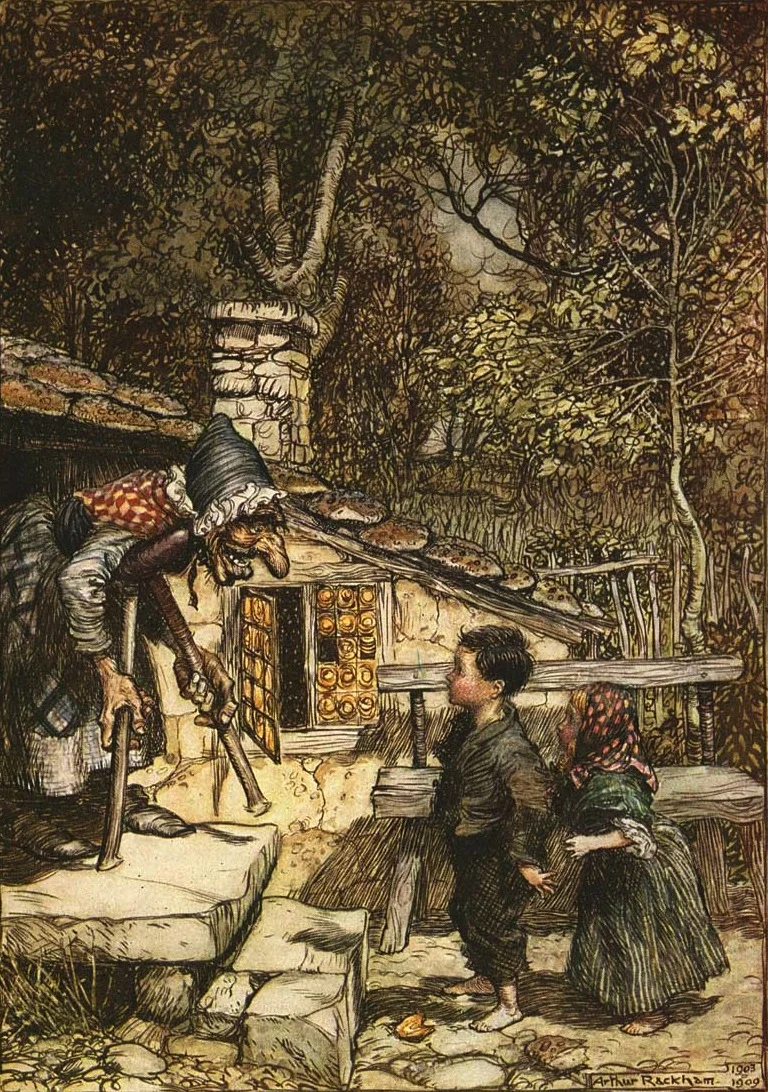
Witch of Hansel and Gretel
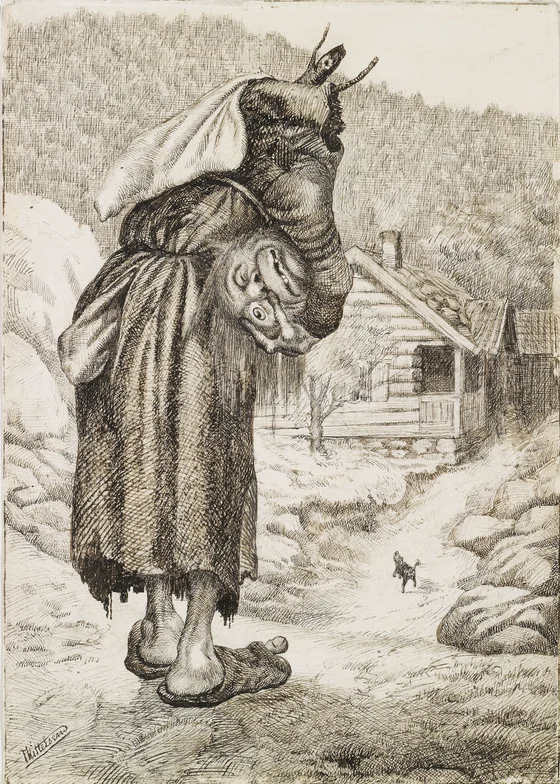
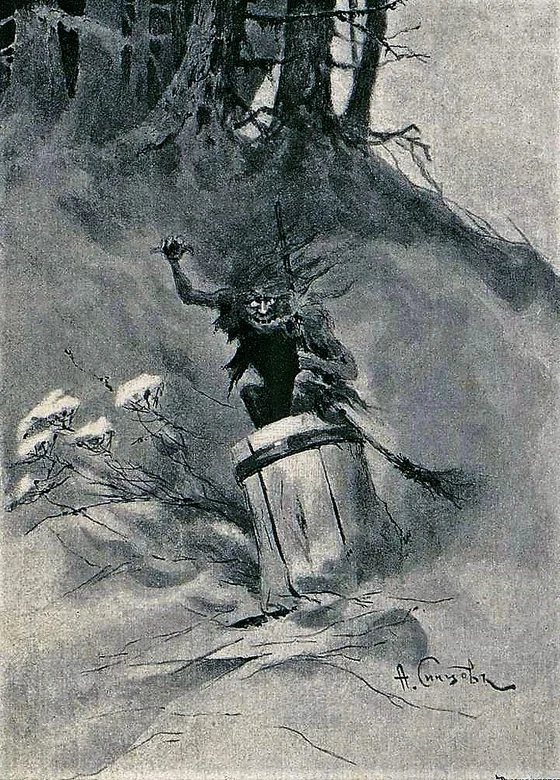
Actual Rackham image inspected: bent witch at cottage door greets Hansel and Gretel. Exact named tale illustration, early20th-century interpretation.
Overview
After abandonment in the forest, the siblings follow a white bird to a house built of bread, roofed with cakes and furnished with sugar windows. Its elderly owner approaches on crutches and offers food and clean beds. The narrator then exposes the apparent welcome as a deliberate trap: she intends to eat children. Her weak eyesight contrasts with a keen sense of approaching human beings.
She confines Hansel behind a grated door and orders Gretel to feed him while receiving meagre scraps herself. A little bone passed through the bars makes the boy seem too thin to eat. After four weeks, impatience overcomes the witch's plan to fatten him. When she attempts to draw Gretel into a hot oven, the girl feigns misunderstanding and reverses the trap. The children escape with treasure. The selected house is not described simply as gingerbread.
Origins & earliest records
This unnamed antagonist belongs to Grimm's tale15, Hänsel und Gretel, selected through Margaret Hunt's1884 English translation. The profile follows the stated bread, cake and sugar construction and the children-eating plot. Its numbered literary witness is not proof of an actual historical witch, nor does that edition date establish the story's first oral performance.
Records & interpretation
The primary tale specifies crutches, shrivelled hands, limited vision, smell and the bone deception. It generalises about witches' red eyes, but that is the narrator's story-world claim, not a fact about real people accused of witchcraft. These are narrative and literary witnesses; there is no zoological evidence or historical verification of the edible-house captor.
In the literature
“the old woman, who had dim eyes, could not see it”
Tale 15, Hansel and Grethel; Hansel offers a bone instead of his finger · Margaret Hunt
Limited vision makes the witch vulnerable to his fattening-test deception.
Selected bibliography
Documented works and useful reading. This is not a list of every appearance.
- 01
Household Tales, tale 15: Hansel and Grethel
Specific numbered primary tale inspected. English translation terms and literary transmission remain distinct from oral origin.
- 02
Household Tales — Hansel and Grethel
Margaret Hunt historical English translation (1884); Project Gutenberg5314. Exact numbered tale and observed HTML anchor used; no inferred printed page or earliest oral date.
Family & connections
A source-supported family tree or inspiration record has not yet been compiled for this profile. Related reading below indicates a connection in subject matter, not a proven lineage or creative influence.
Located primary passages
Specific passages supporting details in this entry, grouped by their published witness.
Household Tales, tale 15: Hansel and Grethel
Margaret Hunt historical English translation (1884); Project Gutenberg5314. Exact numbered tale and observed HTML anchor used; no inferred printed page or earliest oral date.
- A white bird leads the hungry children to a house built of bread, cakes and sugar windows. Its old occupant welcomes and feeds them, but the narrator explains that she is a child-eating witch using the edible house as bait. Her poor sight and keen scent are explicitly described.
Tale 15, Hansel and Grethel; Edible house and feigned hospitality
- The witch imprisons Hansel to fatten him and forces Grethel to work. Hansel substitutes a bone for his finger until she loses patience after four weeks. Grethel feigns ignorance of entering the oven, pushes the demonstrating witch inside and bolts it, then frees Hansel; they take treasure and leave.
Tale 15, Hansel and Grethel; Fattening deception and reversed oven trap
Complete named tale read. Original narrative curse causes and modern species identities are not inferred; prose only, no song or ritual-formula excerpts.
References
Sources supporting this profile. Linked pages have their own scope and editorial standards.
- Primary textHunt's Household Tales — 15 Hansel and GrethelResearch access: 2026-10-05
Image credits
Historical illustrationWitch of Hansel and Gretel
Actual Rackham image inspected: bent witch at cottage door greets Hansel and Gretel. Exact named tale illustration, early20th-century interpretation.